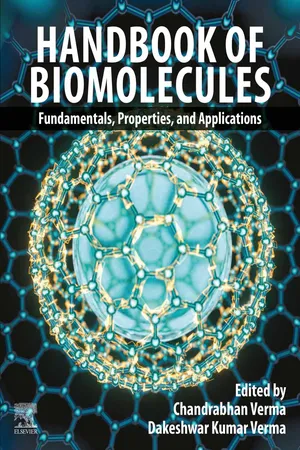
eBook - ePub
Handbook of Biomolecules
Fundamentals, Properties and Applications
- 668 pages
- English
- ePUB (mobile friendly)
- Available on iOS & Android
eBook - ePub
Handbook of Biomolecules
Fundamentals, Properties and Applications
About this book
Handbook of Biomolecules: Fundamentals, Properties and Applications is a comprehensive resource covering new developments in biomolecules and biomaterials and their industrial applications in the fields of bioengineering, biomedical engineering, biotechnology, biochemistry, and their detection methods using biosensors. This book covers the fundamentals of biomolecules, their roll in living organism, structure, sources, important characteristics, and the industrial applications of these biomaterials. Sections explore amino acids, carbohydrates, nucleic acids, proteins, lipids, metabolites and natural products, then go on to discuss purification techniques and detection methods.
Applications in biomolecular engineering, biochemistry and biomedical engineering, among others, are discussed before concluding with coverage of biomolecules as anticorrosion materials.
- Provides the chronological advancement of biomolecules, their biochemical reaction, and many modern industrial applications in engineering and science
- Serves as a valuable source for researchers interested in the fundamentals, basics and modern applications of biomolecules
- Covers both synthetic and natural biomolecule synthesis and purification processes and their modern applications
- Bridges the gap between the fundamental science of biomolecular chemistry and the relevant technology and industrial applications
Information
Topic
Physical SciencesSubtopic
Organic ChemistryTable of contents
- Cover
- Front Matter
- Table of Contents
- Copyright
- Contributors
- List of Illustrations
- List of Tables
- Chapter 1 : Amino acids: Classification, synthesis methods, reactions, and determination
- Chapter 2 : Carbohydrate: Introduction and fundamentals
- Chapter 3 : Nucleic acids: Components, nomenclature, types, and protection method
- Chapter 4 : Proteins: Structure, properties, and importance
- Chapter 5 : Vitamins and metabolites
- Chapter 6 : Enzymes, coenzymes, and pigments
- Chapter 7 : Animal and plant hormone
- Chapter 8 : Alkaloids and terpenoids: Synthesis, classification, isolation and purification, reactions, and applications
- Chapter 9 : Chromatography
- Chapter 10 : Liquid-liquid extraction
- Chapter 11 : Microfluidic devices
- Chapter 12 : Biosensors: Detection of biomolecules by biosensors
- Chapter 13 : Electrochemical biosensors for biomolecules
- Chapter 14 : Nanomechanical sensors
- Chapter 15 : Colorimetric and fluorescence
- Chapter 16 : Mass spectrometry
- Chapter 17 : Current applications of biomolecules as anticoronavirus drugs
- Chapter 18 : Current application of biomolecules in biomolecular engineering
- Chapter 19 : Application of biomolecules in biochemistry
- Chapter 20 : Current applications of biomolecules in biotechnology
- Chapter 21 : Current applications of biomolecules in biomedical engineering
- Chapter 22 : Current applications of biomolecules in biopharmaceuticals and drug discovery
- Chapter 23 : Flavonoids: Chemistry, biosynthesis, isolation, and biological function
- Chapter 24 : Steroids: Isolation, purification, synthesis, reactions, and applications
- Chapter 25 : Carbohydrates as green corrosion inhibitors
- Chapter 26 : Amino acids and nucleic acids as green corrosion inhibitors
- Chapter 27 : Current applications of fatty acids, lignin, and lipids as green corrosion inhibitors
- Chapter 28 : Current industrial- and commercial-scale applications of biomolecules
- Chapter 29 : Current applications of biomolecules in artificial intelligence and machine learning
- Chapter 30 : Plant extracts as bio-based anticorrosive materials
- Chapter 31 : Recent advancements in biosensing and biosensors
- Index
- A
Trusted by 375,005 students
Access to over 1.5 million titles for a fair monthly price.
Study more efficiently using our study tools.
Frequently asked questions
Yes, you can cancel anytime from the Subscription tab in your account settings on the Perlego website. Your subscription will stay active until the end of your current billing period. Learn how to cancel your subscription
No, books cannot be downloaded as external files, such as PDFs, for use outside of Perlego. However, you can download books within the Perlego app for offline reading on mobile or tablet. Learn how to download books offline
Perlego offers two plans: Essential and Complete
- Essential is ideal for learners and professionals who enjoy exploring a wide range of subjects. Access the Essential Library with 800,000+ trusted titles and best-sellers across business, personal growth, and the humanities. Includes unlimited reading time and Standard Read Aloud voice.
- Complete: Perfect for advanced learners and researchers needing full, unrestricted access. Unlock 1.5M+ books across hundreds of subjects, including academic and specialized titles. The Complete Plan also includes advanced features like Premium Read Aloud and Research Assistant.
We are an online textbook subscription service, where you can get access to an entire online library for less than the price of a single book per month. With over 1.5 million books across 990+ topics, we’ve got you covered! Learn about our mission
Look out for the read-aloud symbol on your next book to see if you can listen to it. The read-aloud tool reads text aloud for you, highlighting the text as it is being read. You can pause it, speed it up and slow it down. Learn more about Read Aloud
Yes! You can use the Perlego app on both iOS and Android devices to read anytime, anywhere — even offline. Perfect for commutes or when you’re on the go.
Please note we cannot support devices running on iOS 13 and Android 7 or earlier. Learn more about using the app
Please note we cannot support devices running on iOS 13 and Android 7 or earlier. Learn more about using the app
Yes, you can access Handbook of Biomolecules by Chandrabhan Verma,Dakeshwar Kumar Verma in PDF and/or ePUB format, as well as other popular books in Physical Sciences & Organic Chemistry. We have over 1.5 million books available in our catalogue for you to explore.