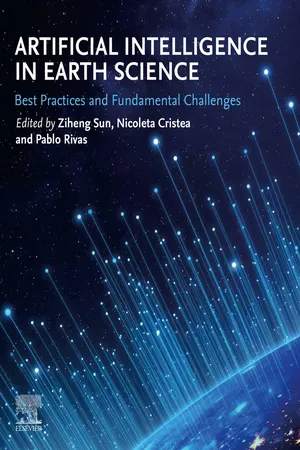
eBook - ePub
Artificial Intelligence in Earth Science
Best Practices and Fundamental Challenges
- 430 pages
- English
- ePUB (mobile friendly)
- Available on iOS & Android
eBook - ePub
Artificial Intelligence in Earth Science
Best Practices and Fundamental Challenges
About this book
Artificial Intelligence in Earth Science: Best Practices and Fundamental Challenges provides a comprehensive, step-by-step guide to AI workflows for solving problems in Earth Science. The book focuses on the most challenging problems in applying AI in Earth system sciences, such as training data preparation, model selection, hyperparameter tuning, model structure optimization, spatiotemporal generalization, transforming model results into products, and explaining trained models. In addition, it provides full-stack workflow tutorials to help walk readers through the whole process, regardless of previous AI experience. The book tackles the complexity of Earth system problems in AI engineering, fully guiding geoscientists who are planning to implement AI in their daily work.
- Provides practical, step-by-step guides for Earth Scientists who are interested in implementing AI techniques in their work
- Features case studies to show real-world examples of techniques described in the book
- Includes additional elements to help readers who are new to AI, including end-of-chapter, key concept bulleted lists that concisely cover key concepts in the chapter
Information
Topic
Physical SciencesSubtopic
Geology & Earth SciencesTable of contents
- Artificial Intelligence in Earth Science
- Cover
- Title Page
- Copyright
- Table of Contents
- Contributors
- Chapter 1 Introduction of artificial intelligence in Earth sciences
- Chapter 2 Machine learning for snow cover mapping
- Chapter 3 AI for sea ice forecasting
- Chapter 4 Deep learning for ocean mesoscale eddy detection
- Chapter 5 Artificial intelligence for plant disease recognition
- Chapter 6 Spatiotemporal attention ConvLSTM networks for predicting and physically interpreting wildfire spread
- Chapter 7 AI for physics-inspired hydrology modeling
- Chapter 8 Theory of spatiotemporal deep analogs and their application to solar forecasting
- Chapter 9 AI for improving ozone forecasting
- Chapter 10 AI for monitoring power plant emissions from space
- Chapter 11 AI for shrubland identification and mapping
- Chapter 12 Explainable AI for understanding ML-derived vegetation products
- Chapter 13 Satellite image classification using quantum machine learning
- Chapter 14 Provenance in earth AI
- Chapter 15 AI ethics for earth sciences
- Index
- Index - Continued
Trusted by 375,005 students
Access to over 1.5 million titles for a fair monthly price.
Study more efficiently using our study tools.
Frequently asked questions
Yes, you can cancel anytime from the Subscription tab in your account settings on the Perlego website. Your subscription will stay active until the end of your current billing period. Learn how to cancel your subscription
No, books cannot be downloaded as external files, such as PDFs, for use outside of Perlego. However, you can download books within the Perlego app for offline reading on mobile or tablet. Learn how to download books offline
Perlego offers two plans: Essential and Complete
- Essential is ideal for learners and professionals who enjoy exploring a wide range of subjects. Access the Essential Library with 800,000+ trusted titles and best-sellers across business, personal growth, and the humanities. Includes unlimited reading time and Standard Read Aloud voice.
- Complete: Perfect for advanced learners and researchers needing full, unrestricted access. Unlock 1.5M+ books across hundreds of subjects, including academic and specialized titles. The Complete Plan also includes advanced features like Premium Read Aloud and Research Assistant.
We are an online textbook subscription service, where you can get access to an entire online library for less than the price of a single book per month. With over 1.5 million books across 990+ topics, we’ve got you covered! Learn about our mission
Look out for the read-aloud symbol on your next book to see if you can listen to it. The read-aloud tool reads text aloud for you, highlighting the text as it is being read. You can pause it, speed it up and slow it down. Learn more about Read Aloud
Yes! You can use the Perlego app on both iOS and Android devices to read anytime, anywhere — even offline. Perfect for commutes or when you’re on the go.
Please note we cannot support devices running on iOS 13 and Android 7 or earlier. Learn more about using the app
Please note we cannot support devices running on iOS 13 and Android 7 or earlier. Learn more about using the app
Yes, you can access Artificial Intelligence in Earth Science by Ziheng Sun,Nicoleta Cristea,Pablo Rivas in PDF and/or ePUB format, as well as other popular books in Physical Sciences & Geology & Earth Sciences. We have over 1.5 million books available in our catalogue for you to explore.