eBook - PDF
Movement and Action in Learning and Development
Clinical Implications for Pervasive Developmental Disorders
- 397 pages
- English
- PDF
- Available on iOS & Android
eBook - PDF
Movement and Action in Learning and Development
Clinical Implications for Pervasive Developmental Disorders
About this book
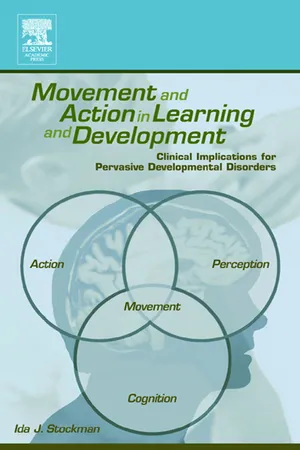
This book presents theories and clinical practices for dealing with children diagnosed with pervasive developmental disability or PDD. These are children who have a wide range of disabilities that affect their participation in even the most routine events of daily life, such as eating, dressing, bathing, and so on. Unlike many who are diagnosed with classic autism, however, these children seem to have normal social behavior, normal physical appearance, the ability to learn, hear, see, and move their bodies at will—in other words, none of the well-known reasons that cause autistic and other children to develop differently. These children have the use of all their senses, but their brains are unable to process the information that is fed through them. While much new research is being done in genetics and neurobiology to explain why something in these children has gone fundamentally wrong with their development, clinicians and therapists who deal with them on a daily basis have needed to develop practical therapies based on how the children react to their environments. Movement and Action in Learning and Development suggests that when therapists plan treatment strategies, children's experiences and interactions with the world should be given the same consideration as the limits of their biological makeups. Too often children diagnosed with PDD are lumped into therapy groups for the classically autistic, where the focus tends to be on the distance senses—hearing and vision. Case studies presented in the first half of the book suggest that for children with PDD, there is a disconnect between the brain and the tactile-kinesthetic senses that involve body movement and physical interaction with the world. Movement, in turn, seems to be connected to perception, interpretation of the world around, and ultimately, the acquisition of knowledge. For children with PDD, "normal" learning seems to be limited not only by their tactile-kinesthetic sense but also by the lack of collaboration between all the senses. The second half of the book demonstrates how these new theories translate into clinical practices.
Information
Table of contents
- Front Cover
- Movement and Action in Learning and Development: Clinical Implications for Pervasive Developmental Disorders
- Copyright Page
- Contents
- Acknowledgments
- Contributors
- Chapter 1. Introduction: The Clinical Problem
- Part I: Introductory Commentary: A Theoretical Framework for Clinical Intervention with Pervasive Developmental Disorders
- Part II: Clinical Applications: Introductory Commentary
- Part III: The Epilogue
- Final Remarks
- Subject Index
- Author Index
Trusted by 375,005 students
Access to over 1.5 million titles for a fair monthly price.
Study more efficiently using our study tools.
Frequently asked questions
Yes, you can cancel anytime from the Subscription tab in your account settings on the Perlego website. Your subscription will stay active until the end of your current billing period. Learn how to cancel your subscription
No, books cannot be downloaded as external files, such as PDFs, for use outside of Perlego. However, you can download books within the Perlego app for offline reading on mobile or tablet. Learn how to download books offline
Perlego offers two plans: Essential and Complete
- Essential is ideal for learners and professionals who enjoy exploring a wide range of subjects. Access the Essential Library with 800,000+ trusted titles and best-sellers across business, personal growth, and the humanities. Includes unlimited reading time and Standard Read Aloud voice.
- Complete: Perfect for advanced learners and researchers needing full, unrestricted access. Unlock 1.5M+ books across hundreds of subjects, including academic and specialized titles. The Complete Plan also includes advanced features like Premium Read Aloud and Research Assistant.
We are an online textbook subscription service, where you can get access to an entire online library for less than the price of a single book per month. With over 1.5 million books across 990+ topics, we’ve got you covered! Learn about our mission
Look out for the read-aloud symbol on your next book to see if you can listen to it. The read-aloud tool reads text aloud for you, highlighting the text as it is being read. You can pause it, speed it up and slow it down. Learn more about Read Aloud
Yes! You can use the Perlego app on both iOS and Android devices to read anytime, anywhere — even offline. Perfect for commutes or when you’re on the go.
Please note we cannot support devices running on iOS 13 and Android 7 or earlier. Learn more about using the app
Please note we cannot support devices running on iOS 13 and Android 7 or earlier. Learn more about using the app
Yes, you can access Movement and Action in Learning and Development by Ida Stockman in PDF and/or ePUB format, as well as other popular books in Psychology & Clinical Psychology. We have over 1.5 million books available in our catalogue for you to explore.