- 233 pages
- English
- PDF
- Available on iOS & Android
eBook - PDF
About this book
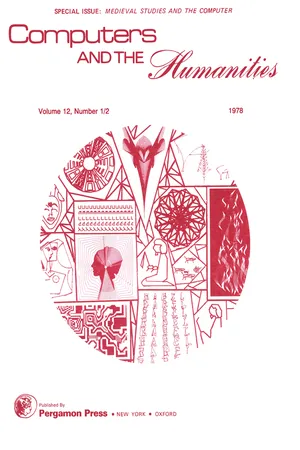
Medieval Studies and the Computer focuses on the use of computers in medieval studies and humanities research. Topics covered range from encoding and concording texts to the use of conceptual glossaries by medievalists, as well as the use of computers for compiling Middle English lexicography and the Wisconsin Dictionary of the Old Spanish Language. A computer analysis of metrical patterns in the epic Beowulf and of Notker Labeo's Old High German is also presented. Comprised of 26 chapters, this volume begins by discussing "contexts" in concordances and the set of conventions employed in text encoding. The reader is then introduced to the series of initiatives undertaken in Belgium to study Latin literature and linguistics; the use of conceptual glossaries by medieval scholars; and the use of the computer to make a word list of the Decretum Gratiani and to study Geoffrey Chaucer's vocabulary. Subsequent chapters discuss a computer program called KLIC (Key Letter In Context) for graphological analysis; a set of routines written in SAIL (Stanford Artificial Intelligence Language) for use by social historians in quantitative analysis or text processing; and the use of Mark IV, a general-purpose file management system, to analyze medieval charters. This book will be of interest to medievalists, social historians, students and scholars of humanities, and computer scientists.
Information
Print ISBN
9780080246772
Subtopic
Mathematics GeneralTable of contents
- Front Cover
- Medieval Studies and the Computer
- Copyright Page
- Table of Contents
- Chapter 1. Guest Editor's Note: Medieval Studies and the Computer
- Chapter 2. Some Considerations Concerning Encoding and Concording Texts
- Chapter 3. Vox Latina: Belgian Initiatives in Data Processing the Intellectual Language of Europe, A. D. 197–1965
- Chapter 4. Conceptual Glossaries: A New Tool for Medievalists
- Chapter 5. An Index Verborum to Gratian's Decretum: The Reason to Computerize It
- Chapter 6. Zur Erstellung einer computerunterstützten Grammatik "Flexionsmorphologie des Frühneuhochdeutschen
- Chapter 7. Computers and the Old Spanish Dictionary
- Chapter 8. Computers and Medieval English Lexicography
- Chapter 9. The Study of Chaucer's Vocabulary
- Chapter 10. A Computer Analysis of Metrical Patterns in Beowulf
- Chapter 11. Towards an Analysis of Notker Labeo's Old High German
- Chapter 12. Dictio probatoria as Fingerprint: Computer Discovery of Manuscript Provenances
- Chapter 13. KLIC: A Computer Aid to Graphological Analysis
- Chapter 14. Möglichkeiten und Grenzen Elektronischer Datenverarbeitung bei der Erforschung der Geschichte des Mittelalters
- Chapter 15. Informatique et Histoire Médiévale à I'lnstitut de Recherche et d'Histoire de Textes
- Chapter 16. Data Base Development and Analysis for the Social Historian: The Educational Status of the Beneficed Clergy of The Diocese of Hereford, 1289-1539
- Chapter 17. Medieval Charters and the Computer: An Analysis Using Mark IV
- Chapter 18. A Prosopographical and Topographical Evaluation of the First Bürgerbuch of Freiburg, Switzerland (1341-1416)
- Chapter 19. The Cognitive Basis of Late Medieval Religious Biographies
- Chapter 20. The Use of Computers in Editing Medieval Baptismal Records in Pisa (1457-1509)
- Chapter 21. From Microfilm to Computer: 15th Century Cadastral and Notarial Archives
- Chapter 22. Projekt "Untersuchungen zu altisländischen Rechtstexten
- Chapter 23. Records of Early English Drama and the Computer
- Chapter 24. Computer Indexing of Illuminated Manuscripts for Use in Medieval Studies
- Chapter 25. A Numerical Taxonomy of Merovingian Coins
- Chapter 26. The Mt. Angel Abbey Manuscript and Rare Books Project: Cataloguing with FAMULUS
- Project Reports
Trusted by 375,005 students
Access to over 1.5 million titles for a fair monthly price.
Study more efficiently using our study tools.
Frequently asked questions
Yes, you can cancel anytime from the Subscription tab in your account settings on the Perlego website. Your subscription will stay active until the end of your current billing period. Learn how to cancel your subscription
No, books cannot be downloaded as external files, such as PDFs, for use outside of Perlego. However, you can download books within the Perlego app for offline reading on mobile or tablet. Learn how to download books offline
Perlego offers two plans: Essential and Complete
- Essential is ideal for learners and professionals who enjoy exploring a wide range of subjects. Access the Essential Library with 800,000+ trusted titles and best-sellers across business, personal growth, and the humanities. Includes unlimited reading time and Standard Read Aloud voice.
- Complete: Perfect for advanced learners and researchers needing full, unrestricted access. Unlock 1.5M+ books across hundreds of subjects, including academic and specialized titles. The Complete Plan also includes advanced features like Premium Read Aloud and Research Assistant.
We are an online textbook subscription service, where you can get access to an entire online library for less than the price of a single book per month. With over 1.5 million books across 990+ topics, we’ve got you covered! Learn about our mission
Look out for the read-aloud symbol on your next book to see if you can listen to it. The read-aloud tool reads text aloud for you, highlighting the text as it is being read. You can pause it, speed it up and slow it down. Learn more about Read Aloud
Yes! You can use the Perlego app on both iOS and Android devices to read anytime, anywhere — even offline. Perfect for commutes or when you’re on the go.
Please note we cannot support devices running on iOS 13 and Android 7 or earlier. Learn more about using the app
Please note we cannot support devices running on iOS 13 and Android 7 or earlier. Learn more about using the app
Yes, you can access Medieval Studies and the Computer by Anne Gilmour-Bryson in PDF and/or ePUB format. We have over 1.5 million books available in our catalogue for you to explore.