eBook - PDF
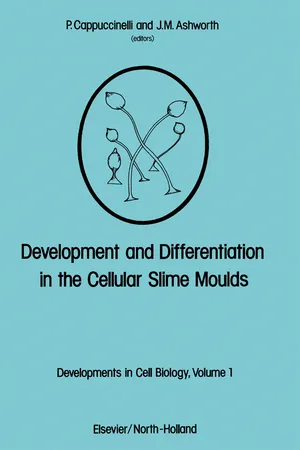
Development and Differentiation in the Cellular Slime Moulds
Proceedings of the International Workshop Held at Porto Conte, Sardinia on 12—16 April, 1977
- 339 pages
- English
- PDF
- Available on iOS & Android
eBook - PDF
Development and Differentiation in the Cellular Slime Moulds
Proceedings of the International Workshop Held at Porto Conte, Sardinia on 12—16 April, 1977
About this book
Developments in Cell Biology, Volume 1: Development and Differentiation in the Cellular Slime Moulds is a collection of papers from the proceedings of the International Workshop held at Porto Conte, Sardinia on April 12-16, 1977. This collection of papers deals with a single group of organisms, the cellular slime molds, particularly with Dictyostelium discoideum. Dictyostelium is dealt, firstly, according to cell differentiation and pattern formation common in this type of organism. These examples are further explored in the Dictyostelium discoideum slug, through the control of morphogenesis. Further research shows that two compounds, 3'5' cyclic AMP and NH3, can affect the course of morphogenesis in D. discoideum. Techniques for cell fusion and mutation induction in D. discoideum, especially as a result of DNA damage following radiation and chemicals, are analyzed. Other studies show that formation and maintenance of stable contacts between cells appear to be necessary for the normal cell cycle involved in the growth of D. discoideum. The changes in plasma membrane protein analyzed using SDS-polyacrylamide gel electrophoresis are examined. Results show that detection and quantitation of tubulin in Dictyostelium discoideum is important when studying the differentiation processes of a wide range of cellular activities. Because many D. discoideum mutants fail to reach proper development, the method for selecting the aggregation of defective mutants of D. discoideum is emphasized. This book is of interest to those whose work involves these organisms and to researchers, professors, and students whose disciplines are in Developmental Biology or Mycology.
Information
Table of contents
- Front Cover
- Development and Differentiation in the Cellular Slime Moulds
- Copyright Page
- Table of Contents
- LIST OF PARTICIPANTS
- EDITORS' PREFACE
- DEDICATION TO KENNETH B. RAPER
- Chapter 1. CELL DIFFERENTIATION AND PATTERN FORMATION IN DICTYOSTELIUM
- Chapter 2. THE CONTROL OF MORPHOGENESIS AND PATTERN IN THE DICTYOSTELIUM DISCOIDEUM SLUG
- Chapter 3. QUANTITATIVE ANALYSIS OF THE PROPORTIONS OF THE DICTYOSTELIUM DISCOIDEUM ASEXUAL FRUITING BODY
- Chapter 4. TOWARD A BIOCHEMICAL DEFINITION OF THE MORPHOGENETIC FIELDS IN D. DISCOIDEUM
- Chapter 5. NEW TECHNIQUES FOR CELL FUSION AND LINKAGE ANALYSIS OF DICTYOSTELIUM DISCOIDEUM
- Chapter 6. MUTATION INDUCTION IN VEGETATIVE AND DEVELOPING CELLS OF DICTYOSTELIUM DISCOIDEUM
- Chapter 7. THE CELL CYCLE DURING THE GROWTH AND DEVELOPMENT OF DICTYOSTELIIUM DISCOIDEUM
- Chapter 8. COMPONENTS OF THE PLASMA MEMBRANE OF DICTYOSTELIUM DISCOIDEUM DURING AGGREGATION
- Chapter 9. CHANGES IN PLASNA MEMBRANE PROTEINS FOLLOWING TREATMENT OF Dictyostelium discoideum CELLS WITH PROTEASES
- Chapter 10. CHEMOTACTIC SIGNAL AND CYCLIC GMP ACCUMULATION IN DICTYOSTELIUM
- Chapter 11. CYCLIC AMP SIGNALS AND THE CONTROL OF CELL AGGREGATION IN DICTYOSTELIUM DISCOIDEUM
- Chapter 12. A PHOSPHODIESTERASE-DEFECTIVE MUTANT OF DICTYOSTELIUM DISCOIDEUM
- Chapter 13. CELL CONTACT, SIGNALLING AND GENE EXPRESSION IN DICTYOSTELIUM DISCOIDEUM
- Chapter 14. INFLUENCE OF cAHP QN CELL DIFFERENTIATION AND MORPHOGENESIS IN POLYSPHONDYLIUN
- Chapter 15. THE EFFECT OF PULSES OF 3':5f CYCLIC ADENOSINE MONOPHOSPHATE ON ENZYME FORMATION IN NON-AGGREGATED AMOEBAE OF DICTYOSTELIUM DISCOIDEUM
- Chapter 16. CELLULAR INTERACTION REGULATING EARLY BIOCHEMICAL DIFFERENTIATION IN DICTYOSTELIUM
- Chapter 17. PERTURBATION OF DIFFERENTIATION AND THE KINETIC MODEL BY GLUCOSE
- Chapter 18. POLYAMINES AND THEIR METABOLISM IN DICTYOSTELIUM DISCOIDEUM
- Chapter 19. TUBULIN IN DICTYOSTELIUM DISCOIDEUM
- Chapter 20. IN VITRO TRANSLATION AND TRANSLATIONAL CONTROL IN DICTYOSTELIUM DISCOIDEUM
- Chapter 21. TRANSLATIONAL AND TRANSCRIPTIONAL CONTROL OF PROTEIN SYNTHESIS DURING DIFFERENTIATION OF DICTYOSTELIUM DISCOIDEUM
- Chapter 22. ANALYSIS OF GENE STRUCTURE AND TRANSCRIPTION IN DICTYOSTELIUM DISCOIDEUM
- Chapter 23. A METHOD FOR SELECTING AGGREGATION-DEFECTIVE MUTANTS OF DICTYOSTELIUM DISCOIDEUM
- Chapter 24. AN EARLY PHASE IN DICTYOSTELIUM CELL DIFFERENTIATION REVEALED BY 3H-L-FUCOSE INCORPORATION
- SUBJECT INDEX
Trusted by 375,005 students
Access to over 1.5 million titles for a fair monthly price.
Study more efficiently using our study tools.
Frequently asked questions
Yes, you can cancel anytime from the Subscription tab in your account settings on the Perlego website. Your subscription will stay active until the end of your current billing period. Learn how to cancel your subscription
No, books cannot be downloaded as external files, such as PDFs, for use outside of Perlego. However, you can download books within the Perlego app for offline reading on mobile or tablet. Learn how to download books offline
We are an online textbook subscription service, where you can get access to an entire online library for less than the price of a single book per month. With over 1.5 million books across 990+ topics, we’ve got you covered! Learn about our mission
Look out for the read-aloud symbol on your next book to see if you can listen to it. The read-aloud tool reads text aloud for you, highlighting the text as it is being read. You can pause it, speed it up and slow it down. Learn more about Read Aloud
Yes! You can use the Perlego app on both iOS and Android devices to read anytime, anywhere — even offline. Perfect for commutes or when you’re on the go.
Please note we cannot support devices running on iOS 13 and Android 7 or earlier. Learn more about using the app
Please note we cannot support devices running on iOS 13 and Android 7 or earlier. Learn more about using the app
Yes, you can access Development and Differentiation in the Cellular Slime Moulds by P. Cappuccinelli,J.M. Ashworth in PDF and/or ePUB format, as well as other popular books in Biological Sciences & Cell Biology. We have over 1.5 million books available in our catalogue for you to explore.