- 730 pages
- English
- ePUB (mobile friendly)
- Available on iOS & Android
eBook - ePub
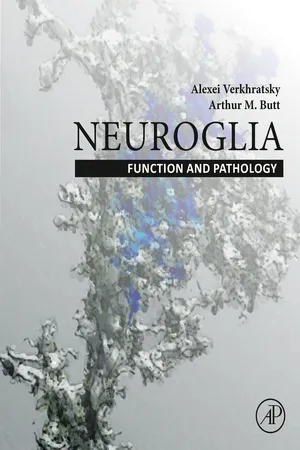
Neuroglia: Function and Pathology
About this book
Diverse specialised neuroglial cells guarantee the development, preservation, and health of the central nervous system, the peripheral nervous system, the enteric nervous system, and the special senses. In the central nervous system, it is the astrocytes, oligodendrocytes, and microglia that safeguard nerve cell function and integrity that controls all behaviours and encompasses the cerebral cortex of the brain which is the root of humanity. In the peripheral nervous system, Schwann cells play the leading role, together with satellite glial cells of the sensory and autonomic ganglia, ensuring correct communication between the organs and tissues with the brain and the spinal cord. In the enteric nervous system, specialised enteric glial cells maintain all aspects of gastrointestinal function. Then there are distinctive glial cells of the special senses that ensure how the body perceives and reacts to its environment.
In pathology, neuroglia strive to protect the diverse cellular components of the nervous system and are responsible for a proactive programme of posttraumatic restructuring that is aimed at recovery of life-sustaining function.
Neuroglia: Function and Pathology provides a highly original and comprehensive account of the physiology and pathophysiology of glial cells in the central and peripheral nervous systems. The first part of the book provides a far-reaching description of glial cell form and function, from their evolution in invertebrates to their complexity in humans, encompassing the developmental origin of the varied glial cell types and their diversity of morphology, molecular biology and cellular physiology. The second part of the book is devoted to an all-embracing evaluation of glial cell pathophysiology, commencing with definitive explanations of the fundamental pathologies of the main glial cell types, and ending in a systematic examination of glial contributions to specific neurological diseases. This book emphasises the central roles played by the different classes of neuroglial cells in the progression and outcome of neurological disorders of the central and peripheral nervous systems and highlights potential of glial cells as therapeutic targets. The book contains more than 2500 key references from over 150 years of glial research and is superbly illustrated with over 350 original and explanatory full colour figures that describe the diverse characteristics and properties of glial cells in health and disease. Under the same cover, this book combines an authoritative reference book for research and clinical neuroscientists and at the same time serves as an instructive textbook for students of neuroscience, from undergraduates to postgraduates.
- Single volume covering key aspects of glial cell physiology and pathology
- In depth overview of the history of glial cell research
- Comprehensive review of glial cell physiology and pathology
- Authoritative special chapters on the major neurological diseases
- Full colour throughout, with 360 illustrations
Information
Table of contents
- Neuroglia: Function and Pathology
- Chapter 1 History of neuroglial research
- 1: Early history of neuroscience
- Chapter 2 The concept of neuroglia
- 1: General perspective: multicellular brain and the active milieu of nervous tissue
- Chapter 3 Astroglial physiology
- 1: Definition and nomenclature
- 5: Physiology of astroglia: receptors to neurotransmitters and neuromodulators
- 5.1: General remarks
- Reference
- Chapter 4 Astroglial functions
- 1: General remarks
- 8: Astrocytes as secretory cells of the CNS
- 8.1: The gliocrine astrocyte: the general concept
- Reference
- Chapter 5 Oligodendroglial physiology and function
- 1: Definition and nomenclature
- Reference
- Chapter 6 Microglial physiology and function
- 1: Definition
- Reference
- Chapter 7 Peripheral glia physiology and function
- 1: Definitions and nomenclature
- Chapter 8 Glia of special senses
- 1: General remarks
- Chapter 9 Principles of gliopathology
- 1: Neuroglia in neurological diseases: general remarks
- 4: Neuroglia define cognitive reserve and are susceptible to life-style modifications
- Chapter 10 Inflammatory diseases of the CNS
- 1: Neurotrauma
- Chapter 11 Neurodegenerative diseases
- 1: General remarks
- Chapter 12 Neuropsychiatric disorders
- 1: General remarks
- Chapter 13 Other diseases of the CNS
- 1: Epilepsy and migraine
- Reference
- Chapter 14 Pathology of the peripheral nervous system
- 1: General remarks
- Epilogue
- Index
Trusted by 375,005 students
Access to over 1.5 million titles for a fair monthly price.
Study more efficiently using our study tools.
Frequently asked questions
Yes, you can cancel anytime from the Subscription tab in your account settings on the Perlego website. Your subscription will stay active until the end of your current billing period. Learn how to cancel your subscription
No, books cannot be downloaded as external files, such as PDFs, for use outside of Perlego. However, you can download books within the Perlego app for offline reading on mobile or tablet. Learn how to download books offline
Perlego offers two plans: Essential and Complete
- Essential is ideal for learners and professionals who enjoy exploring a wide range of subjects. Access the Essential Library with 800,000+ trusted titles and best-sellers across business, personal growth, and the humanities. Includes unlimited reading time and Standard Read Aloud voice.
- Complete: Perfect for advanced learners and researchers needing full, unrestricted access. Unlock 1.5M+ books across hundreds of subjects, including academic and specialized titles. The Complete Plan also includes advanced features like Premium Read Aloud and Research Assistant.
We are an online textbook subscription service, where you can get access to an entire online library for less than the price of a single book per month. With over 1.5 million books across 990+ topics, we’ve got you covered! Learn about our mission
Look out for the read-aloud symbol on your next book to see if you can listen to it. The read-aloud tool reads text aloud for you, highlighting the text as it is being read. You can pause it, speed it up and slow it down. Learn more about Read Aloud
Yes! You can use the Perlego app on both iOS and Android devices to read anytime, anywhere — even offline. Perfect for commutes or when you’re on the go.
Please note we cannot support devices running on iOS 13 and Android 7 or earlier. Learn more about using the app
Please note we cannot support devices running on iOS 13 and Android 7 or earlier. Learn more about using the app
Yes, you can access Neuroglia: Function and Pathology by Alexej Verkhratsky,Arthur Butt,Alexei Verkhratsky in PDF and/or ePUB format, as well as other popular books in Medicine & Pathology. We have over 1.5 million books available in our catalogue for you to explore.