eBook - ePub
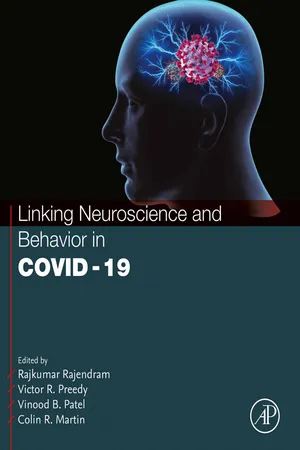
Linking Neuroscience and Behavior in COVID-19
- 600 pages
- English
- ePUB (mobile friendly)
- Available on iOS & Android
eBook - ePub
Linking Neuroscience and Behavior in COVID-19
About this book
Linking Neuroscience and Behavior in COVID-19 examines the impact of the virus and pandemic on behavior and mental health. Chapters look at those with pre-existing conditions, including dementia and multiple sclerosis, and how the pandemic has burdened them further. There is also discussion on the mental health consequences the pandemic has had and continues to have on the broad populace, including depression and anxiety, as well as neurological effects of the virus itself. Finally, managing care and treatment of conditions - those preceding, caused by, or emerging for the first time during the pandemic are also detailed.
- Discusses the impact of the COVID-19 pandemic and the virus itself on behavior and psychology
- Examines comorbidities including Parkinson's disease, neuroinflammation, and autism spectrum disorders
- Outlines the management and care for coexisting conditions including brain tumors, multiple sclerosis, and ischemic stroke
- Features chapters on the severe damage to the nervous system which may be caused by SARS-CoV-2 infection including myelitis
- Contains chapters with key facts, dictionary of terms, summary points, applications to other areas pertinent to each chapter, and policies and procedures
Information
Table of contents
- Linking Neuroscience and Behavior in COVID-19
- Cover
- Title Page
- Copyright Page
- Contents
- Dedication
- Contributors
- Preface
- Chapter 1 The historical aspects of the SARS-CoV-2 virus and the ensuing pandemic
- Chapter 2 Different variants of SARS-CoV-2
- Chapter 3 Lateral flow assay for SARS-CoV-2 infection: Uses and limitations
- Chapter 4 Linking community participation, mobility disabilities, and the COVID-19 pandemic
- Chapter 5 Influence of the sources used to obtain information on COVID-19 and their impact on mental health
- Chapter 6 The psychological experiences and distress of defined populations in the COVID-19 pandemic: Doctors
- Chapter 7 Impact of COVID-19 on behavior in autism spectrum disorder
- Chapter 8 Prepandemic stressors in mental health responses to the COVID-19 pandemic: Early life adversities and beyond
- Chapter 9 Compulsive hoarding in the COVID-19 pandemic
- Chapter 10 The psychological experiences and distress in Japan and Sweden during the COVID-19 pandemic
- Chapter 11 The COVID-19 pandemic, mental health, and sleep: Linking depression, anxiety, and perceived stress
- Chapter 12 The COVID-19 pandemic and the occupational overload of health professionals: Indicators of burnout
- Chapter 13 Neurocognitive sequelae of SARS-CoV-2 infection: Pathogenesis, risk factors, assessment, and implications
- Chapter 14 Acute neurocognitive disorder as a presenting manifestation of COVID-19
- Chapter 15 Mental health and the impact of confinement
- Chapter 16 Cannabis use in the COVID-19 pandemic: Changes in different populations and implications for policy
- Chapter 17 Impact of COVID-19 on women's mental health: Socioeconomic groups and global aspects
- Chapter 18 Quality of life assessment of patients after COVID-19
- Chapter 19 COVID-19 pandemic and remote working: Toward a new way of working
- Chapter 20 Long COVID-19 and its persistence: A focus on mental health
- Chapter 21 The impact of the COVID-19 pandemic on behavioral and psychological features of vulnerable groups: Patients with multiple sclerosis and their quality of life
- Chapter 22 The COVID-19 pandemic and the interlink with psychological distress and eating behaviors
- Chapter 23 Linking pediatric COVID-19 with basal ganglia and dentate nucleus
- Chapter 24 Sensory disorders, neuroinflammation, and COVID-19
- Chapter 25 The effects of COVID-19 isolations on nonmotor features of Parkinson’s disease
- Chapter 26 Myelitis following COVID-19
- Chapter 27 The corpus callosum: Effects due to SARS-CoV-2 infection and the mRNA vaccine
- Chapter 28 Assessing the impact of prenatal SARS-CoV-2 exposure on infants’ neurodevelopment: A comprehensive analysis of current evidence
- Chapter 29 Electroencephalographic features with COVID-19
- Chapter 30 Survivors of COVID-19 and clinical neuropsychological domain characteristics
- Chapter 31 Neuroinflammation following SARS-CoV-2 infection
- Chapter 32 Functional magnetic resonance imaging and depressive symptoms in subjects with COVID-19
- Chapter 33 Impact of COVID-19 on the brain: Antibodies against brain stem antigens
- Chapter 34 The kynurenine pathway and role in mental health of post-COVID-19 patients
- Chapter 35 Management of brain tumors in the COVID-19 pandemic
- Chapter 36 The impact of the COVID-19 pandemic on ischemic stroke management: From hyperacute to chronic phase
- Chapter 37 Long COVID-19 and the potential use of palmitoylethanolamide
- Chapter 38 Cognitive assessments in post-COVID-19 syndrome: A focus on the neuropsychological tests and protocols
- Chapter 39 Supporting those with intellectual and developmental disabilities during the COVID-19 pandemic
- Chapter 40 Preserving well-being and quality of life through school-based interventions focused on physical activity during the COVID-19 pandemic
- Chapter 41 Hesitancy in using COVID-19 prevention behaviors among African Americans: Strategies to build confidence
- Chapter 42 New strategies for psychological well-being at work
- Chapter 43 Mitigating mental health changes with virtual reality technology during COVID-19 outbreak
- Chapter 44 Music therapy for patients with neurological disorders during COVID-19 pandemic
- Chapter 45 Mental health and the modulating effects of receiving the COVID-19 vaccination
- Chapter 46 Personalized cognitive behavioral therapy on patients with obesity in COVID-19 pandemic
- Chapter 47 Social anxiety disorder and COVID-19: Treatment with cognitive behavioral therapy
- Chapter 48 Burnout during the COVID-19 pandemic: Modulating role of mindfulness
- Chapter 49 Case study: Evaluation of a Long Covid Assessment Service (LCAS)
- Chapter 50 Case study: Navigating youth mental health and addictions care in the context of the COVID-19 pandemic
- Chapter 51 Case study: Restless leg syndrome associated with COVID-19
- Chapter 52 Recommended resources linking neuroscience and behavior in coronavirus disease 2019 (COVID-19)
- Index
Trusted by 375,005 students
Access to over 1.5 million titles for a fair monthly price.
Study more efficiently using our study tools.
Frequently asked questions
Yes, you can cancel anytime from the Subscription tab in your account settings on the Perlego website. Your subscription will stay active until the end of your current billing period. Learn how to cancel your subscription
No, books cannot be downloaded as external files, such as PDFs, for use outside of Perlego. However, you can download books within the Perlego app for offline reading on mobile or tablet. Learn how to download books offline
Perlego offers two plans: Essential and Complete
- Essential is ideal for learners and professionals who enjoy exploring a wide range of subjects. Access the Essential Library with 800,000+ trusted titles and best-sellers across business, personal growth, and the humanities. Includes unlimited reading time and Standard Read Aloud voice.
- Complete: Perfect for advanced learners and researchers needing full, unrestricted access. Unlock 1.5M+ books across hundreds of subjects, including academic and specialized titles. The Complete Plan also includes advanced features like Premium Read Aloud and Research Assistant.
We are an online textbook subscription service, where you can get access to an entire online library for less than the price of a single book per month. With over 1.5 million books across 990+ topics, we’ve got you covered! Learn about our mission
Look out for the read-aloud symbol on your next book to see if you can listen to it. The read-aloud tool reads text aloud for you, highlighting the text as it is being read. You can pause it, speed it up and slow it down. Learn more about Read Aloud
Yes! You can use the Perlego app on both iOS and Android devices to read anytime, anywhere — even offline. Perfect for commutes or when you’re on the go.
Please note we cannot support devices running on iOS 13 and Android 7 or earlier. Learn more about using the app
Please note we cannot support devices running on iOS 13 and Android 7 or earlier. Learn more about using the app
Yes, you can access Linking Neuroscience and Behavior in COVID-19 by Rajkumar Rajendram, Victor R Preedy, Vinood Patel, Colin R Martin, Rajkumar Rajendram,Victor R Preedy,Vinood Patel,Colin R Martin,Colin R. Martin,Victor R. Preedy in PDF and/or ePUB format, as well as other popular books in Biological Sciences & Genetics & Genomics. We have over 1.5 million books available in our catalogue for you to explore.