eBook - ePub
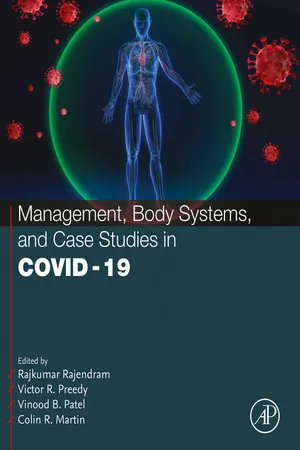
Management, Body Systems, and Case Studies in COVID-19
- 600 pages
- English
- ePUB (mobile friendly)
- Available on iOS & Android
eBook - ePub
Management, Body Systems, and Case Studies in COVID-19
About this book
COVID-19 Management in the Brain and Body describes the management of patients with the novel coronavirus in their varied symptoms. Detailing this multisystem disease and the variety of organs and tissues affected, this volume features chapters on neurological systems, including brain cancer, brain embolism, and meningoencephalitis. Several systems are addressed, including conditions affecting hematological, hepatobiliary, gastrointestinal, and cardiovascular systems. Telemedicine and are also discussed. This volume is relevant for all clinicians working to ensure the best outcomes and patient care of patients with COVID-19.
- Discusses the management of multisystem symptomatology, including the effects of COVID-19 on the neurological, respiratory, hematological, hepatobiliary, gastrointestinal, and cardiovascular systems
- Includes select guidelines for clinics providing care for COVID-19 patients
- Features individual chapter introductions, and a section on case studies to provide a comprehensive primer for each topic
- Contains chapters with key facts, dictionary of terms, summary points, applications to other areas pertinent to each chapter, and policies and procedures
Information
Table of contents
- Cover
- Front Matter
- Table of Contents
- Copyright
- Dedication
- Contributors
- Preface
- List of Illustrations
- List of Tables
- Chapter 1 : Hand hygiene strategies
- Chapter 2 : Approved vaccines for the COVID-19 pandemic: Linking in future perspectives
- Chapter 3 : Molecular methods for SARS-CoV-2 variant detection
- Chapter 4 : Systematic patient assessment for acute respiratory tract ailments (SPARTA): A simple tool to improve outcomes from COVID-19 and other pulmonary diseases
- Chapter 5 : Point of care ultrasound for coronavirus disease 2019: The multiorgan approach to COVID-19
- Chapter 6 : COVID-19 in patients with inflammatory bowel diseases: Characteristics and guidelines
- Chapter 7 : Management of COVID-19 and clinical nutrition
- Chapter 8 : The management of head and neck cancer in COVID-19
- Chapter 9 : The COVID-19 pandemic: Inventory management and allocation of personal protective equipment
- Chapter 10 : Clinical management in the COVID-19 pandemic: Rheumatic disease
- Chapter 11 : Managing migraines during the COVID-19 pandemic: An Italian experience
- Chapter 12 : Managing acute ischemic stroke in the SARS-CoV-2 pandemic
- Chapter 13 : Impact of the coronavirus disease 2019 pandemic on patients with hypertension
- Chapter 14 : Neurosurgical trauma management during COVID-19 restrictions
- Chapter 15 : The COVID-19 pandemic and management of weight gain: Implications for obesity
- Chapter 16 : COVID-19 and the management of heart failure using telemedicine
- Chapter 17 : Guidelines for breast imaging in the COVID-19 pandemic
- Chapter 18 : Vaccine-induced (immune) thrombotic thrombocytopenia (VITT): Diagnosis, guidelines, and reporting
- Chapter 19 : Lung cancer in the era of COVID-19
- Chapter 20 : Multisystem inflammatory syndrome in children/pediatric inflammatory multisystem syndrome: Clinical guidelines
- Chapter 21 : Ground-glass nodules in the lungs of COVID-19 patients
- Chapter 22 : Cardiothoracic imaging in patients affected by COVID-19
- Chapter 23 : Bronchial epithelial cells in cystic fibrosis: What happens in SARS-CoV-2 infection?
- Chapter 24 : Biomechanics and mechanobiology of the lung parenchyma following SARS-CoV-2 infection
- Chapter 25 : Long noncoding RNA profiling in respiratory specimens from COVID-19 patients
- Chapter 26 : COVID-19 and acute pulmonary embolism
- Chapter 27 : The usefulness of the alveolar-arteriolar gradient during the COVID-19 pandemic
- Chapter 28 : Cardiac manifestations of COVID-19: An overview
- Chapter 29 : Limb ischemia and COVID-19
- Chapter 30 : Thrombosis and coagulopathy in COVID-19: A current narrative
- Chapter 31 : COVID-19 myocarditis: Features of echocardiography
- Chapter 32 : COVID-19 lockdown and impact on arrhythmias
- Chapter 33 : Cardiometabolic disease and COVID-19: A new narrative
- Chapter 34 : Postrecovery COVID-19 and interlinking diabetes and cardiovascular events
- Chapter 35 : COVID-19 patients and extracorporeal membrane oxygenation
- Chapter 36 : Sars-CoV-2 infection in different hematological patients
- Chapter 37 : Dermatological reactions associated with personal protective equipment use during the COVID-19 pandemic
- Chapter 38 : Hemodialysis patients, effects of infections by SARS-CoV-2 and vaccine response
- Chapter 39 : Coinfections with COVID-19: A focus on tuberculosis (TB)
- Chapter 40 : Patients with autoimmune liver disease and the impact of Sars-COV-2 infection
- Chapter 41 : COVID-19 severity and nonalcoholic fatty liver disease
- Chapter 42 : Changes in obesity and diabetes severity during the COVID-19 pandemic at Virginia Commonwealth University health system
- Chapter 43 : COVID-19 associated rhino-orbital-cerebral mucormycosis in patients with diabetes and comorbid conditions
- Chapter 44 : Tissue location of SARS-CoV-2 RNA: A focus on bone and implications for skeletal health
- Chapter 45 : Linking between gastrointestinal tract effects of COVID-19 and tryptophan metabolism
- Chapter 46 : Organ damage in SARS-CoV-2 infection in children: A focus on acute kidney injury
- Chapter 47 : Obesity, COVID-19 severity, and mortality
- Chapter 48 : Upper and lower gastrointestinal symptoms and manifestations of COVID-19
- Chapter 49 : The COVID-19 survivors: Impact on skeletal muscle strength
- Chapter 50 : Case study: Oral mucosal lesions in patients with COVID-19
- Chapter 51 : Case study: COVID-19 pneumonia presented with cavitary lesions
- Chapter 52 : Case study: Optic neuritis in SARS-CoV-2 infection
- Chapter 53 : Recommended resources relevant to the body systems involvement and management of COVID-19
- Index
- A
Trusted by 375,005 students
Access to over 1.5 million titles for a fair monthly price.
Study more efficiently using our study tools.
Frequently asked questions
Yes, you can cancel anytime from the Subscription tab in your account settings on the Perlego website. Your subscription will stay active until the end of your current billing period. Learn how to cancel your subscription
No, books cannot be downloaded as external files, such as PDFs, for use outside of Perlego. However, you can download books within the Perlego app for offline reading on mobile or tablet. Learn how to download books offline
Perlego offers two plans: Essential and Complete
- Essential is ideal for learners and professionals who enjoy exploring a wide range of subjects. Access the Essential Library with 800,000+ trusted titles and best-sellers across business, personal growth, and the humanities. Includes unlimited reading time and Standard Read Aloud voice.
- Complete: Perfect for advanced learners and researchers needing full, unrestricted access. Unlock 1.5M+ books across hundreds of subjects, including academic and specialized titles. The Complete Plan also includes advanced features like Premium Read Aloud and Research Assistant.
We are an online textbook subscription service, where you can get access to an entire online library for less than the price of a single book per month. With over 1.5 million books across 990+ topics, we’ve got you covered! Learn about our mission
Look out for the read-aloud symbol on your next book to see if you can listen to it. The read-aloud tool reads text aloud for you, highlighting the text as it is being read. You can pause it, speed it up and slow it down. Learn more about Read Aloud
Yes! You can use the Perlego app on both iOS and Android devices to read anytime, anywhere — even offline. Perfect for commutes or when you’re on the go.
Please note we cannot support devices running on iOS 13 and Android 7 or earlier. Learn more about using the app
Please note we cannot support devices running on iOS 13 and Android 7 or earlier. Learn more about using the app
Yes, you can access Management, Body Systems, and Case Studies in COVID-19 by Rajkumar Rajendram, Victor R Preedy, Vinood Patel, Colin R Martin, Rajkumar Rajendram,Victor R Preedy,Vinood Patel,Colin R Martin,Colin R. Martin,Victor R. Preedy in PDF and/or ePUB format, as well as other popular books in Biological Sciences & Epidemiology. We have over 1.5 million books available in our catalogue for you to explore.