eBook - ePub
Forces of Transformation
The End of the Bronze Age in the Mediterranean
- 236 pages
- English
- ePUB (mobile friendly)
- Available on iOS & Android
eBook - ePub
Forces of Transformation
The End of the Bronze Age in the Mediterranean
About this book
The volume is the first in nearly a decade to focus a wide range of scholarship on one of the most compelling periods in the antiquity of the Mediterranean and Near East. It presents new interpretive approaches to the problems of the Bronze Age to Iron Age transformation, as well as re-assessments of a wide range of high profile sites and evidence ranging from the Ugaritic archives, Hazor, the Medinet Habu reliefs, Tiryns and Troy. Implications for a changing climate are also explored in the volume. The end of the Bronze Age in the Mediterranean and Near East is a huge challenge requiring a diverse, global, flexible and open minded strategy for its interpretation - it is too vast and complex for any one scholar or interpretive approach. The scope of this volume is great, but not overwhelming, as the papers are organized coherently into themes considering climate, exchange and interregional dynamics, iconography and perception, the built environment - cemeteries, citadels, and landscapes, and social implications for the production and consumption of pottery. Thus, Forces of Transformation is broad enough to address many of the major concerns of the end of the Bronze Age, and also to encapsulate the current position of scholarship as it relates to this problem.
Information
Subtopic
ArchaeologyIndex
Social SciencesPART 1
CONSIDERATIONS OF CLIMATE
1
HOLOCENE CLIMATE VARIABILITY IN THE EASTERN MEDITERRANEAN, AND THE END OF THE BRONZE AGE
Eelco J. Rohling, Angela Hayes, Paul A. Mayewski, and Michal Kucera
The Late Bronze Age/Early Iron Age transition in the eastern Mediterranean (about 1200–900 BCE) coincided with one of the current interglacial (Holocene) Rapid Climate Change events (RCC), as documented in about 50 globally distributed climate proxy records (Mayewski et al. 2004). That compilation study demonstrates that the RCC between 1500 and 500 BCE was characterised by glacier advances on a global scale (in Scandinavia, Central Asia, North America, and the Southern Hemisphere), similar to other RCCs in the intervals 4000–3000 and 2200–1800 BCE, and 800–1000 and 1400–1850 CE. It is evident, therefore, that the RCC at around the end of the Bronze Age was not unique, but part of a repeating pattern of global climate deteriorations during the Holocene.
The present contribution reviews previous studies to evaluate the severity of the impact of the Holocene RCCs in the eastern Mediterranean region with emphasis on the RCC of 1500–500 BCE. It also evaluates the constraints on the timing relationship between the end of the Bronze Age and expressions of the RCC of 1500–500 BCE in the eastern Mediterranean region.
Holocene RCCs and the eastern Mediterranean
Besides global glacier advances, the Holocene RCCs are also marked by distinct increases in the concentration of K+ ions (i.e. [K+]) in the GISP2 ice core from the Greenland summit (Fig. 1: O’Brien et al. 1995; Mayewski et al. 1997; Mayewski et al. 2004). Potassium transport to the Greenland ice sheet is strongly related to the late winter-spring intensity of the atmospheric high-pressure conditions over Siberia (Meeker and Mayewski 2002). Enhanced [K+] within the RCCs therefore suggests an intensification of Eurasian winter conditions.
The Holocene RCCs are also characterized by peaks in the sea-salt [Na+] series from the GISP2 ice core (Fig. 1.1). These sea-salt [Na+] variations closely reflect the intensity of the Icelandic Low (Meeker and Mayewski 2002). An intensified (deeper) Icelandic Low causes intensification of onshore winds to Greenland, so that sea ice stays longer each season, and more persists from season to season. The inferred increase of North Atlantic sea-ice extent and duration during the Holocene RCCs is supported by concomitant increases in Holocene, most likely sea-ice transported, ice-rafted debris concentrations in North Atlantic sediments during the RCCs (Bond et al. 2001).
A key record for the identification of Holocene RCCs in the eastern Mediterranean region has been developed by investigation of marine microfossil assemblages in sediment core LC21 (Rohling et al. 2002b). LC21 was recovered from the SE Aegean Sea, on the boundary between the north-south extended Aegean Sea and the west-east extended Levantine Sea. This is a highly sensitive location for the recording of expansions and contractions of the cooler Aegean signature relative to the warmer Levantine signature.
Temperature changes in the region of sediment core LC21 have been deduced from changes in the assemblages of marine unicellular zooplankton microfossils (planktonic foraminifera Rohling et al. 2002b). These were grouped in species clusters according to affinities to warmer or cooler conditions, yielding a relative record of warming and cooling. Based on mapping of the same assemblages in core tops from the Aegean Sea, the relative changes were roughly calibrated to quantitative estimates of sea surface temperature change. This suggested that the RCCs were associated with temperature drops of the order of 2–3°C in the SE Aegean region, notably in winter. We corroborate this initial estimate by similar values from statistically more robust calibrations of the faunal changes using an Artificial Neural Network approach (Fig. 1.1: for method, see Hayes et al. 2005). In central Aegean Sea core SL-11 (Casford et al. 2002; Casford et al. 2003), the ANN method suggests a magnitude of cooling of about 2.5°C for the Holocene RCCs (unpublished data). This may suggest that the impact of cooling was stronger in more northern sites, and somewhat weaker further to the south, which would agree with the inferred cause of the cooling events in the Aegean Sea (northerly outbreaks of cold air – see below).
The approximate 2°C magnitude of the Holocene RCCs in the Aegean compares well with the magnitude of contemporaneous cooling events in the western Mediterranean, which were quantified with organic geochemical techniques (Cacho et al. 2001). Oxygen isotope analyses from speleothems in southwest Romania (Poleva Cave) also provide evidence of climatic cooling within this time period. In that record, the oxygen isotope record is used as a relative temperature proxy, and the magnitude of the decrease was not quantified. However, the observed shift of about 1.5‰ in the isotope data implies a significant temperature decrease in the period between 1500 and 500 BCE (Constantin et al. 2007). Another speleothem record, from Spannagel Cave in the central Alps, also shows a marked interval of relatively heavy oxygen isotope ratios (about 1500–800 BCE), which starts with a shift that implies around 3°C winter cooling (Mangini et al. 2007). The temporal structure of the Spannagel Cave record closely resembles that of records of North Atlantic hydrographic/sea-ice variations, as obtained from ice-rafted debris counts in marine sediment cores (Bond et al. 2001) and supported by the GISP2 ice-core [Na+] series (Fig. 1.1). The combined information demonstrates a significant correlation between terrestrial and marine palaeoclimate records at this time, with an emphasis on winter-time perturbations.
The cooling events in the Aegean Sea have been ascribed to intensification and frequency increase of wintertime northerly outbreaks of cold polar and continental air over the basin, relative to the present (Rohling et al. 2002b). Such outbreaks still occur today (for a summary and data of such an event in the year 2001, see Casford et al. 2003). These outbreaks are a consequence of the Mediterranean’s latitudinal position and its mountainous northerly margin, which exert an important control on circulation and water-mass transformations in the Mediterranean Sea. Contemporaneous cooling events have been found in the Adriatic Sea and in the western Mediterranean (Rohling et al. 1997; Cacho et al. 1999; Cacho et al. 2000; Cacho et al. 2001; Casford et al. 2001; Rohling et al. 2002a; Frigola et al. 2007). To understand the relationship between the frequency and intensity of wintertime northerly outbreaks over the Mediterranean and the climatic patterns inferred from proxy records from the wider northern hemisphere (particularly the Greenland ice sheet), it is important to first consider the main drivers behind the general climatic conditions over the region.
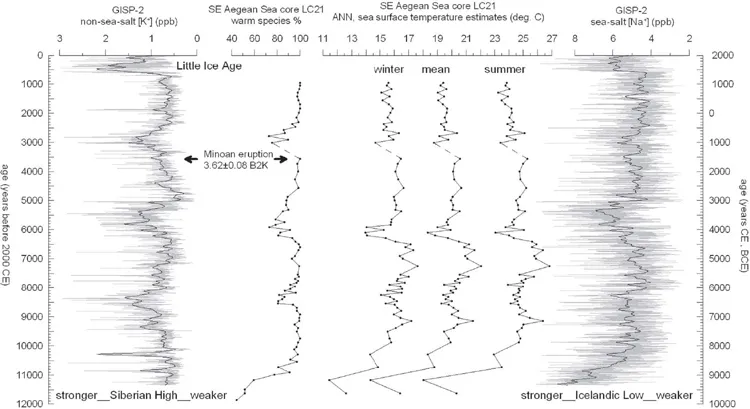
Fig. 1.1: Compilation of the Holocene non-sea-salt [K+] and sea-salt [Na+] series for the GISP2 ice core from Greenland (O’Brien et al. 1995; Mayewski et al. 1997), with 200-year bandpass filters, along with the sea surface reconstructions for the SE Aegean Sea from planktonic foraminiferal abundance data for sediment core LC21. The qualitative warm species percentage record is the same as that shown in Rohling et al. (2002b). An artificial neural network (ANN) technique is used to transform the faunal abundance data into records of winter, summer, and annual mean sea surface temperature. The technique and its core-top calibration set are fully explained in Hayes et al. (2005). Note that the records are presented on the left-hand side versus age in years Before 2000 CE (B2K), which is the conventionally used ice-core reference datum, as well as (right-hand side) versus age in years CE/BCE (as used throughout this volume). The age of the Minoan eruption is indicated after Bruins and Van Der Plicht (1996) and Kuniholm et al. (1996)
During summer, climatic conditions over the Levantine Sea (the eastern sector of the eastern Mediterranean) are dominated by displacement of the North African subtropical high-pressure conditions to the north, causing widespread drought. The Aegean Sea then comes under the influence of northerly winds (‘Etesians’), caused by extension of the deep monsoon low-pressure system of northwest India over the Iranian highlands and Anatolia. Although this semi-permanent extension of the monsoon low causes local depression formation around Cyprus and the Middle East, dry summer conditions prevail due to descent in the upper troposphe...
Table of contents
- Cover
- Title Page
- Copyright Page
- Contents
- Editors’ Preface
- List of Contributors
- Part 1: Considerations of climate
- Part 2: Exchange and interregional dynamics
- Part 3: Iconography and perception
- Part 4: Built environment – cemeteries, citadels, and landscapes
- Part 5: Social implications for the production and consumption of pottery
- Bibliography
Trusted by 375,005 students
Access to over 1.5 million titles for a fair monthly price.
Study more efficiently using our study tools.
Frequently asked questions
Yes, you can cancel anytime from the Subscription tab in your account settings on the Perlego website. Your subscription will stay active until the end of your current billing period. Learn how to cancel your subscription
No, books cannot be downloaded as external files, such as PDFs, for use outside of Perlego. However, you can download books within the Perlego app for offline reading on mobile or tablet. Learn how to download books offline
Perlego offers two plans: Essential and Complete
- Essential is ideal for learners and professionals who enjoy exploring a wide range of subjects. Access the Essential Library with 800,000+ trusted titles and best-sellers across business, personal growth, and the humanities. Includes unlimited reading time and Standard Read Aloud voice.
- Complete: Perfect for advanced learners and researchers needing full, unrestricted access. Unlock 1.5M+ books across hundreds of subjects, including academic and specialized titles. The Complete Plan also includes advanced features like Premium Read Aloud and Research Assistant.
We are an online textbook subscription service, where you can get access to an entire online library for less than the price of a single book per month. With over 1.5 million books across 990+ topics, we’ve got you covered! Learn about our mission
Look out for the read-aloud symbol on your next book to see if you can listen to it. The read-aloud tool reads text aloud for you, highlighting the text as it is being read. You can pause it, speed it up and slow it down. Learn more about Read Aloud
Yes! You can use the Perlego app on both iOS and Android devices to read anytime, anywhere — even offline. Perfect for commutes or when you’re on the go.
Please note we cannot support devices running on iOS 13 and Android 7 or earlier. Learn more about using the app
Please note we cannot support devices running on iOS 13 and Android 7 or earlier. Learn more about using the app
Yes, you can access Forces of Transformation by Christoph Bachhuber, Gareth Roberts, Christoph Bachhuber,Gareth Roberts in PDF and/or ePUB format, as well as other popular books in Social Sciences & Archaeology. We have over 1.5 million books available in our catalogue for you to explore.