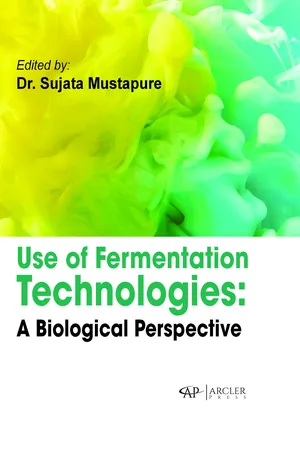
Fermentation technology has been employed since ancient times for food preservation and the production of diverse items like bread, beer, yogurt, cheese, and wine. Not only does it preserve food, but it also enhances its taste and nutritional value. Fermented products offer calories, vitamins, fiber, antioxidants, and the breakdown of antinutritive compounds. Enzymes derived from fermentation have applications in various industries including pharmaceuticals, food, detergents, paper, and cosmetics. The use of fermentation is expanding rapidly and plays a crucial role in biotechnology. Industries such as pharmaceuticals, chemicals, food, and alcoholic beverages extensively utilize fermentation technology on a large scale. Productivity in fermentation processes is influenced by factors such as strain selection, growth conditions, and media composition. Fermentation involves the use of microorganisms like yeast, bacteria, and fungi to produce enzymes, metabolites, biomass, recombinant technologies, and biotransformation products at an industrial level. By-products of fermentation include organic acids, alcohol, and released metabolites. In the competitive modern fermentation sector, new technologies are being explored to improve fermentation processes and produce high-quality food products. This book provides a comprehensive overview of different microbial species, such as yeast and fungi, their impact on raw materials, and the resulting by-products. It also discusses the environmental conditions that influence fermentation processes and the production of different products. This resource is valuable for students, researchers, and professionals in academia and industry who seek knowledge and a fundamental understanding of fermentation technology.
- 239 pages
- English
- PDF
- Available on iOS & Android
eBook - PDF
Use of fermentation technologies: A biological perspective
About this book
Information
Subtopic
BiochemistryIndex
Biological SciencesTable of contents
- Cover
- HalfTitle Page
- Title Page
- Copyright
- About the Editor
- Table of Contents
- List of Figures
- Preface
- Introduction
- Chapter 1: Introduction to Fermentation Technology
- Chapter 2: Food Fermentation
- Chapter 3: Microbiology of Fermented Foods
- Chapter 4: Fermentation Technology
- Chapter 5: Fermented Products with Plants
- Chapter 6: Distillation and Fermentation
- Chapter 7: Beverage Fermentation
- Chapter 8: Advances in Food Fermentation Technology
- Reference
- Index
- Back Cover
Trusted by 375,005 students
Access to over 1.5 million titles for a fair monthly price.
Study more efficiently using our study tools.
Frequently asked questions
Yes, you can cancel anytime from the Subscription tab in your account settings on the Perlego website. Your subscription will stay active until the end of your current billing period. Learn how to cancel your subscription
No, books cannot be downloaded as external files, such as PDFs, for use outside of Perlego. However, you can download books within the Perlego app for offline reading on mobile or tablet. Learn how to download books offline
Perlego offers two plans: Essential and Complete
- Essential is ideal for learners and professionals who enjoy exploring a wide range of subjects. Access the Essential Library with 800,000+ trusted titles and best-sellers across business, personal growth, and the humanities. Includes unlimited reading time and Standard Read Aloud voice.
- Complete: Perfect for advanced learners and researchers needing full, unrestricted access. Unlock 1.5M+ books across hundreds of subjects, including academic and specialized titles. The Complete Plan also includes advanced features like Premium Read Aloud and Research Assistant.
We are an online textbook subscription service, where you can get access to an entire online library for less than the price of a single book per month. With over 1.5 million books across 990+ topics, we’ve got you covered! Learn about our mission
Look out for the read-aloud symbol on your next book to see if you can listen to it. The read-aloud tool reads text aloud for you, highlighting the text as it is being read. You can pause it, speed it up and slow it down. Learn more about Read Aloud
Yes! You can use the Perlego app on both iOS and Android devices to read anytime, anywhere — even offline. Perfect for commutes or when you’re on the go.
Please note we cannot support devices running on iOS 13 and Android 7 or earlier. Learn more about using the app
Please note we cannot support devices running on iOS 13 and Android 7 or earlier. Learn more about using the app
Yes, you can access Use of fermentation technologies: A biological perspective by Sujata Mustapure in PDF and/or ePUB format, as well as other popular books in Biological Sciences & Biochemistry. We have over 1.5 million books available in our catalogue for you to explore.