- 291 pages
- English
- ePUB (mobile friendly)
- Available on iOS & Android
eBook - ePub
About this book
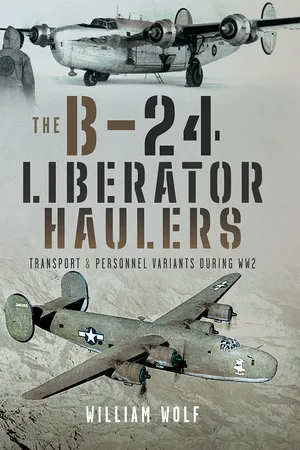
"… for the story of the early development of US military air transport and the Libertors that were its backbone, nobody has provided anything to match this book." -The Journal of the Air Force Historical Foundation With iconic images depicting it in the skies over Occupied Europe or the Far East, the B-24 Liberator is remembered for its part in the Allies' bombing campaigns during the Second World War. But there was another part to this famous four-engine aircraft – one that is less well known. While the Douglas C-47 Dakota is deservedly celebrated as the most important twin-engine transport aircraft of the war, the early use of the four-engine Consolidated B-24 Liberator bomber as a passenger carrier is virtually unknown but was as important. Since the B-24 had more interior room than the B-17, it could be more easily be converted into a personnel carrier. These early Liberators operated America's and Britain's early diplomatic missions and then were to be extensively flown by the Atlantic Ferry Organization and the Transport Commands on missions that opened the world to air transport as never before. Several B-24s were converted for VIP personal and diplomatic use, which included Harriman's Moscow and round-the-world diplomatic mission, and those used by Churchill and Eisenhower to 'get around'. To meet the need for a cargo and personnel transport which had longer transoceanic range and improved high-altitude performance than the C-47, in early 1942 the C-87, a hastily designed B-24 derivative, was placed into production. By installing a built-up floor section that replaced the bomb bay doors, the C-87 could carry six tons of cargo loaded through a cargo door cut into the side of its fuselage or through a special hinged door in its nose. Most C-87s were operated by the US Ferrying Command and Air Transport Command; by the late summer of 1943, they were extensively operating regular routes from the United States to the world's most remote areas. To meet this increased requirement for air transport, the ATC was forced to turn to four civil commercial airlines for help operating the system. Of the 287 purpose-built C-87s, 24 were transferred to the RAF under Lend-Lease for RAF Ferry and Transport Command. The C-87 would remain as a prime mover until the dedicated C-54 Skymaster four-engine transport came into service. The 218 C-109s were fuel tanker conversions of completed B-24 bombers which had all armament removed and extra fuel tanks added to carry fuel from India for B-29s based in China. Due to the lack of C-47s after D-Day, conventional B-24s were again converted for transporting vital supplies and bulk fuel to troops in France. Once Allied troops broke out of the Normandy beachhead, converted Liberators flew Trucking supply drop operations delivering emergency fuel and supplies to Patton's fuel-starved armies racing across France. Later these B-24s supplied the ill-fated Operation Market Garden at Arnhem.
Information
Subtopic
Military & Maritime HistoryIndex
HistoryTable of contents
- Cover
- Title
- Copyright
- Dedication
- Table of Contents
- Foreword
- Acknowledgments
- Caption Credit and Other Abbreviations
- Chapter 1 US and UK Liberators Become Essential for Transport Conversion
- Chapter 2 C-87 Liberator Express
- Chapter 3 C-109 Fuel Transport
- Chapter 4 Navy RY Liberator Hauler Series
- Chapter 5 XB-24B Test Bed Becomes a VIP Transport
- Chapter 6 C-87s and C-109s in Over the Hump Service
- Chapter 7 B-24 ETO Trucking and Supply Drop Operations
- Chapter 8 Trolley Missions
- Bibliography
Trusted by 375,005 students
Access to over 1.5 million titles for a fair monthly price.
Study more efficiently using our study tools.
Frequently asked questions
Yes, you can cancel anytime from the Subscription tab in your account settings on the Perlego website. Your subscription will stay active until the end of your current billing period. Learn how to cancel your subscription
No, books cannot be downloaded as external files, such as PDFs, for use outside of Perlego. However, you can download books within the Perlego app for offline reading on mobile or tablet. Learn how to download books offline
Perlego offers two plans: Essential and Complete
- Essential is ideal for learners and professionals who enjoy exploring a wide range of subjects. Access the Essential Library with 800,000+ trusted titles and best-sellers across business, personal growth, and the humanities. Includes unlimited reading time and Standard Read Aloud voice.
- Complete: Perfect for advanced learners and researchers needing full, unrestricted access. Unlock 1.5M+ books across hundreds of subjects, including academic and specialized titles. The Complete Plan also includes advanced features like Premium Read Aloud and Research Assistant.
We are an online textbook subscription service, where you can get access to an entire online library for less than the price of a single book per month. With over 1.5 million books across 990+ topics, we’ve got you covered! Learn about our mission
Look out for the read-aloud symbol on your next book to see if you can listen to it. The read-aloud tool reads text aloud for you, highlighting the text as it is being read. You can pause it, speed it up and slow it down. Learn more about Read Aloud
Yes! You can use the Perlego app on both iOS and Android devices to read anytime, anywhere — even offline. Perfect for commutes or when you’re on the go.
Please note we cannot support devices running on iOS 13 and Android 7 or earlier. Learn more about using the app
Please note we cannot support devices running on iOS 13 and Android 7 or earlier. Learn more about using the app
Yes, you can access The B-24 Liberator Haulers by William Wolf in PDF and/or ePUB format, as well as other popular books in History & Military & Maritime History. We have over 1.5 million books available in our catalogue for you to explore.