Winner of the British Association of Film, Television and Screen Studies Best First Monograph Award
In A Siberian History of Soviet Film, Caroline Damiens explores how the depictions of the indigenous 'Peoples of the North' in Soviet cinema and television evolved between 1920 and 1980.
Damiens combines a detailed analysis of key works such as Forest People (1928), Igdenbu (1930), Dersu Uzala (1961 & 1975), Tymancha's Friend (1969) and The Most Beautiful Ships (1972), with primary sources like press articles, archives, and interviews, to reveal how these cinematic portrayals were created and negotiated, providing insight into the concepts of progress and authenticity in the Soviet context. She emphasises the role of indigenous individuals in shaping their cinematic image, both in front of and behind the camera, highlighting the works of lesser-known figures like Suntsai Geonka, Zinaida Pikunova, and Iurii Rytkheu. In doing so, Damiens emphasises the multifaceted nature of film, where interpretations differ based on the perspectives of those involved.
Using a decolonial approach and drawing from extensive archival materials, Damiens prompts a re-evaluation of the Soviet cinematic past and present by centring indigenous voices in the narrative. In doing so, she provides a thorough exploration of the intricate relationship between culture, representation, and identity in Soviet cinema.
eBook - ePub
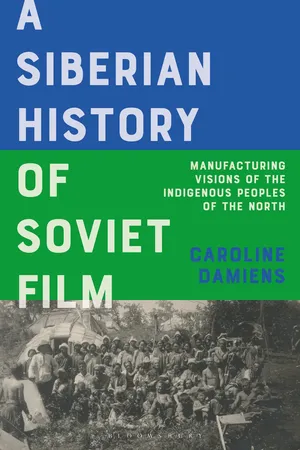
A Siberian History of Soviet Film
Manufacturing Visions of the Indigenous Peoples of the North
- 317 pages
- English
- ePUB (mobile friendly)
- Available on iOS & Android
eBook - ePub
A Siberian History of Soviet Film
Manufacturing Visions of the Indigenous Peoples of the North
About this book
Information
Table of contents
- Cover
- Half Title
- Series Page
- Title Page
- Copyright Page
- Contents
- List of illustrations
- Acknowledgements
- Note on transliteration
- Introduction
- Part One Shooting with indigenous people: Expeditionary practices and filmic co-construction in the peripheries (1926–35)
- Part Two Indigenous people in Soviet discourse on modernity: The politics of casting and representation (1935–79)
- Part Three On TV: Towards visual sovereignty (1969–82)
- Epilogue: Rediscovering indigenous voices in Soviet cinema
- Glossary
- Notes
- Filmography
- Bibliography
- Index
Trusted by 375,005 students
Access to over 1.5 million titles for a fair monthly price.
Study more efficiently using our study tools.
Frequently asked questions
Yes, you can cancel anytime from the Subscription tab in your account settings on the Perlego website. Your subscription will stay active until the end of your current billing period. Learn how to cancel your subscription
No, books cannot be downloaded as external files, such as PDFs, for use outside of Perlego. However, you can download books within the Perlego app for offline reading on mobile or tablet. Learn how to download books offline
Perlego offers two plans: Essential and Complete
- Essential is ideal for learners and professionals who enjoy exploring a wide range of subjects. Access the Essential Library with 800,000+ trusted titles and best-sellers across business, personal growth, and the humanities. Includes unlimited reading time and Standard Read Aloud voice.
- Complete: Perfect for advanced learners and researchers needing full, unrestricted access. Unlock 1.5M+ books across hundreds of subjects, including academic and specialized titles. The Complete Plan also includes advanced features like Premium Read Aloud and Research Assistant.
We are an online textbook subscription service, where you can get access to an entire online library for less than the price of a single book per month. With over 1.5 million books across 990+ topics, we’ve got you covered! Learn about our mission
Look out for the read-aloud symbol on your next book to see if you can listen to it. The read-aloud tool reads text aloud for you, highlighting the text as it is being read. You can pause it, speed it up and slow it down. Learn more about Read Aloud
Yes! You can use the Perlego app on both iOS and Android devices to read anytime, anywhere — even offline. Perfect for commutes or when you’re on the go.
Please note we cannot support devices running on iOS 13 and Android 7 or earlier. Learn more about using the app
Please note we cannot support devices running on iOS 13 and Android 7 or earlier. Learn more about using the app
Yes, you can access A Siberian History of Soviet Film by Caroline Damiens in PDF and/or ePUB format, as well as other popular books in Media & Performing Arts & Russian History. We have over 1.5 million books available in our catalogue for you to explore.