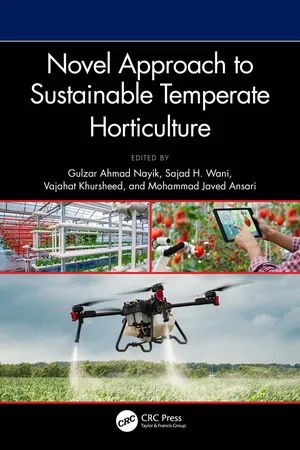
Novel Approach to Sustainable Temperate Horticulture
eBook - ePub

Novel Approach to Sustainable Temperate Horticulture

  1. 312 pages
  2. English
  3. ePUB (mobile friendly)
  4. Available on iOS & Android
eBook - ePub

Novel Approach to Sustainable Temperate Horticulture

About this book

In the current scenario, marked by a continual improvement in living standards, it becomes imperative to boost the productivity as well as the efficiency of agriculture, especially horticulture, which holds the potential for significant economic prosperity aligning with Sustainable Development Goal number 8, "Decent Work and Economic Growth". Modern technological interventions, such as geospatial technology and geographic information system (GIS) technology, can be harnessed to yield effective results in addressing challenges and providing enhanced decision support, particularly in the planning of horticultural resource management. Cultivation and production of fresh produce face several challenges, including prolonged juvenile phases and reproductive cycles with extended breeding periods, creating bottlenecks in the process. The evolving trends in biotechnology offer promising solutions for improving the selection of desirable traits. Biotechnological techniques aimed at improving fruit efficiency encompass tissue culture, induction of genetic variability, germplasm conservation, and molecular breeding/genomics. These methods involve the study of genetic diversity, DNA fingerprinting, and Quantitative Trait Loci (QTL) analysis for marker-assisted selection. Over the past few decades, the global population has consistently risen, raising concerns about the ability of the current food system to adequately feed the anticipated 10 billion people in the next 30 years. While this challenge is deemed achievable, certain changes in both food production and consumption systems are essential to ensure sustainability, reduce food loss and waste, and contribute to a global shift toward healthier and more sustainable diets. Implementing sustainable models of crop production represents a significant undertaking. To address the growing food demand amid deteriorating production environments, there is a need for promising technologies and effective management options to enhance productivity.

This book is poised to be a valuable resource for horticultural scientists operating in universities, government agencies, and research centers, offering insights into achieving sustainable cultivation practices for fruits. It stands out as the first of its kind, providing in?depth knowledge on environmentally friendly methods for cultivating temperate fruit crops, to reduce harmful emissions and pollution. This book will delve into the application of geographic information system (GIS) for estimating horticulture area expansion and crop yield. Additionally, it will encompass recent biotechnological interventions in horticulture, circular agriculture models, and emerging non?thermal food preservation techniques as significant components.

Features:

  • Aims to provide a comprehensive and integrated overview of current techno-statistical techniques employed in horticulture, delving into the associated livelihood benefits derived from the practice.
  • Explores the novel geographical trends to identify the site suitability indices of several temperate fruits.
  • Offers a comprehensive and integrated exploration of recent trends in biotechnological approaches aimed at enhancing food production, quality, and safety.

Frequently asked questions

Yes, you can cancel anytime from the Subscription tab in your account settings on the Perlego website. Your subscription will stay active until the end of your current billing period. Learn how to cancel your subscription.
No, books cannot be downloaded as external files, such as PDFs, for use outside of Perlego. However, you can download books within the Perlego app for offline reading on mobile or tablet. Learn more here.
Perlego offers two plans: Essential and Complete
  • Essential is ideal for learners and professionals who enjoy exploring a wide range of subjects. Access the Essential Library with 800,000+ trusted titles and best-sellers across business, personal growth, and the humanities. Includes unlimited reading time and Standard Read Aloud voice.
  • Complete: Perfect for advanced learners and researchers needing full, unrestricted access. Unlock 1.4M+ books across hundreds of subjects, including academic and specialized titles. The Complete Plan also includes advanced features like Premium Read Aloud and Research Assistant.
Both plans are available with monthly, semester, or annual billing cycles.
We are an online textbook subscription service, where you can get access to an entire online library for less than the price of a single book per month. With over 1 million books across 1000+ topics, we’ve got you covered! Learn more here.
Look out for the read-aloud symbol on your next book to see if you can listen to it. The read-aloud tool reads text aloud for you, highlighting the text as it is being read. You can pause it, speed it up and slow it down. Learn more here.
Yes! You can use the Perlego app on both iOS or Android devices to read anytime, anywhere — even offline. Perfect for commutes or when you’re on the go.
Please note we cannot support devices running on iOS 13 and Android 7 or earlier. Learn more about using the app.
Yes, you can access Novel Approach to Sustainable Temperate Horticulture by Gulzar Ahmad Nayik,Sajad H. Wani,Vajahat Khursheed,Mohammad Javed Ansari in PDF and/or ePUB format, as well as other popular books in Biological Sciences & Biotechnology. We have over one million books available in our catalogue for you to explore.

Information

Table of contents

  1. Cover
  2. Half Title
  3. Title Page
  4. Copyright Page
  5. Dedication
  6. Table of Contents
  7. Preface
  8. Editors Biography
  9. List of Contributors
  10. Chapter 1 Estimation of Horticulture Area Expansion and Crop Yield Quantification by Using Remotely Sensed Data and Geographic Information Systems
  11. Chapter 2 Cost-Benefit Analysis and Measuring Livelihood Development Index of Horticulturalists in Kashmir Valley
  12. Chapter 3 Recent Advances in Rootstock and Varietal Improvement in Horticulture Crops
  13. Chapter 4 Biotechnological Intervention in Horticulture
  14. Chapter 5 Potential of Nanotechnology for Improving Nutrient Efficiency of Temperate Horticulture Crops
  15. Chapter 6 Role of Digital Technologies in the Field of Horticultural Science and Technology
  16. Chapter 7 Strategies for Adding Value to Food Byproducts (Recovery and Valorization)
  17. Chapter 8 Emerging Non-thermal Food Preservation Techniques
  18. Chapter 9 Circular Models and Strategies to Reduce and Reuse Food Waste
  19. Chapter 10 Environmentally Friendly Food Processes, Biorefineries and 3D Food Printing
  20. Chapter 11 Biotechnological Approaches to Increase Food Production Quality and Safety
  21. Index