American novelist Edith Wharton (1862–1937) is best known today for her tales of the city and the experiences of patrician New Yorkers in the "Gilded Age." This book pushes against the grain of critical orthodoxy by prioritizing other "species of spaces" in Wharton's work. For example, how do Wharton's narratives represent the organic profusion of external nature? Does the current scholarly fascination with the environmental humanities reveal previously unexamined or overlooked facets of Wharton's craft? I propose that what is most striking about her narrative practice is how she utilizes, adapts, and translates pastoral tropes, conventions, and concerns to twentieth-century American actualities. It is no accident that Wharton portrays characters returning to, or exploring, various natural localities, such as private gardens, public parks, chic mountain resorts, monumental ruins, or country-estate "follies." Such encounters and adventures prompt us to imagine new relationships with various geographies and the lifeforms that can be found there. The book addresses a knowledge gap in Wharton and the environmental humanities, especially recent debates in ecocriticism. The excavation of Wharton's words and the background of her narratives with an eye to offering an ecocritical reading of her work is whatthe book focuseson.
eBook - ePub
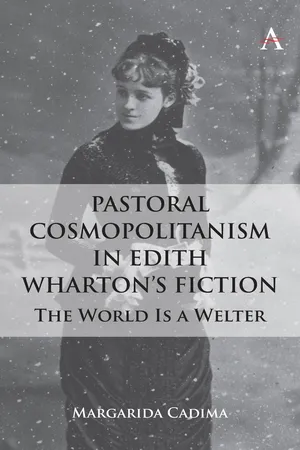
Pastoral Cosmopolitanism in Edith Wharton's Fiction
The World is a Welter'
- English
- ePUB (mobile friendly)
- Available on iOS & Android
eBook - ePub
About this book
Information
Edition
0Table of contents
- Cover
- Half-Title
- Title
- Copyright
- Contents
- Epigraph
- Acknowledgments
- Introduction
- Part I. Gardens
- Part II. Mountains
- Part III. Ruin/Ation
- Conclusion
- Appendix 1: Spring in a French Riviera Garden
- Appendix 2: December in a French Rivera Garden
- Bibliography
- Index
Trusted by 375,005 students
Access to over 1.5 million titles for a fair monthly price.
Study more efficiently using our study tools.