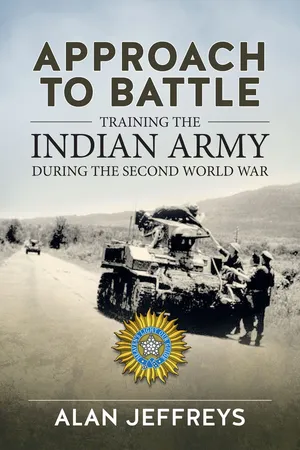
The Indian Army was the largest volunteer army during the Second World War. Indian Army divisions fought in the Middle East, North Africa and Italy - and went to make up the overwhelming majority of the troops in South East Asia. Over two million personnel served in the Indian Army - and India provided the base for supplies for the Middle Eastern and South East Asian theatres. This monograph is a modern historical interpretation of the Indian Army as a holistic organisation during the Second World War. It will look at training in India - charting how the Indian Army developed a more comprehensive training structure than any other Commonwealth country. This was achieved through both the dissemination of doctrine and the professionalism of a small coterie of Indian Army officers who brought about a military culture within the Indian Army - starting in the 1930s - that came to fruition during the Second World War, which informed the formal learning process. Finally, it will show that the Indian Army was reorganised after experiences of the First World War. During the interwar period, the army developed training and belief for both fighting on the North West Frontier, and as an aid to civil power. With the outbreak of the Second World War, in addition to these roles, the army had to expand and adapt to fighting modern professional armies in the difficult terrains of desert, jungle and mountain warfare. A clear development of doctrine and training can be seen, with many pamphlets being produced by GHQ India that were, in turn, used to formulate training within formations and then used in divisional, brigade and unit training instructions - thus a clear line of process can be seen not only from GHQ India down to brigade and battalion level, but also upwards from battalion and brigade level based on experience in battle that was absorbed into new training instructions. Together with the added impetus for education in the army, by 1945 the Indian Army had become a modern, professional and national army.
- 250 pages
- English
- ePUB (mobile friendly)
- Available on iOS & Android
eBook - ePub
About this book
Information
Subtopic
Military & Maritime HistoryIndex
HistoryTable of contents
- Cover
- Title
- Copyright
- Contents
- List of Maps
- List of Abbreviations
- Foreword
- Acknowledgements
- Ranks in the Indian Army
- Introduction
- 1 The Indian Army prior to 1939
- 2 Training in India at the beginning of the Second World War
- 3 Mechanisation and Desert Warfare
- 4 Mountain Warfare4 Mountain Warfare
- 5 Jungle Warfare: Malaya 1941-42
- 6 Jungle Warfare: Burma, 1942-44
- 7 Training in India at the end of the Second World War
- Conclusion
- Biographical Notes
- Bibliography
Trusted by 375,005 students
Access to over 1.5 million titles for a fair monthly price.
Study more efficiently using our study tools.
Frequently asked questions
Yes, you can cancel anytime from the Subscription tab in your account settings on the Perlego website. Your subscription will stay active until the end of your current billing period. Learn how to cancel your subscription
No, books cannot be downloaded as external files, such as PDFs, for use outside of Perlego. However, you can download books within the Perlego app for offline reading on mobile or tablet. Learn how to download books offline
Perlego offers two plans: Essential and Complete
- Essential is ideal for learners and professionals who enjoy exploring a wide range of subjects. Access the Essential Library with 800,000+ trusted titles and best-sellers across business, personal growth, and the humanities. Includes unlimited reading time and Standard Read Aloud voice.
- Complete: Perfect for advanced learners and researchers needing full, unrestricted access. Unlock 1.5M+ books across hundreds of subjects, including academic and specialized titles. The Complete Plan also includes advanced features like Premium Read Aloud and Research Assistant.
We are an online textbook subscription service, where you can get access to an entire online library for less than the price of a single book per month. With over 1.5 million books across 990+ topics, we’ve got you covered! Learn about our mission
Look out for the read-aloud symbol on your next book to see if you can listen to it. The read-aloud tool reads text aloud for you, highlighting the text as it is being read. You can pause it, speed it up and slow it down. Learn more about Read Aloud
Yes! You can use the Perlego app on both iOS and Android devices to read anytime, anywhere — even offline. Perfect for commutes or when you’re on the go.
Please note we cannot support devices running on iOS 13 and Android 7 or earlier. Learn more about using the app
Please note we cannot support devices running on iOS 13 and Android 7 or earlier. Learn more about using the app
Yes, you can access Approach to Battle by Alan Jeffreys in PDF and/or ePUB format, as well as other popular books in History & Military & Maritime History. We have over 1.5 million books available in our catalogue for you to explore.