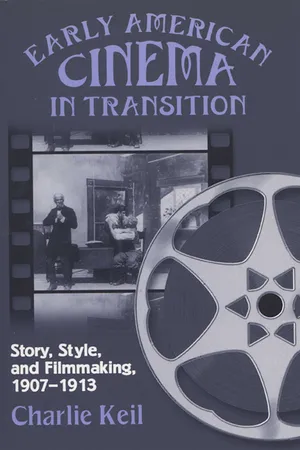
The period 1907–1913 marks a crucial transitional moment in American cinema. As moving picture shows changed from mere novelty to an increasingly popular entertainment, fledgling studios responded with longer running times and more complex storytelling. A growing trade press and changing production procedures also influenced filmmaking. In Early American Cinema in Transition, Charlie Keil looks at a broad cross-section of fiction films to examine the formal changes in cinema of this period and the ways that filmmakers developed narrative techniques to suit the fifteen-minute, one-reel format.
Keil outlines the kinds of narratives that proved most suitable for a single reel's duration, the particular demands that time and space exerted on this early form of film narration, and the ways filmmakers employed the unique features of a primarily visual medium to craft stories that would appeal to an audience numbering in the millions. He underscores his analysis with a detailed look at six films: The Boy Detective; The Forgotten Watch; Rose O'Salem-Town; Cupid's Monkey Wrench; Belle Boyd, A Confederate Spy; and Suspense.
- 321 pages
- English
- PDF
- Available on iOS & Android
eBook - PDF
About this book
Information
Publisher
University of Wisconsin PressYear
2001Print ISBN
9780299173647
9780299173609
eBook ISBN
9780299173630
Subtopic
Film History & CriticismTable of contents
- Contents
- Tables
- Acknowledgments
- 1. Introduction
- 2. “Boom Time in the Moving-Picture Business” : Industrial Structure, Production Practices, and the Trade Press
- 3. “A Story Vital and Unified in Its Action” : The Demands of Narrative
- 4. “An Immeasurably Greater Freedom” : Time and Space in Transitional Cinema
- 5. “The Modern Technique of the Art” : The Style of Transitional Cinema
- 6. Analyzing Transition: Six Sample Films
- 7. Conclusion
- Appendix A: Notes on Method
- Appendix B: Shot-by-Shot Analyses for Chapter 6
- Notes
- Filmography: Viewed Titles, 1907–1913
- Works Cited
- Film Index
- General Index
Trusted by 375,005 students
Access to over 1.5 million titles for a fair monthly price.
Study more efficiently using our study tools.
Frequently asked questions
Yes, you can cancel anytime from the Subscription tab in your account settings on the Perlego website. Your subscription will stay active until the end of your current billing period. Learn how to cancel your subscription
No, books cannot be downloaded as external files, such as PDFs, for use outside of Perlego. However, you can download books within the Perlego app for offline reading on mobile or tablet. Learn how to download books offline
Perlego offers two plans: Essential and Complete
- Essential is ideal for learners and professionals who enjoy exploring a wide range of subjects. Access the Essential Library with 800,000+ trusted titles and best-sellers across business, personal growth, and the humanities. Includes unlimited reading time and Standard Read Aloud voice.
- Complete: Perfect for advanced learners and researchers needing full, unrestricted access. Unlock 1.5M+ books across hundreds of subjects, including academic and specialized titles. The Complete Plan also includes advanced features like Premium Read Aloud and Research Assistant.
We are an online textbook subscription service, where you can get access to an entire online library for less than the price of a single book per month. With over 1.5 million books across 990+ topics, we’ve got you covered! Learn about our mission
Look out for the read-aloud symbol on your next book to see if you can listen to it. The read-aloud tool reads text aloud for you, highlighting the text as it is being read. You can pause it, speed it up and slow it down. Learn more about Read Aloud
Yes! You can use the Perlego app on both iOS and Android devices to read anytime, anywhere — even offline. Perfect for commutes or when you’re on the go.
Please note we cannot support devices running on iOS 13 and Android 7 or earlier. Learn more about using the app
Please note we cannot support devices running on iOS 13 and Android 7 or earlier. Learn more about using the app
Yes, you can access Early American Cinema in Transition by Charlie Keil in PDF and/or ePUB format, as well as other popular books in Media & Performing Arts & Film History & Criticism. We have over 1.5 million books available in our catalogue for you to explore.