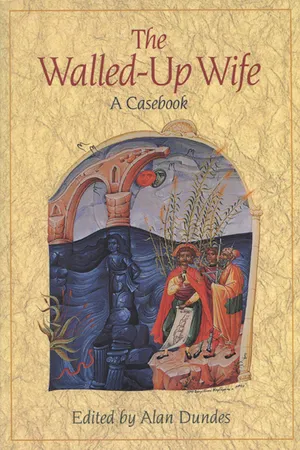
For centuries, many Indo-European peoples have sung a poignant ballad about the tragic sacrifice of a female victim to ensure the successful completion of an important undertaking, such as the construction of a building, bridge, or well. The legend, and its many regional and stylistic variations throughout Eastern Europe and India, provides material for an original and engaging casebook of interpretations by folklorists, anthropologists, scholars of comparative religion, and literary critics.
Alan Dundes brings together eighteen essays on this classic ballad, each introduced by his headnotes. Some contributors offer competing nationalistic claims concerning the ballad's origin, claims now in dispute because of previously overlooked South Asian versions; Ruth Mandel examines gender and power issues in the ballad; Lyubomira Parpulova-Gribble presents a structuralist reading; Krstivoj Kotur proposes a Christian interpretation; Mircea Eliade advocates a myth-ritual reading of blood sacrifices with cosmogonic connections in the Romanian text; and other readings explore female victimization and heroism by seeing the ballad's theme as a metaphor for marriage, a male-constructed trap seriously restricting women's freedom and mobility. Dundes concludes the collection with his own feminist and psychoanalytic interpretations of the ballad, followed by suggestions for further reading.
By emphasizing the ballad's variant forms in diverse cultural contexts, analyzed from different disciplinary perspectives, this volume asks students of folklore to be aware of the multiplicity of approaches available to them in researching folk narrative.
eBook - PDF
About this book
Information
Publisher
University of Wisconsin PressYear
1996Print ISBN
9780299150747
9780299150709
eBook ISBN
9780299150730
Table of contents
- Contents
- Preface
- "The Building of Skadar"
- Three Santal Tales
- "Story of the Bridge"
- "The Song of the Bridge"
- The Foundation Sacrifice Motif in Legend, Folksong, Game, and Dance
- The Greek Ballad "The Bridge of Arta" as Myth
- "Master Manole and the Monastery of Argeş"
- Beyond the Pale: Boundaries in the "Monastirea Argeşului"
- The Wall and the Water: Marginalia to "Master Manole"
- "Kulh" (The Waterway): A Basketmaker's Ballad from Kangra, Northwest India
- "Keregehara" (A Feast for the Well): A Kannada Ballad from South India
- "Kerege Haara"—A Tribute
- The Awareness of Values in Folk Poetry: "Kerege Hara"
- The Value of Innocent Sacrifice: The Christian Moment in the Poem "The Erection of Skutari"
- Moral Vision in the Serbian Folk Epic: The Foundation Sacrifice of Skadar
- "Sacrifice at the Bridge of Arta": Sex Roles and the Manipulation of Power
- The Ballad of "The Walled-Up Wife": Its Structure and Semantics
- The Ballad of "The Walled-Up Wife"
- A Selected Bibliography: Suggestions for Further Reading on "The Walled-Up Wife"
- Index
Trusted by 375,005 students
Access to over 1.5 million titles for a fair monthly price.
Study more efficiently using our study tools.
Frequently asked questions
Yes, you can cancel anytime from the Subscription tab in your account settings on the Perlego website. Your subscription will stay active until the end of your current billing period. Learn how to cancel your subscription
No, books cannot be downloaded as external files, such as PDFs, for use outside of Perlego. However, you can download books within the Perlego app for offline reading on mobile or tablet. Learn how to download books offline
Perlego offers two plans: Essential and Complete
- Essential is ideal for learners and professionals who enjoy exploring a wide range of subjects. Access the Essential Library with 800,000+ trusted titles and best-sellers across business, personal growth, and the humanities. Includes unlimited reading time and Standard Read Aloud voice.
- Complete: Perfect for advanced learners and researchers needing full, unrestricted access. Unlock 1.5M+ books across hundreds of subjects, including academic and specialized titles. The Complete Plan also includes advanced features like Premium Read Aloud and Research Assistant.
We are an online textbook subscription service, where you can get access to an entire online library for less than the price of a single book per month. With over 1.5 million books across 990+ topics, we’ve got you covered! Learn about our mission
Look out for the read-aloud symbol on your next book to see if you can listen to it. The read-aloud tool reads text aloud for you, highlighting the text as it is being read. You can pause it, speed it up and slow it down. Learn more about Read Aloud
Yes! You can use the Perlego app on both iOS and Android devices to read anytime, anywhere — even offline. Perfect for commutes or when you’re on the go.
Please note we cannot support devices running on iOS 13 and Android 7 or earlier. Learn more about using the app
Please note we cannot support devices running on iOS 13 and Android 7 or earlier. Learn more about using the app
Yes, you can access Walled-Up Wife by Alan Dundes in PDF and/or ePUB format, as well as other popular books in Social Sciences & Folklore & Mythology. We have over 1.5 million books available in our catalogue for you to explore.