Die Jahre 1550–1552 waren aus heutiger Sicht Schicksalsjahre der Reformation. Wenige Jahre nach dem Tod Luthers und der Niederlage der Protestanten im Schmalkaldischen Krieg war Kaiser Karl V. gewillt, die religionspolitischen Streitigkeiten auf der Fortsetzung des Trienter Konzils endgültig beizulegen. Philipp Melanchthon wurde als religionspolitischer Berater des Kurfürsten Moritz von Sachsen mit den Vorbereitungen auf eine Teilnahme betraut. Dafür verfasste Melanchthon nicht nur mit der Confessio Saxonica eine neue Bekenntnisschrift, sondern bemühte sich auch um eine abgestimmte evangelische Konzilsvorbereitung. Dass es schließlich nicht zu diesem Besuch kam, ist Moritz von Sachsen zuzuschreiben, der sich für eine militärische Intervention gegen den Kaiser entschied. Auch wenn diese riskante Unternehmung erfolgreich verlief, haderte Melanchthon auch noch nach dem Abschluss des Passauer Vertrags mit diesem Vorgehen.[Melanchthon's Religious-Political Activities between the Interim and the Treaty of Passau]From today's perspective, the years 1550–1552 were crucial years for the Reformation. A few years after Luther's death and the defeat of the Protestants in the Schmalkaldic War, Emperor Charles V was willing to finally settle the religious-political disputes at the continuation of the Council of Trent. Philipp Melanchthon was entrusted with the preparations for participation as religious-political advisor to the Kurfürst Moritz of Saxony. For this purpose, Melanchthon not only wrote a new confession, the Confessio Saxonica, but also made efforts to coordinate Protestant preparations for the Council. The fact that it finally did not come to a visit is attributable to Moritz of Saxony, who decided in favor of a military intervention against the emperor. Even though this risky venture was successful, Melanchthon continued to resent this course of action even after the Treaty of Passau was concluded.
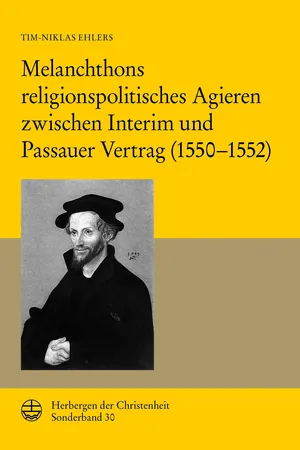
eBook - PDF
Melanchthons religionspolitisches Agieren zwischen Interim und Passauer Vertrag (1550–1552)
- 353 pages
- English
- PDF
- Available on iOS & Android
eBook - PDF
Melanchthons religionspolitisches Agieren zwischen Interim und Passauer Vertrag (1550–1552)
About this book
Information
Table of contents
- Frontmatter
- KAPITEL 1: ANALYSE DER HISTORISCHEN UND THEOLOGISCHEN VORAUSSETZUNGEN
- KAPITEL 2: DIE KONZILFRAGE IM UMFELD DES AUGSBURGER REICHTAGS 1550/51
- KAPITEL 3: DIE VORBEREITUNG KURSACHSENS AUF DIE ZWEITE TRIENTER TAGUNGSPERIODE
- KAPITEL 4: DIE CONFESSIO SAXONIA
- KAPITEL 5: DAS SCHEITERN DES KONZILS
- KAPITEL 6: DER FÜRSTENKRIEG UND SEINE FOLGEN
- KAPITEL 7: MELANCHTHONS EINSATZ FÜR DEN PROTESTANTISMUS
- Backmatter
Trusted by 375,005 students
Access to over 1.5 million titles for a fair monthly price.
Study more efficiently using our study tools.
Frequently asked questions
Yes, you can cancel anytime from the Subscription tab in your account settings on the Perlego website. Your subscription will stay active until the end of your current billing period. Learn how to cancel your subscription
No, books cannot be downloaded as external files, such as PDFs, for use outside of Perlego. However, you can download books within the Perlego app for offline reading on mobile or tablet. Learn how to download books offline
Perlego offers two plans: Essential and Complete
- Essential is ideal for learners and professionals who enjoy exploring a wide range of subjects. Access the Essential Library with 800,000+ trusted titles and best-sellers across business, personal growth, and the humanities. Includes unlimited reading time and Standard Read Aloud voice.
- Complete: Perfect for advanced learners and researchers needing full, unrestricted access. Unlock 1.5M+ books across hundreds of subjects, including academic and specialized titles. The Complete Plan also includes advanced features like Premium Read Aloud and Research Assistant.
We are an online textbook subscription service, where you can get access to an entire online library for less than the price of a single book per month. With over 1.5 million books across 990+ topics, we’ve got you covered! Learn about our mission
Look out for the read-aloud symbol on your next book to see if you can listen to it. The read-aloud tool reads text aloud for you, highlighting the text as it is being read. You can pause it, speed it up and slow it down. Learn more about Read Aloud
Yes! You can use the Perlego app on both iOS and Android devices to read anytime, anywhere — even offline. Perfect for commutes or when you’re on the go.
Please note we cannot support devices running on iOS 13 and Android 7 or earlier. Learn more about using the app
Please note we cannot support devices running on iOS 13 and Android 7 or earlier. Learn more about using the app
Yes, you can access Melanchthons religionspolitisches Agieren zwischen Interim und Passauer Vertrag (1550–1552) by Tim-Niklas Ehlers in PDF and/or ePUB format, as well as other popular books in Theology & Religion & Christian Theology. We have over 1.5 million books available in our catalogue for you to explore.