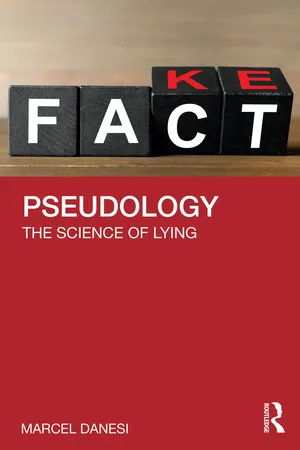
Pseudology
eBook - ePub

Pseudology

The Science of Lying

  1. 186 pages
  2. English
  3. ePUB (mobile friendly)
  4. Available on iOS & Android
eBook - ePub

Pseudology

The Science of Lying

About this book

In an age where fake news, conspiracy theories, and outright lies by political and cultural leaders are commonplace, we may be becoming accustomed to lying, or worse, even immune to it. Pseudology unravels the reasons for this by describing a "science of lying" that looks at various aspects of this trait, from how it affects the brain to how it distorts perception.

Interest in lying goes back to antiquity and writing and debate has only increased in the present day, but what is missing is a treatment that synthesizes the work from linguists, political scientists, anthropologists, psychologists, neuroscientists, and sociologists, tying them to the philosophical and literary views of lying throughout history. Such a treatment can be called "pseudology": an interdisciplinary science for classifying, collating, and assessing ideas about lying. This book is a comprehensive treatment of pseudology, emphasising the importance of studying lying in our current climate. Pseudology addresses questions such as:

• What is a lie?

• Why do we lie?

• Why are we so susceptible to lying?

• How does lying activate false beliefs and generate hatred of others?

• How has lying shaped the course of history (at least to some extent)?

• How has lying been adopted as a basic thematic element in literature and the arts?

Synthesising research from a broad range of disciplines and from the perspective of a leading cognitive linguist, this text weaves ideas and theories about lying cohesively into an overall interdisciplinary science. This landmark book is vital for students and scholars of language as well as anyone interested in politics, sociology, or psychology.

Frequently asked questions

Yes, you can cancel anytime from the Subscription tab in your account settings on the Perlego website. Your subscription will stay active until the end of your current billing period. Learn how to cancel your subscription.
No, books cannot be downloaded as external files, such as PDFs, for use outside of Perlego. However, you can download books within the Perlego app for offline reading on mobile or tablet. Learn more here.
Perlego offers two plans: Essential and Complete
  • Essential is ideal for learners and professionals who enjoy exploring a wide range of subjects. Access the Essential Library with 800,000+ trusted titles and best-sellers across business, personal growth, and the humanities. Includes unlimited reading time and Standard Read Aloud voice.
  • Complete: Perfect for advanced learners and researchers needing full, unrestricted access. Unlock 1.4M+ books across hundreds of subjects, including academic and specialized titles. The Complete Plan also includes advanced features like Premium Read Aloud and Research Assistant.
Both plans are available with monthly, semester, or annual billing cycles.
We are an online textbook subscription service, where you can get access to an entire online library for less than the price of a single book per month. With over 1 million books across 1000+ topics, we’ve got you covered! Learn more here.
Look out for the read-aloud symbol on your next book to see if you can listen to it. The read-aloud tool reads text aloud for you, highlighting the text as it is being read. You can pause it, speed it up and slow it down. Learn more here.
Yes! You can use the Perlego app on both iOS or Android devices to read anytime, anywhere — even offline. Perfect for commutes or when you’re on the go.
Please note we cannot support devices running on iOS 13 and Android 7 or earlier. Learn more about using the app.
Yes, you can access Pseudology by Marcel Danesi in PDF and/or ePUB format, as well as other popular books in Languages & Linguistics & Linguistics. We have over one million books available in our catalogue for you to explore.

Table of contents

  1. Cover
  2. Half Title
  3. Title Page
  4. Copyright Page
  5. Table of Contents
  6. Introduction
  7. 1. The Phenomenon of Lying
  8. 2. Neuroscientific Aspects
  9. 3. Semantic and Discursive Tactics
  10. 4. Psychological Tactics
  11. 5. Mass Psychological Schemes
  12. 6. False Narrativity
  13. 7. Con Artistry
  14. 8. Pathological Lying
  15. 9. Biological Aspects
  16. 10. Lying in Literature and Popular Culture
  17. Conclusion
  18. Index