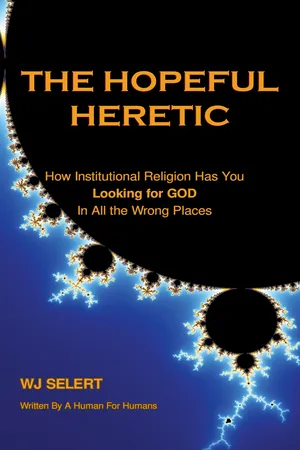
The Hopeful Heretic
eBook - ePub

The Hopeful Heretic

How Institutional Religions Have You Looking For God In All The Wrong Places

  1. English
  2. ePUB (mobile friendly)
  3. Available on iOS & Android
eBook - ePub

The Hopeful Heretic

How Institutional Religions Have You Looking For God In All The Wrong Places

About this book

Why do "peace-loving" religions so often cause instability, conflict, and violence?

The Hopeful Heretic explores the history and evolution of western institutional religion, providing the context, language, and arguments free societies need to understand and inoculate themselves against resurgent religious fanaticism in the 21st Century.

Book I examines the invention of institutional religion as a social governance operating system built around the human need to understand our place in the Universe. From pre-historic nature-based religions to structured polytheism to the main western institutional monotheistic religions, Th Hopeful Heretic charts the history, innovations, key features, and inherent defects of those systems, demonstrating each is man-made, inherently divisive, and prone to chronic instability and conflict.

Book II surveys the immense body of scientific knowledge accumulated since the questionable mythologies of our ancestors became generationally entrenched. From Newtonian Physics to Quantum Mechanics, Deep Field Astronomy, and Emergent Intelligence, the Hopeful Heretic argues that spirituality and meaning can be found without the need for "blind faith" by appreciating the scientific fact that life is a pre-programmed feature of a sublimely beautiful Universal Operating System and that we may all be part of and contributing to a living Universal Being.

A fascinating tour through history, religion, politics and science.

Frequently asked questions

Yes, you can cancel anytime from the Subscription tab in your account settings on the Perlego website. Your subscription will stay active until the end of your current billing period. Learn how to cancel your subscription.
No, books cannot be downloaded as external files, such as PDFs, for use outside of Perlego. However, you can download books within the Perlego app for offline reading on mobile or tablet. Learn more here.
Perlego offers two plans: Essential and Complete
  • Essential is ideal for learners and professionals who enjoy exploring a wide range of subjects. Access the Essential Library with 800,000+ trusted titles and best-sellers across business, personal growth, and the humanities. Includes unlimited reading time and Standard Read Aloud voice.
  • Complete: Perfect for advanced learners and researchers needing full, unrestricted access. Unlock 1.4M+ books across hundreds of subjects, including academic and specialized titles. The Complete Plan also includes advanced features like Premium Read Aloud and Research Assistant.
Both plans are available with monthly, semester, or annual billing cycles.
We are an online textbook subscription service, where you can get access to an entire online library for less than the price of a single book per month. With over 1 million books across 1000+ topics, we’ve got you covered! Learn more here.
Look out for the read-aloud symbol on your next book to see if you can listen to it. The read-aloud tool reads text aloud for you, highlighting the text as it is being read. You can pause it, speed it up and slow it down. Learn more here.
Yes! You can use the Perlego app on both iOS or Android devices to read anytime, anywhere — even offline. Perfect for commutes or when you’re on the go.
Please note we cannot support devices running on iOS 13 and Android 7 or earlier. Learn more about using the app.
Yes, you can access The Hopeful Heretic by Whitney Selert,WJ Selert in PDF and/or ePUB format, as well as other popular books in Philosophy & Political Philosophy. We have over one million books available in our catalogue for you to explore.

Information

Table of contents

  1. Foreword
  2. Book I: The Evolution of Western Institutional Monotheism as a Social Governance Operating System
  3. Book II: Universal Biology and the Moment of Infinite Possibility