Internationally renowned for its pioneering role in the ecological restoration of tallgrass prairies, savannas, forests, and wetlands, the University of Wisconsin Arboretum contains the world's oldest and most diverse restored ecological communities. A site for land restoration research, public environmental education, and enjoyment by nature lovers, the arboretum remains a vibrant treasure in the heart of Madison's urban environment.
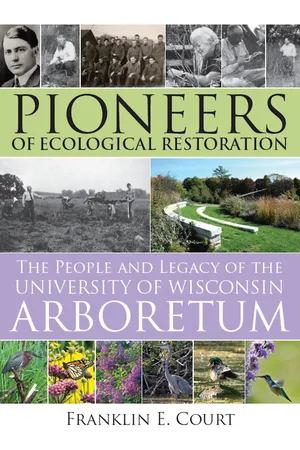
Pioneers of Ecological Restoration chronicles the history of the arboretum and the people who created, shaped, and sustained it up to the present. Although the arboretum was established by the University of Wisconsin in 1932, author Franklin E. Court begins his history in 1910 with John Nolen, the famous landscape architect who was invited to create plans for the city of Madison, the university campus, and Wisconsin state parks. Drawing extensive details from archives and interviews, Court follows decades of collaborative work related to the arboretum's lands, including the early efforts of Madison philanthropists and businessmen Michael Olbrich, Paul E. Stark, and Joseph W. "Bud" Jackson.
With labor from the Civilian Conservation Corps during the 1930s Depression, University of Wisconsin scientists began establishing both a traditional horticultural collection of trees and plants and a completely new, visionary approach to recreate native ecosystems. Hundreds of dedicated scientists and staff have carried forward the arboretum's mission in the decades since, among them G. William Longenecker, Aldo Leopold, John T. Curtis, Rosemary Fleming, Virginia Kline, and William R. Jordan III.
This archival record of the arboretum's history provides rare insights into how the mission of healing and restoring the land gradually shaped the arboretum's future and its global reputation; how philosophical conflicts, campus politics, changing priorities, and the encroaching city have affected the arboretum over the decades; and how early aspirations (some still unrealized) have continued to motivate the work of this extraordinary institution.
eBook - PDF
Pioneers of Ecological Restoration
The People and Legacy of the University of Wisconsin Arboretum
- 338 pages
- English
- PDF
- Available on iOS & Android
eBook - PDF
Pioneers of Ecological Restoration
The People and Legacy of the University of Wisconsin Arboretum
About this book
Information
Table of contents
- Contents
- List of Illustrations
- Preface
- Acknowledgments
- List of Abbreviations
- 1. The Beginnings: John Nolen, Michael Olbrich, Paul E. Stark, and the Prairie School of Landscape Design
- 2. 1930–1932: Acquiring the Land, Building the Road
- 3. 1932–1934: Pre-Dedication Years, Edward M. Gilbert, Aldo Leopold, G. William Longenecker, the Politics of Governance
- 4. 1934–1935: Two Directors, Dedication, Camp Madison, and the CCC
- 5. 1935: “Go Make a Prairie,” Fassett’s Planting Experiments, Sperry’s Fieldwork
- 6. Late 1930s: Frustrations, “Golden Years,” Efforts to Increase Funding
- 7. The 1940s: Curtis Years, Postwar Challenges, Leopold’s Death
- 8. The 1950s: Outside Threats, “the Beltline Cometh”
- 9. The 1960s: Last Lost City Lots, Building a Reputation, Shifting Focus
- 10. The 1970s: World Famous Prairies, Conflicts in Leadership, New Appointments and a Visitor Center
- 11. The 1980s and Beyond: A Restoration Ecology Legacy, “Earth Partnerships,” Reflections
- Notes
- Bibliography
- Index
Trusted by 375,005 students
Access to over 1.5 million titles for a fair monthly price.
Study more efficiently using our study tools.
Frequently asked questions
Yes, you can cancel anytime from the Subscription tab in your account settings on the Perlego website. Your subscription will stay active until the end of your current billing period. Learn how to cancel your subscription
No, books cannot be downloaded as external files, such as PDFs, for use outside of Perlego. However, you can download books within the Perlego app for offline reading on mobile or tablet. Learn how to download books offline
Perlego offers two plans: Essential and Complete
- Essential is ideal for learners and professionals who enjoy exploring a wide range of subjects. Access the Essential Library with 800,000+ trusted titles and best-sellers across business, personal growth, and the humanities. Includes unlimited reading time and Standard Read Aloud voice.
- Complete: Perfect for advanced learners and researchers needing full, unrestricted access. Unlock 1.5M+ books across hundreds of subjects, including academic and specialized titles. The Complete Plan also includes advanced features like Premium Read Aloud and Research Assistant.
We are an online textbook subscription service, where you can get access to an entire online library for less than the price of a single book per month. With over 1.5 million books across 990+ topics, we’ve got you covered! Learn about our mission
Look out for the read-aloud symbol on your next book to see if you can listen to it. The read-aloud tool reads text aloud for you, highlighting the text as it is being read. You can pause it, speed it up and slow it down. Learn more about Read Aloud
Yes! You can use the Perlego app on both iOS and Android devices to read anytime, anywhere — even offline. Perfect for commutes or when you’re on the go.
Please note we cannot support devices running on iOS 13 and Android 7 or earlier. Learn more about using the app
Please note we cannot support devices running on iOS 13 and Android 7 or earlier. Learn more about using the app
Yes, you can access Pioneers of Ecological Restoration by Franklin E. Court in PDF and/or ePUB format, as well as other popular books in Biological Sciences & Teaching Science & Technology. We have over 1.5 million books available in our catalogue for you to explore.