- 168 pages
- English
- ePUB (mobile friendly)
- Available on iOS & Android
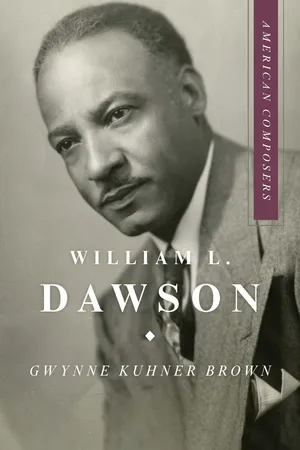
William L. Dawson
About this book
Born in 1899, Dawson studied at the Tuskegee Institute in Alabama. He worked as a church, jazz, and orchestral musician in Kansas City and Chicago in the 1920s while continuing his education as a composer. He then joined the Tuskegee faculty, where for 25 years he led the Tuskegee Institute Choir to national prominence through performances of spirituals at the opening of Radio City Music Hall, on radio and television, and at the White House. The Philadelphia Orchestra conducted by Leopold Stokowski premiered Dawson's Negro Folk Symphony in 1934.
Engaging and long overdue, William L. Dawson celebrates a pioneering Black composer whose contributions to African American music, history, and education inspire performers and audiences to this day.
Frequently asked questions
- Essential is ideal for learners and professionals who enjoy exploring a wide range of subjects. Access the Essential Library with 800,000+ trusted titles and best-sellers across business, personal growth, and the humanities. Includes unlimited reading time and Standard Read Aloud voice.
- Complete: Perfect for advanced learners and researchers needing full, unrestricted access. Unlock 1.4M+ books across hundreds of subjects, including academic and specialized titles. The Complete Plan also includes advanced features like Premium Read Aloud and Research Assistant.
Please note we cannot support devices running on iOS 13 and Android 7 or earlier. Learn more about using the app.
Information
Table of contents
- Cover Page
- Title Page
- Copyright Page
- Dedication
- Contents
- Preface
- Acknowledgments
- Introduction
- 1. Early Life
- 2. Tuskegee
- 3. Vocal Music
- 4. Instrumental Music
- 5. After Tuskegee
- Notes
- Select Discography
- Works
- Sources and Bibliography
- Index