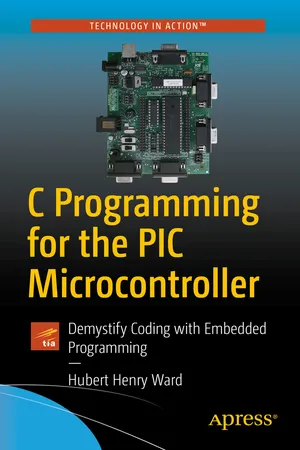
C Programming for the PIC Microcontroller
eBook - ePub

C Programming for the PIC Microcontroller

Demystify Coding with Embedded Programming

  1. English
  2. ePUB (mobile friendly)
  3. Available on iOS & Android
eBook - ePub

C Programming for the PIC Microcontroller

Demystify Coding with Embedded Programming

About this book

Go beyond the jigsaw approach of just using blocks of code you don't understand and become a programmer who really understands how your code works.
Starting with the fundamentals on C programming, this book walks you through where the C language fits with microcontrollers. Next, you'll see how to use the industrial IDE, create and simulate a project, and download your program to an actual PIC microcontroller.
You'll then advance into the main process of a C program and explore in depth the most common commands applied to a PIC microcontroller and see how to use the range of control registers inside the PIC. With C Programming for the PIC Microcontroller as your guide, you'll become a better programmer who can truly say they have written and understand the code they use.
What You'll Learn

  • Use the freely available MPLAX software
  • Build a project and writea program using inputs from switches
  • Create a variable delay with the oscillator source
  • Measure real-world signals using pressure, temperature, and speed inputs
  • Incorporate LCD screens into your projects
  • Apply what you've learned into a simple embedded program

Who This Book Is For
Hobbyists who want to move into the challenging world of embedded programming or students on an engineering course.

Frequently asked questions

Yes, you can cancel anytime from the Subscription tab in your account settings on the Perlego website. Your subscription will stay active until the end of your current billing period. Learn how to cancel your subscription.
At the moment all of our mobile-responsive ePub books are available to download via the app. Most of our PDFs are also available to download and we're working on making the final remaining ones downloadable now. Learn more here.
Perlego offers two plans: Essential and Complete
  • Essential is ideal for learners and professionals who enjoy exploring a wide range of subjects. Access the Essential Library with 800,000+ trusted titles and best-sellers across business, personal growth, and the humanities. Includes unlimited reading time and Standard Read Aloud voice.
  • Complete: Perfect for advanced learners and researchers needing full, unrestricted access. Unlock 1.4M+ books across hundreds of subjects, including academic and specialized titles. The Complete Plan also includes advanced features like Premium Read Aloud and Research Assistant.
Both plans are available with monthly, semester, or annual billing cycles.
We are an online textbook subscription service, where you can get access to an entire online library for less than the price of a single book per month. With over 1 million books across 1000+ topics, we’ve got you covered! Learn more here.
Look out for the read-aloud symbol on your next book to see if you can listen to it. The read-aloud tool reads text aloud for you, highlighting the text as it is being read. You can pause it, speed it up and slow it down. Learn more here.
Yes! You can use the Perlego app on both iOS or Android devices to read anytime, anywhere — even offline. Perfect for commutes or when you’re on the go.
Please note we cannot support devices running on iOS 13 and Android 7 or earlier. Learn more about using the app.
Yes, you can access C Programming for the PIC Microcontroller by Hubert Henry Ward in PDF and/or ePUB format, as well as other popular books in Computer Science & Hardware. We have over one million books available in our catalogue for you to explore.

Information

Publisher
Apress
Year
2019
Print ISBN
9781484255247
eBook ISBN
9781484255254

Table of contents

  1. Cover
  2. Front Matter
  3. 1. Introduction
  4. 2. Our First Program
  5. 3. Updating the Program
  6. 4. Applying What We’ve Learned
  7. 5. Real-World Inputs
  8. 6. Using the LCD
  9. 7. Creating a Header File
  10. 8. Understanding Some Useful Code
  11. Back Matter