eBook - ePub
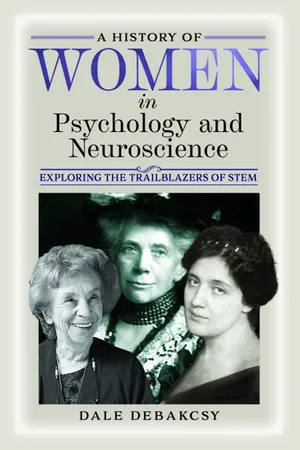
A History of Women in Psychology and Neuroscience
Exploring the Trailblazers of STEM
- 224 pages
- English
- ePUB (mobile friendly)
- Available on iOS & Android
eBook - ePub
About this book
Since virtually its first moments as an academic science, women have played a major role in the development of psychology, gaining from the outset research opportunities and academic positions that had been denied them for centuries in other branches of scientific investigation. Look wherever you will, in any branch of psychology or neuroscience in the last century and a half, and what you will find are a plethora of women whose discoveries fundamentally changed how we view the brain and its role in the formation of our perceptions and behaviors. A History of Women in Psychology and Neuroscience tells the story of 267 women whose work opened new doors in humanity's ongoing attempt to learn about its own nature, from Christine Ladd Franklin's late 19th century studies of how the brain perceives color to Virginia Johnson's pioneering studies of the human sexual response, and Augusta Dejerine-Klumpke's early association of neurological conditions with their underlying brain regions to May-Britt Moser's Nobel-winning discovery a century later of the grid cells that allow us to mentally model our surroundings. Here are the stories of when and how we learned how memories are formed, what role an enriched environment plays in mental development, why some individuals are better able to cope with chronic stress than others, how societal stereotypes unconsciously feed into our daily interactions with other people, what role evolution might have played in the formation of our social habits, what light the practices of sign language might shed on our brain's basic capacity for language, how children internalize the violence they experience from others, and hundreds of other tales of the women who dug deep into the structures of the human mind to uncover, layer by layer, the answers to millennia-old questions of what humans are, and why they behave as they do.
Information
Subtopic
Women in HistoryIndex
HistoryTable of contents
- Cover
- Title
- Copyright
- Dedication
- Contents
- Introduction
- Chapter 1 Christine Ladd-Franklin and the Colour Wars of the Late Nineteenth Century
- Chapter 2 The Woman of a Thousand Brains: Augusta Déjerine-Klumpke, Pioneer Neuroscientist
- Chapter 3 Self-Remembrance: Mary Whiton Calkins’s Adventures Among the Atomists
- Chapter 4 The Two Montessoris: The Rise, Fall and Rebirth of an Educational Revolution
- Chapter 5 Margaret Floy Washburn and the Motion of Thought
- Chapter 6 Generations: The Neuroscience Dynasty of Cécile and Marthe Vogt
- Chapter 7 Brief Portraits: The Nineteenth Century
- Chapter 8 Workers as Humans: Lillian Moller Gilbreth and the Founding of Industrial Psychology
- Chapter 9 Filled With People: The Teeming Mental Spaces of Melanie Klein
- Chapter 10 Helene Deutsch, As-If Personalities, Adolescent Friendship and the Art of the Quiet Revolution
- Chapter 11 Speaking Culture to Psychoanalysis: Karen Horney’s Gender Revolution
- Chapter 12 Bringing Science to Psychoanalysis: The Many Survivals of Sabina Spielrein
- Chapter 13 Tsuruko Haraguchi: The Strenuous Road to Becoming Japan’s First Woman Doctor of Psychology
- Chapter 14 Of Gifted Children and the Banality of Menstruation: The Educational Psychology of Leta Hollingworth
- Chapter 15 Come Together? Inez Prosser and the Psychological Impact of Mixed Schooling Systems
- Chapter 16 Children are People: The Life and Science of Anna Freud
- Chapter 17 Neuroembryology in Wartime: Rita Levi-Montalcini and the Discovery of Nerve Growth Factor
- Chapter 18 Mary Ainsworth, Infant Anxiety and the Case of the ‘Strange Situation’
- Chapter 19 Separate: Mamie Phipps Clark and the Psychology of American Segregation
- Chapter 20 Virginia Satir and the Art of Family Communication
- Chapter 21 More than the Sum of their Parts: Eleanor Maccoby’s Studies of Children in Groups and the Adults they Become
- Chapter 22 Building a Kingdom in the Brain’s Unfashionable District: Brenda Milner’s Century of Neuropsychology
- Chapter 23 Edith Graef McGeer, the Great Neurotransmitter Race and a Glimpse towards the End of Alzheimer’s
- Chapter 24 Virginia Johnson and the Development of Effective Sex Therapy
- Chapter 25 Beyond Nature vs. Nurture: The Enriched Heredity of Marian Cleeves Diamond and the Evolutionary Psychology of Leda Cosmides
- Chapter 26 Brief Portraits: The Early Twentieth Century
- Chapter 27 Signs: Ursula Bellugi and the Neuroscience of Language
- Chapter 28 When Memory Has Gone: Suzanne Corkin’s Journeys through the Hippocampus
- Chapter 29 Filling in the Gaps: Naomi Weisstein’s Active Brains and Activist Life
- Chapter 30 Making Working Memory Work: The Multidisciplinary Neuroscience of Patricia Goldman-Rakic
- Chapter 31 Life on the Grid: Nobel Laureate May-Britt Moser and the Fine Art of Knowing Where You Are
- Chapter 32 Dr. Tania Singer and the Neuroscience of Empathy
- Chapter 33 Dealing: Dr. Iris Mauss and the Science of Emotion Regulation
- Chapter 34 Brains In Love and Brains Alone: The Social Neuroscience of Stephanie Cacioppo
- Chapter 35 Achtung, Brainy: Grace Lindsay and the Mathematical Modeling of the Human Brain
- Chapter 36 Brief Portraits: The Modern Age
- So… What Does That Mean?: A Glossary of Frequently Used But Kind of Weird Terms
- Selected Bibliography
- Plates Section
Trusted by 375,005 students
Access to over 1.5 million titles for a fair monthly price.
Study more efficiently using our study tools.
Frequently asked questions
Yes, you can cancel anytime from the Subscription tab in your account settings on the Perlego website. Your subscription will stay active until the end of your current billing period. Learn how to cancel your subscription
No, books cannot be downloaded as external files, such as PDFs, for use outside of Perlego. However, you can download books within the Perlego app for offline reading on mobile or tablet. Learn how to download books offline
We are an online textbook subscription service, where you can get access to an entire online library for less than the price of a single book per month. With over 1.5 million books across 990+ topics, we’ve got you covered! Learn about our mission
Look out for the read-aloud symbol on your next book to see if you can listen to it. The read-aloud tool reads text aloud for you, highlighting the text as it is being read. You can pause it, speed it up and slow it down. Learn more about Read Aloud
Yes! You can use the Perlego app on both iOS and Android devices to read anytime, anywhere — even offline. Perfect for commutes or when you’re on the go.
Please note we cannot support devices running on iOS 13 and Android 7 or earlier. Learn more about using the app
Please note we cannot support devices running on iOS 13 and Android 7 or earlier. Learn more about using the app
Yes, you can access A History of Women in Psychology and Neuroscience by Dale DeBakcsy in PDF and/or ePUB format, as well as other popular books in History & Women in History. We have over 1.5 million books available in our catalogue for you to explore.