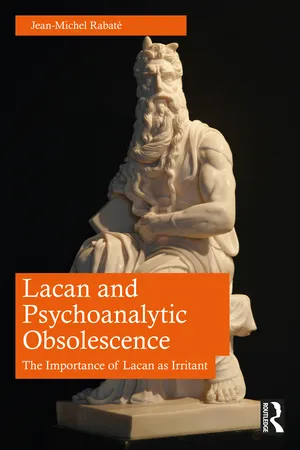
Lacan and Psychoanalytic Obsolescence
The Importance of Lacan as Irritant
- 216 pages
- English
- ePUB (mobile friendly)
- Available on iOS & Android
About this book
This book explores the importance of Lacan's role as an irritant within psychoanalysis, and how Freud and Lacan saw that as key to ensuring that psychoanalysis remained fresh and vital rather than becoming obsolescent.
Drawing on Freud's thinking as well as Lacan's, Rabate examines how Lacan's unwillingness to allow psychoanalytic thinking to become stale or pigeonholed into one part of life was key in his thinking. By constantly returning to psychoanalytic ideas in new and evolving ways, Lacan kept psychoanalysis moving and changing, much as Socrates did for philosophical thinking in classical Athens. This 'gadfly' or irritant role gave him free reign to explore all aspects of psychoanalytic thinking and treatment, and how it can permeate all aspects of life, both in the consulting room and beyond.
Drawing on a deep understanding of Lacan's work as well as Freud's, this book is key reading for all those seeking to understand why Lacan's work remains so important and so challenging for contemporary psychoanalysis.
Frequently asked questions
- Essential is ideal for learners and professionals who enjoy exploring a wide range of subjects. Access the Essential Library with 800,000+ trusted titles and best-sellers across business, personal growth, and the humanities. Includes unlimited reading time and Standard Read Aloud voice.
- Complete: Perfect for advanced learners and researchers needing full, unrestricted access. Unlock 1.4M+ books across hundreds of subjects, including academic and specialized titles. The Complete Plan also includes advanced features like Premium Read Aloud and Research Assistant.
Please note we cannot support devices running on iOS 13 and Android 7 or earlier. Learn more about using the app.
Information
Table of contents
- Cover Page
- Half Title page
- Title Page
- Copyright Page
- Contents
- Preface
- Acknowledgments
- Introduction: Irritations
- Chapter 1 Psychoanalysis as irritant translation
- Chapter 2 Freud’s irritations
- Chapter 3 Affects and their vicissitudes
- Chapter 4 Cruor, or the cruel fictionof psychoanalysis
- Chapter 5 Irritating Kant with Sade, irritating Sade with Kant
- Chapter 6 Lacan’s quarrel with Nancy and posthumous victory
- Chapter 7 “Perpetual translation made language”: Lacan’s response to deconstruction in “Lituraterre”
- Conclusion: “I am a poem, not a poet”: Lacan’s autopoiesis
- Index