Honorable Mention for the 2025 LASA Mexico Section for Best Book in the Humanities
During Porfirio Díaz’s thirty-year rule, Mexico dealt with the press in disparate ways in hopes of forging an informed and, above all, orderly citizenry. Even as innumerable journalists were sent to prison on exaggerated and unfair charges of defamation or slander, Díaz’s government subsidized multiple newspapers to expand literacy and to aggrandize the image of the regime.
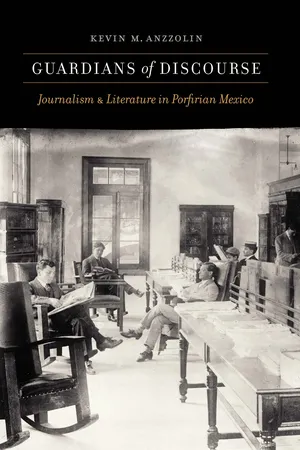
In Guardians of Discourse Kevin M. Anzzolin analyzes the role and representation of journalism in literary texts from Porfirian Mexico to argue that these writings created a literate, objective, refined, and informed public. By exploring works by Porfirian writers such as Emilio Rabasa, Ángel del Campo, Rafael Delgado, Laura Méndez de Cuenca, and Salvador Quevedo y Zubieta, Anzzolin demonstrates that a primary goal of the lettered class was to define and shape the character of public life, establish the social position of citizens, and interrogate the character of civil institutions.
These elite letrados—whom Anzzolin refers to as “guardians of discourse”—aimed to define the type of discourses that would buttress the transformed Mexico of the Díaz regime to forge a truly national literature that could be discussed among an expanded coterie of lettered thinkers. In addition, these Porfirian guardians hoped to construct an extensive and active public able to debate political and social issues via a press befitting a modern nation-state and create a press that would be independent, illuminating, and distinguished. Through an innovative look at Mexico’s public sphere via literary fiction in the Porfirian era, Anzzolin contributes to our knowledge of Mexican and Latin American political, cultural, and literary history in the late nineteenth and early twentieth centuries.
- 286 pages
- English
- ePUB (mobile friendly)
- Available on iOS & Android
eBook - ePub
About this book
Information
Table of contents
- Cover
- Frontispiece
- Title Page
- Copyright Page
- Epigraph
- Contents
- List of Illustrations
- Acknowledgments
- Introduction: Guardians of Discourse
- 1. Insane Journalism in Novelas mexicanas and Reproducciones
- 2. Insalubrious Journalism in Pacotillas and La cuarta plana
- 3. Reporterism as Social Death in La Rumba and La Calandria
- 4. Yellow Journalism and Female Sociability in the Narrative of Laura Méndez de Cuenca
- 5. Arnulfo Arroyo, the Subsidized Press, and Illocutionary Acts in Quevedo y Zubieta’s La camada
- Epilogue: The Public Sphere, or The Porfiriato’s Unfinished Project
- Notes
- Bibliography
- Index
- About Kevin M. Anzzolin
Trusted by 375,005 students
Access to over 1.5 million titles for a fair monthly price.
Study more efficiently using our study tools.
Frequently asked questions
Yes, you can cancel anytime from the Subscription tab in your account settings on the Perlego website. Your subscription will stay active until the end of your current billing period. Learn how to cancel your subscription
No, books cannot be downloaded as external files, such as PDFs, for use outside of Perlego. However, you can download books within the Perlego app for offline reading on mobile or tablet. Learn how to download books offline
Perlego offers two plans: Essential and Complete
- Essential is ideal for learners and professionals who enjoy exploring a wide range of subjects. Access the Essential Library with 800,000+ trusted titles and best-sellers across business, personal growth, and the humanities. Includes unlimited reading time and Standard Read Aloud voice.
- Complete: Perfect for advanced learners and researchers needing full, unrestricted access. Unlock 1.5M+ books across hundreds of subjects, including academic and specialized titles. The Complete Plan also includes advanced features like Premium Read Aloud and Research Assistant.
We are an online textbook subscription service, where you can get access to an entire online library for less than the price of a single book per month. With over 1.5 million books across 990+ topics, we’ve got you covered! Learn about our mission
Look out for the read-aloud symbol on your next book to see if you can listen to it. The read-aloud tool reads text aloud for you, highlighting the text as it is being read. You can pause it, speed it up and slow it down. Learn more about Read Aloud
Yes! You can use the Perlego app on both iOS and Android devices to read anytime, anywhere — even offline. Perfect for commutes or when you’re on the go.
Please note we cannot support devices running on iOS 13 and Android 7 or earlier. Learn more about using the app
Please note we cannot support devices running on iOS 13 and Android 7 or earlier. Learn more about using the app
Yes, you can access Guardians of Discourse by Kevin M. Anzzolin in PDF and/or ePUB format, as well as other popular books in History & Mexican History. We have over 1.5 million books available in our catalogue for you to explore.