2018 Choice Outstanding Academic Title
2019 Dwight L. Smith (ABC-CLIO) Award from the Western History Association
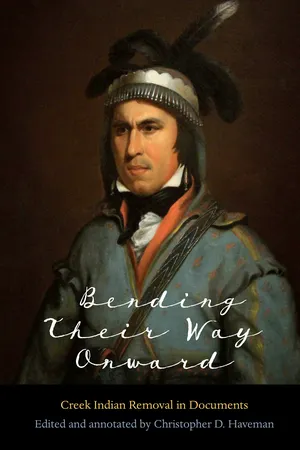
Between 1827 and 1837 approximately twenty-three thousand Creek Indians were transported across the Mississippi River, exiting their homeland under extreme duress and complex pressures. During the physically and emotionally exhausting journey, hundreds of Creeks died, dozens were born, and almost no one escaped without emotional scars caused by leaving the land of their ancestors.
Bending Their Way Onward is an extensive collection of letters and journals describing the travels of the Creeks as they moved from Alabama to present-day Oklahoma. This volume includes documents related to the “voluntary” emigrations that took place beginning in 1827 as well as the official conductor journals and other materials documenting the forced removals of 1836 and the coerced relocations of 1836 and 1837.
This volume also provides a comprehensive list of muster rolls from the voluntary emigrations that show the names of Creek families and the number of slaves who moved west. The rolls include many prominent Indian countrymen (such as white men married to Creek women) and Creeks of mixed parentage. Additional biographical data for these Creek families is included whenever possible. Bending Their Way Onward is the most exhaustive collection to date of previously unpublished documents related to this pivotal historical event.
- 864 pages
- English
- PDF
- Available on iOS & Android
eBook - PDF
About this book
Information
Table of contents
- Cover
- Title Page
- Copyright Page
- Contents
- List of Illustrations
- List of Maps
- Acknowledgments
- Introduction
- List of Abbreviations
- Part 1
- Part 2
- Part 3
- Part 4
- Part 5
- Notes
- Bibliography
- Index
Trusted by 375,005 students
Access to over 1.5 million titles for a fair monthly price.
Study more efficiently using our study tools.
Frequently asked questions
Yes, you can cancel anytime from the Subscription tab in your account settings on the Perlego website. Your subscription will stay active until the end of your current billing period. Learn how to cancel your subscription
No, books cannot be downloaded as external files, such as PDFs, for use outside of Perlego. However, you can download books within the Perlego app for offline reading on mobile or tablet. Learn how to download books offline
Perlego offers two plans: Essential and Complete
- Essential is ideal for learners and professionals who enjoy exploring a wide range of subjects. Access the Essential Library with 800,000+ trusted titles and best-sellers across business, personal growth, and the humanities. Includes unlimited reading time and Standard Read Aloud voice.
- Complete: Perfect for advanced learners and researchers needing full, unrestricted access. Unlock 1.5M+ books across hundreds of subjects, including academic and specialized titles. The Complete Plan also includes advanced features like Premium Read Aloud and Research Assistant.
We are an online textbook subscription service, where you can get access to an entire online library for less than the price of a single book per month. With over 1.5 million books across 990+ topics, we’ve got you covered! Learn about our mission
Look out for the read-aloud symbol on your next book to see if you can listen to it. The read-aloud tool reads text aloud for you, highlighting the text as it is being read. You can pause it, speed it up and slow it down. Learn more about Read Aloud
Yes! You can use the Perlego app on both iOS and Android devices to read anytime, anywhere — even offline. Perfect for commutes or when you’re on the go.
Please note we cannot support devices running on iOS 13 and Android 7 or earlier. Learn more about using the app
Please note we cannot support devices running on iOS 13 and Android 7 or earlier. Learn more about using the app
Yes, you can access Bending Their Way Onward by Christopher D. Haveman in PDF and/or ePUB format, as well as other popular books in Social Sciences & North American History. We have over 1.5 million books available in our catalogue for you to explore.