Defending Whose Country?
eBook - PDF

Defending Whose Country?

Indigenous Soldiers in the Pacific War

  1. 336 pages
  2. English
  3. PDF
  4. Available on iOS & Android
eBook - PDF

Defending Whose Country?

Indigenous Soldiers in the Pacific War

About this book

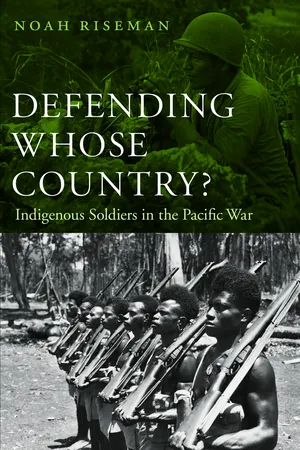
In the campaign against Japan in the Pacific during the Second World War, the armed forces of the United States, Australia, andthe Australian colonies of Papua and New Guinea made use of indigenous peoples in new capacities. The United States had long used American Indians as soldiers and scouts in frontier conflicts and in wars with other nations. With the advent of the Navajo Code Talkers in the Pacific theater, Native servicemen were now being employed for contributions that were unique to their Native cultures. In contrast, Australia, Papua, and New Guinea had long attempted to keep indigenous peoples out of the armed forces altogether. With the threat of Japanese invasion, however, they began to bring indigenous peoples into the military as guerilla patrollers, coastwatchers, and regular soldiers.

Defending Whose Country? is a comparative study of the military participation of Papua New Guineans, Yolngu, and Navajos in the Pacific theater. In examining the decisions of state and military leaders to bring indigenous peoples into military service, as well as the decisions of indigenous individuals to serve in the armed forces, Noah Riseman reconsiders the impact of the largely forgotten contributions of indigenous soldiers in the Second World War.

Frequently asked questions

Yes, you can cancel anytime from the Subscription tab in your account settings on the Perlego website. Your subscription will stay active until the end of your current billing period. Learn how to cancel your subscription.
No, books cannot be downloaded as external files, such as PDFs, for use outside of Perlego. However, you can download books within the Perlego app for offline reading on mobile or tablet. Learn more here.
Perlego offers two plans: Essential and Complete
  • Essential is ideal for learners and professionals who enjoy exploring a wide range of subjects. Access the Essential Library with 800,000+ trusted titles and best-sellers across business, personal growth, and the humanities. Includes unlimited reading time and Standard Read Aloud voice.
  • Complete: Perfect for advanced learners and researchers needing full, unrestricted access. Unlock 1.4M+ books across hundreds of subjects, including academic and specialized titles. The Complete Plan also includes advanced features like Premium Read Aloud and Research Assistant.
Both plans are available with monthly, semester, or annual billing cycles.
We are an online textbook subscription service, where you can get access to an entire online library for less than the price of a single book per month. With over 1 million books across 1000+ topics, we’ve got you covered! Learn more here.
Look out for the read-aloud symbol on your next book to see if you can listen to it. The read-aloud tool reads text aloud for you, highlighting the text as it is being read. You can pause it, speed it up and slow it down. Learn more here.
Yes! You can use the Perlego app on both iOS or Android devices to read anytime, anywhere — even offline. Perfect for commutes or when you’re on the go.
Please note we cannot support devices running on iOS 13 and Android 7 or earlier. Learn more about using the app.
Yes, you can access Defending Whose Country? by Noah Riseman in PDF and/or ePUB format, as well as other popular books in History & World War II. We have over one million books available in our catalogue for you to explore.

Information

Table of contents

  1. Title Page
  2. Copyright Page
  3. Contents
  4. List of Illustrations
  5. Preface
  6. List of Abbreviations
  7. Introduction: Reading Colonialism and Indigenous Involvement in the Second World War
  8. 1. An Exception in the Equation? Donald Thomson and the NTSRU
  9. 2. Allies at War: De Facto Yolngu Soldiers
  10. 3. Black Skins, Black Work: Papuan and New Guinean Labor
  11. 4. Guerillas for the White Men: Formal Papuan andNew Guinean Fighters
  12. 5. The Navajo Code Talkers: Warriors for the Settler Nation
  13. 6. When the War Was Over: Forgetting and (Re)membering the Code Talkers
  14. Conclusion: The Soldier-Warrior in Modern War
  15. Source Acknowledgments
  16. Notes
  17. Bibliography
  18. Index