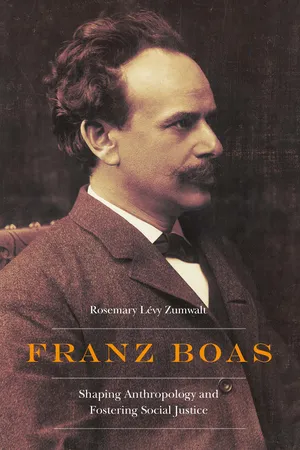
Franz Boas defined the concept of cultural relativism and reoriented the humanities and social sciences away from race science toward an antiracist and anticolonialist understanding of human biology and culture. Franz Boas: Shaping Anthropology and Fostering Social Justice is the second volume in Rosemary Lévy Zumwalt’s two-part biography of the renowned anthropologist and public intellectual.
Zumwalt takes the reader through the most vital period in the development of Americanist anthropology and Boas’s rise to dominance in the subfields of cultural anthropology, physical anthropology, ethnography, and linguistics. Boas’s emergence as a prominent public intellectual, particularly his opposition to U.S. entry into World War I, reveals his struggle against the forces of nativism, racial hatred, ethnic chauvinism, scientific racism, and uncritical nationalism.
Boas was instrumental in the American cultural renaissance of the 1920s and 1930s, training students and influencing colleagues such as Melville Herskovits, Zora Neale Hurston, Benjamin Botkin, Alan Lomax, Langston Hughes, and others involved in combating racism and the flourishing Harlem Renaissance. He assisted German and European émigré intellectuals fleeing Nazi Germany to relocate in the United States and was instrumental in organizing the denunciation of Nazi racial science and American eugenics. At the end of his career Boas guided a network of former student anthropologists, who spread across the country to university departments, museums, and government agencies, imprinting his social science more broadly in the world of learned knowledge.
Franz Boas is a magisterial biography of Franz Boas and his influence in shaping not only anthropology but also the sciences, humanities, social science, visual and performing arts, and America’s public sphere during a period of great global upheaval and democratic and social struggle.
- 645 pages
- English
- PDF
- Available on iOS & Android
eBook - PDF
About this book
Information
Table of contents
- Cover
- Title Page
- Copyright Page
- Contents
- List of Illustrations
- Series Editors’ Introduction
- Preface
- Acknowledgments
- Introduction
- Note on Translations
- 1. Building the Department of Anthropology at Columbia University
- 2. Franz Boas and His Early Students, 1901–1915
- 3. Race and the Quest for Social Justice
- 4. Folklore and Ruins in Mexico and Puerto Rico
- 5. Conflict, War, and Censure
- 6. Preponderance of Women Students
- 7. Loss and Loneliness
- 8. The Last Cohort of Boas’s Students
- 9. Rescuing Scientists
- 10. After Retirement
- Appendix
- Notes
- Bibliography
- Index
Trusted by 375,005 students
Access to over 1.5 million titles for a fair monthly price.
Study more efficiently using our study tools.
Frequently asked questions
Yes, you can cancel anytime from the Subscription tab in your account settings on the Perlego website. Your subscription will stay active until the end of your current billing period. Learn how to cancel your subscription
No, books cannot be downloaded as external files, such as PDFs, for use outside of Perlego. However, you can download books within the Perlego app for offline reading on mobile or tablet. Learn how to download books offline
Perlego offers two plans: Essential and Complete
- Essential is ideal for learners and professionals who enjoy exploring a wide range of subjects. Access the Essential Library with 800,000+ trusted titles and best-sellers across business, personal growth, and the humanities. Includes unlimited reading time and Standard Read Aloud voice.
- Complete: Perfect for advanced learners and researchers needing full, unrestricted access. Unlock 1.5M+ books across hundreds of subjects, including academic and specialized titles. The Complete Plan also includes advanced features like Premium Read Aloud and Research Assistant.
We are an online textbook subscription service, where you can get access to an entire online library for less than the price of a single book per month. With over 1.5 million books across 990+ topics, we’ve got you covered! Learn about our mission
Look out for the read-aloud symbol on your next book to see if you can listen to it. The read-aloud tool reads text aloud for you, highlighting the text as it is being read. You can pause it, speed it up and slow it down. Learn more about Read Aloud
Yes! You can use the Perlego app on both iOS and Android devices to read anytime, anywhere — even offline. Perfect for commutes or when you’re on the go.
Please note we cannot support devices running on iOS 13 and Android 7 or earlier. Learn more about using the app
Please note we cannot support devices running on iOS 13 and Android 7 or earlier. Learn more about using the app
Yes, you can access Franz Boas by Rosemary Lévy Zumwalt in PDF and/or ePUB format, as well as other popular books in History & Education Biographies. We have over 1.5 million books available in our catalogue for you to explore.