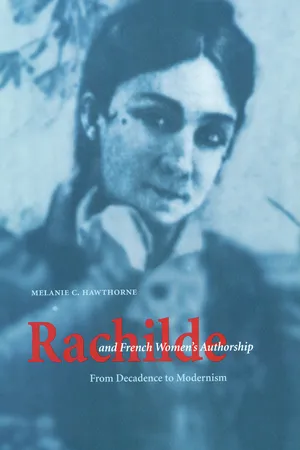
Rachilde and French Women's Authorship
eBook - PDF

Rachilde and French Women's Authorship

From Decadence to Modernism

  1. 304 pages
  2. English
  3. PDF
  4. Available on iOS & Android
eBook - PDF

Rachilde and French Women's Authorship

From Decadence to Modernism

About this book

Under the assumed name Rachilde, Marguerite Eymery (1860–1953) wrote over sixty works of fiction, drama, poetry, memoir, and criticism, including Monsieur VĂ©nus, one of the most famous examples of decadent fiction. She was closely associated with the literary journal Mercure de France, inspired parts of Oscar Wilde's The Picture of Dorian Gray, and mingled with all the literary lights of the day. Yet for all that, very little has been written about her. Melanie C. Hawthorne corrects this oversight and counters the traditional approach to Rachilde by persuasively portraying this "eccentric" as patently representative of the French women writers of her time and of the social and literary issues they faced. Seen in this light, Rachilde's writing clearly illustrates important questions in feminist literary theory as well as significant features of turn-of-the-century French society. Hawthorne arranges her approach to Rachilde around several defining events in the author's life, including the controversial publication of Monsieur VĂ©nus, with its presentation of sex reversals. Weaving back and forth in time, she is able to depict these moments in relation to Rachilde's life, work, and times and to illuminate nineteenth-century publishing practices and rivalries, including authorial manipulations of the market for sexually suggestive literature. The most complete and accurate account yet written of this emblematic author, Hawthorne's work is also the first to situate Rachilde in the broader social contexts and literary currents of her time and of our own.

Frequently asked questions

Yes, you can cancel anytime from the Subscription tab in your account settings on the Perlego website. Your subscription will stay active until the end of your current billing period. Learn how to cancel your subscription.
No, books cannot be downloaded as external files, such as PDFs, for use outside of Perlego. However, you can download books within the Perlego app for offline reading on mobile or tablet. Learn more here.
Perlego offers two plans: Essential and Complete
  • Essential is ideal for learners and professionals who enjoy exploring a wide range of subjects. Access the Essential Library with 800,000+ trusted titles and best-sellers across business, personal growth, and the humanities. Includes unlimited reading time and Standard Read Aloud voice.
  • Complete: Perfect for advanced learners and researchers needing full, unrestricted access. Unlock 1.4M+ books across hundreds of subjects, including academic and specialized titles. The Complete Plan also includes advanced features like Premium Read Aloud and Research Assistant.
Both plans are available with monthly, semester, or annual billing cycles.
We are an online textbook subscription service, where you can get access to an entire online library for less than the price of a single book per month. With over 1 million books across 1000+ topics, we’ve got you covered! Learn more here.
Look out for the read-aloud symbol on your next book to see if you can listen to it. The read-aloud tool reads text aloud for you, highlighting the text as it is being read. You can pause it, speed it up and slow it down. Learn more here.
Yes! You can use the Perlego app on both iOS or Android devices to read anytime, anywhere — even offline. Perfect for commutes or when you’re on the go.
Please note we cannot support devices running on iOS 13 and Android 7 or earlier. Learn more about using the app.
Yes, you can access Rachilde and French Women's Authorship by Melanie C. Hawthorne in PDF and/or ePUB format, as well as other popular books in Literature & French Literary Criticism. We have over one million books available in our catalogue for you to explore.

Table of contents

  1. CONTENTS
  2. ILLUSTRATIONS
  3. ACKNOWLEDGMENTS
  4. ABBREVIATIONS FOR WORKS BY RACHILDE
  5. INTRODUCTION: On Writing Biography: In which the author pays a visit to Périgueux and makes a detour to Galveston
  6. 1860, FEBRUARY 11: Women as Outsiders: In which Marguerite Eymery (Rachilde) is born, a werewolf appears, and traps are both set and sprung
  7. 1870, OCTOBER 29: The Ambivalence of the Paternal: In which Captain Eymery is taken prisoner
  8. 1875, JANUARY OR EARLY FEBRUARY: The Cultural Injunction to Silence: In which Rachilde is engaged, appears to attempt suicide, and meets a ghost who delivers an important message
  9. 1876, MARCH 1: Woman as Medium: In which sĂ©ances are held, Madame Eymery meets “Rachilde,” and doubles mysteriously appear
  10. 1877, JUNE 23: Authority, Authorship, and Authorization: In which Rachilde publishes her first story and Victor Hugo authorizes her
  11. 1884, MAY–JULY: The Politics of Publishing: In which Monsieur VĂ©nus is published and the French police take an interest in Rachilde
  12. 1884, DECEMBER 12: Writing as Cross-Dressing: In which Rachilde applies for permission to cross-dress and become a writer
  13. 1885, A THURSDAY IN MARCH: Marriage and the Woman Writer: In which Rachilde meets Alfred Vallette and marries him, despite some second thoughts
  14. 1887, FEBRUARY 26 (A SATURDAY): The Photograph Never Lies: In which a front page brings attention to Rachilde’s hair
  15. 1889, OCTOBER 25: The Cultural Legitimacy of the Woman Writer: In which Rachilde’s daughter is born and questions are raised about legitimacy
  16. 1890, NOVEMBER 10: Imagining the Self: In which Rachilde’s first play is performed and some mirrors are looked into
  17. 1894, A TUESDAY: Male Anxiety at the Fin de SiĂšcle: In which Rachilde, cupbearer to the symbolist gods, meets Alfred Jarry
  18. 1900, DECEMBER 10: Women and Education: In which Rachilde’s mother is admitted to the asylum of Charenton and some deficiencies in Rachilde’s education become apparent
  19. 1925, JULY 2: Women and Surrealism: In which Rachilde gets into a bun fight
  20. 1928, JUNE: Gender Anxiety in French Modernism: In which Le Prisonnier is published and Rachilde acts rather queerly
  21. 1953, APRIL 4: On Minding: In which Rachilde is reunited with Lison
  22. NOTES
  23. BIBLIOGRAPHY
  24. INDEX