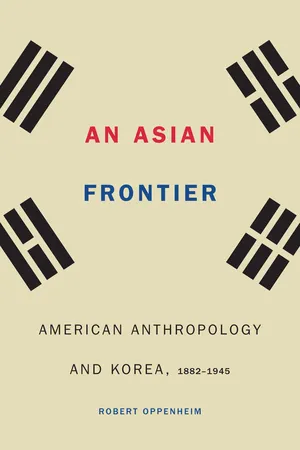
In the nineteenth century the predominant focus of American anthropology centered on the native peoples of North America, and most anthropologists would argue that Korea during this period was hardly a cultural area of great anthropological interest. However, this perspective underestimates Korea as a significant object of concern for American anthropology during the period from 1882 to 1945—otherwise a turbulent, transitional period in Korea's history. An Asian Frontier focuses on the dialogue between the American anthropological tradition and Korea, from Korea's first treaty with the United States to the end of World War II, with the goal of rereading anthropology's history and theoretical development through its Pacific frontier. Drawing on notebooks and personal correspondence as well as the publications of anthropologists of the day, Robert Oppenheim shows how and why Korea became an important object of study—with, for instance, more published about Korea in the pages of American Anthropologist before 1900 than would be seenfor decades after. Oppenheim chronicles the actions of American collectors, Korean mediators, and metropolitan curators who first created Korean anthropological exhibitions for the public. He moves on to examine anthropologists—such as Aleš Hrdlicka, Walter Hough, Stewart Culin, Frederick Starr, and Frank Hamilton Cushing—who fit Korea into frameworks of evolution, culture, and race even as they engaged questions of imperialism that were raised by Japan's colonization of the country. In tracing the development of American anthropology's understanding of Korea, Oppenheim discloses the legacy present in our ongoing understanding of Korea and of anthropology's past.
- 416 pages
- English
- ePUB (mobile friendly)
- Available on iOS & Android
eBook - ePub
About this book
Information
Table of contents
- Cover
- Series Page
- Title Page
- Copyright Page
- Dedication
- Contents
- List of Illustrations
- Series Editors’ Introduction
- Acknowledgments
- Note on Editorial Method
- Introduction
- 1. Anthropological Collecting Networks in Late Nineteenth-Century Korea
- 2. Ceramic Economies
- 3. From China in America to Korea in Chicago
- 4. Orientalist against Orientalism
- 5. The Anthropologist without Qualities
- 6. Worlding Korea from Without and Within
- 7. Interwar Asymmetries of Race and Anti-imperialism
- Conclusion
- Source Acknowledgments
- Notes
- Bibliography
- Index
- About Robert Oppenheim
- Series List
Trusted by 375,005 students
Access to over 1.5 million titles for a fair monthly price.
Study more efficiently using our study tools.
Frequently asked questions
Yes, you can cancel anytime from the Subscription tab in your account settings on the Perlego website. Your subscription will stay active until the end of your current billing period. Learn how to cancel your subscription
No, books cannot be downloaded as external files, such as PDFs, for use outside of Perlego. However, you can download books within the Perlego app for offline reading on mobile or tablet. Learn how to download books offline
Perlego offers two plans: Essential and Complete
- Essential is ideal for learners and professionals who enjoy exploring a wide range of subjects. Access the Essential Library with 800,000+ trusted titles and best-sellers across business, personal growth, and the humanities. Includes unlimited reading time and Standard Read Aloud voice.
- Complete: Perfect for advanced learners and researchers needing full, unrestricted access. Unlock 1.5M+ books across hundreds of subjects, including academic and specialized titles. The Complete Plan also includes advanced features like Premium Read Aloud and Research Assistant.
We are an online textbook subscription service, where you can get access to an entire online library for less than the price of a single book per month. With over 1.5 million books across 990+ topics, we’ve got you covered! Learn about our mission
Look out for the read-aloud symbol on your next book to see if you can listen to it. The read-aloud tool reads text aloud for you, highlighting the text as it is being read. You can pause it, speed it up and slow it down. Learn more about Read Aloud
Yes! You can use the Perlego app on both iOS and Android devices to read anytime, anywhere — even offline. Perfect for commutes or when you’re on the go.
Please note we cannot support devices running on iOS 13 and Android 7 or earlier. Learn more about using the app
Please note we cannot support devices running on iOS 13 and Android 7 or earlier. Learn more about using the app
Yes, you can access An Asian Frontier by Robert Oppenheim in PDF and/or ePUB format, as well as other popular books in Social Sciences & Korean History. We have over 1.5 million books available in our catalogue for you to explore.