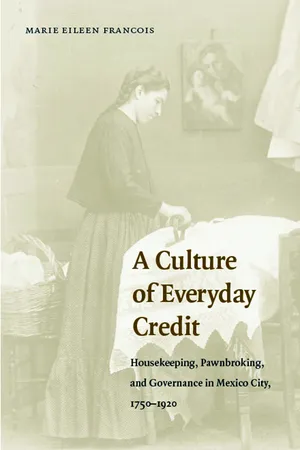
A Culture of Everyday Credit
eBook - PDF

A Culture of Everyday Credit

Housekeeping, Pawnbroking, and Governance in Mexico City, 1750-1920

  1. 416 pages
  2. English
  3. PDF
  4. Available on iOS & Android
eBook - PDF

A Culture of Everyday Credit

Housekeeping, Pawnbroking, and Governance in Mexico City, 1750-1920

About this book

Pawning was the most common credit mechanism in Mexico City in the nineteenth century. A diverse, largely female pawning clientele from lower- and middle-class households regularly secured small consumption loans by hocking household goods. A two-tiered sector of public and private pawnbrokers provided collateral credit. Rather than just providing emergency subsistence for the poor, pawnbroking facilitated consumption by Creole and mestizo middle sectors of Mexican society and enhanced identity formation for those in middling households by allowing them to cash in on material investments to maintain status during lean times. A Culture of Everyday Credit shows how Mexican women have depended on credit to run their households since the Bourbon era and how the collateral credit business of pawnbroking developed into a profitable enterprise built on the demand for housekeeping loans as restrictions on usury waned during the nineteenth century.

Pairing the study of household consumption with a detailed analysis of the rise of private and public pawnbroking provides an original context for understanding the role of small business in everyday life. Marie Eileen Francois weighs colonial reforms, liberal legislation, and social revolution in terms of their impact on households and pawning businesses.

Based on evidence from pawnshop inventories, censuses, legislation, petitions, literature, and newspapers, A Culture of Everyday Credit portrays households, small businesses, and government entities as intersecting arenas in one material world, a world strapped for cash throughout most of the century and turned upside down during the Mexican Revolution.

Frequently asked questions

Yes, you can cancel anytime from the Subscription tab in your account settings on the Perlego website. Your subscription will stay active until the end of your current billing period. Learn how to cancel your subscription.
No, books cannot be downloaded as external files, such as PDFs, for use outside of Perlego. However, you can download books within the Perlego app for offline reading on mobile or tablet. Learn more here.
Perlego offers two plans: Essential and Complete
  • Essential is ideal for learners and professionals who enjoy exploring a wide range of subjects. Access the Essential Library with 800,000+ trusted titles and best-sellers across business, personal growth, and the humanities. Includes unlimited reading time and Standard Read Aloud voice.
  • Complete: Perfect for advanced learners and researchers needing full, unrestricted access. Unlock 1.4M+ books across hundreds of subjects, including academic and specialized titles. The Complete Plan also includes advanced features like Premium Read Aloud and Research Assistant.
Both plans are available with monthly, semester, or annual billing cycles.
We are an online textbook subscription service, where you can get access to an entire online library for less than the price of a single book per month. With over 1 million books across 1000+ topics, we’ve got you covered! Learn more here.
Look out for the read-aloud symbol on your next book to see if you can listen to it. The read-aloud tool reads text aloud for you, highlighting the text as it is being read. You can pause it, speed it up and slow it down. Learn more here.
Yes! You can use the Perlego app on both iOS or Android devices to read anytime, anywhere — even offline. Perfect for commutes or when you’re on the go.
Please note we cannot support devices running on iOS 13 and Android 7 or earlier. Learn more about using the app.
Yes, you can access A Culture of Everyday Credit by Marie Eileen Francois in PDF and/or ePUB format, as well as other popular books in History & Mexican History. We have over one million books available in our catalogue for you to explore.

Information

Table of contents

  1. Contents
  2. Illustrations
  3. Tables
  4. Acknowledgments
  5. Abbreviations
  6. Introduction
  7. 1. Hocking the Private in Public: Credit Policy, Housekeeping, and Status, 1750-1840
  8. 2. Collateral Lending: Pulperias and the Monte de Piedad, 1750-1840
  9. 3. Collateral Living: Consumption, Anxious Liberals, and Daily Life, 1830-80
  10. 4. Brokering Interests: Casas de Empeno and an Expanded Monte de Piedad, 1830-75
  11. 5. Positivist Housekeeping: Domesticity, Work, and Consumer Credit, 1880-1910
  12. 6. Porfirian Paradoxes: Profit versus Regulation, Capital versus Welfare
  13. 7. A Material Revolution: Militancy, Policy, and Housekeeping, 1911-20
  14. Conclusion: Housekeeping, Pawnbroking, and Politics
  15. Epilogue: Still a Culture of Everyday Credit
  16. Appendix 1: Collateral Transactions Data
  17. Appendix 2: Pawnbroker Data
  18. Appendix 3: Census Data
  19. Notes
  20. Index