Late nineteenth-century Mexico was a country rife with health problems. In 1876, one out of every nineteen people died prematurely in Mexico City, a staggeringly high rate when compared to other major Western world capitals at the time, which saw more modest premature death rates of one out of fifty-two (London), one out of forty-four (Paris), and one out of thirty-five (Madrid). It is not an exaggeration to maintain that each day dozens of bodies could be found scattered throughout the streets of Mexico City, making the capital city one of the most unsanitary places in the Western Hemisphere. In light of such startling scenes, in Death Is All around Us Jonathan M. Weber examines how Mexican state officials, including President Porfirio Díaz, tried to resolve the public health dilemmas facing the city. By reducing the high mortality rate, state officials believed that Mexico City would be seen as a more modern and viable capital in North America. To this end the government used new forms of technology and scientific knowledge to deal with the thousands of unidentified and unburied corpses found in hospital morgues and cemeteries and on the streets. Tackling the central question of how the government used the latest technological and scientific advancements to persuade citizens and foreigners alike that the capital city—and thus Mexico as a whole—was capable of resolving the hygienic issues plaguing the city, Weber explores how the state's attempts to exert control over procedures of death and burial became a powerful weapon for controlling the behavior of its citizens.
eBook - ePub
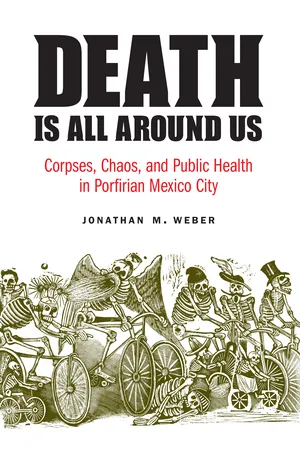
Death Is All around Us
Corpses, Chaos, and Public Health in Porfirian Mexico City
- 312 pages
- English
- ePUB (mobile friendly)
- Available on iOS & Android
eBook - ePub
About this book
Information
Table of contents
- Cover
- Series Page
- Title Page
- Copyright Page
- Dedication
- Contents
- List of Illustrations
- Acknowledgments
- Introduction
- 1. Moving into the Modern Era
- 2. “An Extraordinary Tool”
- 3. Wet or Dry Remains
- 4. Undermining Progress
- Conclusion
- Notes
- Bibliography
- Index
- About Jonathan M. Weber
- Series List
Trusted by 375,005 students
Access to over 1.5 million titles for a fair monthly price.
Study more efficiently using our study tools.
Frequently asked questions
Yes, you can cancel anytime from the Subscription tab in your account settings on the Perlego website. Your subscription will stay active until the end of your current billing period. Learn how to cancel your subscription
No, books cannot be downloaded as external files, such as PDFs, for use outside of Perlego. However, you can download books within the Perlego app for offline reading on mobile or tablet. Learn how to download books offline
Perlego offers two plans: Essential and Complete
- Essential is ideal for learners and professionals who enjoy exploring a wide range of subjects. Access the Essential Library with 800,000+ trusted titles and best-sellers across business, personal growth, and the humanities. Includes unlimited reading time and Standard Read Aloud voice.
- Complete: Perfect for advanced learners and researchers needing full, unrestricted access. Unlock 1.5M+ books across hundreds of subjects, including academic and specialized titles. The Complete Plan also includes advanced features like Premium Read Aloud and Research Assistant.
We are an online textbook subscription service, where you can get access to an entire online library for less than the price of a single book per month. With over 1.5 million books across 990+ topics, we’ve got you covered! Learn about our mission
Look out for the read-aloud symbol on your next book to see if you can listen to it. The read-aloud tool reads text aloud for you, highlighting the text as it is being read. You can pause it, speed it up and slow it down. Learn more about Read Aloud
Yes! You can use the Perlego app on both iOS and Android devices to read anytime, anywhere — even offline. Perfect for commutes or when you’re on the go.
Please note we cannot support devices running on iOS 13 and Android 7 or earlier. Learn more about using the app
Please note we cannot support devices running on iOS 13 and Android 7 or earlier. Learn more about using the app
Yes, you can access Death Is All around Us by Jonathan M. Weber in PDF and/or ePUB format, as well as other popular books in History & Mexican History. We have over 1.5 million books available in our catalogue for you to explore.