In the popular literature and scholarship of the Civil War, the days immediately after the surrender at Fort Sumter are overshadowed by the great battles and seismic changes in American life that followed. The twelve days that began with the federal evacuation of the fort and ended with the arrival of the New York Seventh Militia Regiment in Washington were critically important. The nation’s capital never again came so close to being captured by the Confederates.
Tony Silber’s riveting account starts on April 14, 1861, with President Lincoln’s call for seventy-five thousand militia troops. Washington, a Southern slaveholding city, was the focal point: both sides expected the first clash to occur there. The capital was barely defended, by about two thousand local militia troops of dubious training and loyalty. In Charleston, less than two days away by train, the Confederates had an organized army that was much larger and ready to fight.
Maryland’s eastern sections were already reeling in violent insurrection, and within days Virginia would secede. For half of the twelve days after Fort Sumter, Washington was severed from the North, the telegraph lines cut and the rail lines impassable, sabotaged by secessionist police and militia members. There was no cavalry coming. The United States had a tiny standing army at the time, most of it scattered west of the Mississippi. The federal government’s only defense would be state militias. But in state after state, the militia system was in tatters.
Southern leaders urged an assault on Washington. A Confederate success in capturing Washington would have changed the course of the Civil War. It likely would have assured the secession of Maryland. It might have resulted in England’s recognition of the Confederacy. It would have demoralized the North. Fortunately, none of this happened. Instead, Lincoln emerged as the master of his cabinet, a communications genius, and a strategic giant who possessed a crystal-clear core objective and a powerful commitment to see it through. Told in real time, Twelve Days alternates between the four main scenes of action: Washington, insurrectionist Maryland, the advance of Northern troops, and the Confederate planning and military movements. Twelve Days tells for the first time the entire harrowing story of the first days of the Civil War.
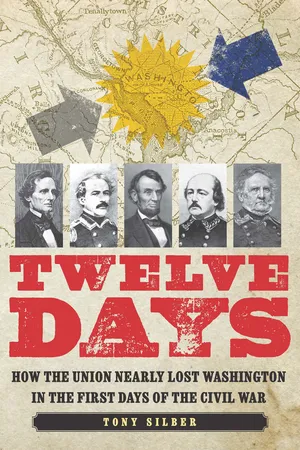
eBook - ePub
Twelve Days
How the Union Nearly Lost Washington in the First Days of the Civil War
- 392 pages
- English
- ePUB (mobile friendly)
- Available on iOS & Android
eBook - ePub
About this book
Information
Table of contents
- Cover
- Title Page
- Copyright Page
- Contents
- List of Illustrations
- Acknowledgments
- Preface
- Day Ten: Tuesday, April 23, 1861
- 1. Why Don’t They Come?
- Day One: Sunday, April 14
- 2. The Evacuation of Sumter
- 3. Washington, the Secessionist City
- Day Two: Monday, April 15
- 4. “If I Were Beauregard I Would Take Washington”
- 5. Northern Militia in Tatters
- Day Three: Tuesday, April 16
- 6. “Take Washington City Immediately”
- Day Four: Wednesday, April 17
- 7. Virginia’s Decision
- Day Five: Thursday, April 18
- 8. The First Defenders
- 9. Washington Prepares for the Worst
- 10. Indecision at the Navy Yard and Harpers Ferry Is Lost
- Day Six: Friday, April 19
- 11. The New York Seventh Departs
- 12. The Baltimore Riots
- 13. Insurrection in Maryland
- Days Six and Seven: Friday, April 19–Saturday, April 20
- 14. Washington Cut Off and Insurrection Rages in Maryland
- Day Seven: Saturday, April 20
- 15. A New Route to Washington
- 16. The Fortified Capital
- Day Eight: Sunday, April 21
- 17. Confederate Troops Move North
- 18. A Northern Convoy Departs
- 19. Brinksmanship in Washington
- Day Nine: Monday, April 22
- 20. A Torrent of Federal Resignations
- 21. General Butler, the Belligerent Brigadier
- Day Ten: Tuesday, April 23
- 22. Stalled in Annapolis
- 23. New York’s Irish Join the Fight
- Day Eleven: Wednesday, April 24
- 24. The March of the Seventh and Eighth Regiments
- Day Twelve: Thursday, April 25
- 25. Washington Is Saved
- Friday, April 26–Monday, April 29
- 26. The Aftermath
- Notes
- Bibliography
- Index
- About Tony Silber
- Illustrations
Trusted by 375,005 students
Access to over 1.5 million titles for a fair monthly price.
Study more efficiently using our study tools.
Frequently asked questions
Yes, you can cancel anytime from the Subscription tab in your account settings on the Perlego website. Your subscription will stay active until the end of your current billing period. Learn how to cancel your subscription
No, books cannot be downloaded as external files, such as PDFs, for use outside of Perlego. However, you can download books within the Perlego app for offline reading on mobile or tablet. Learn how to download books offline
Perlego offers two plans: Essential and Complete
- Essential is ideal for learners and professionals who enjoy exploring a wide range of subjects. Access the Essential Library with 800,000+ trusted titles and best-sellers across business, personal growth, and the humanities. Includes unlimited reading time and Standard Read Aloud voice.
- Complete: Perfect for advanced learners and researchers needing full, unrestricted access. Unlock 1.5M+ books across hundreds of subjects, including academic and specialized titles. The Complete Plan also includes advanced features like Premium Read Aloud and Research Assistant.
We are an online textbook subscription service, where you can get access to an entire online library for less than the price of a single book per month. With over 1.5 million books across 990+ topics, we’ve got you covered! Learn about our mission
Look out for the read-aloud symbol on your next book to see if you can listen to it. The read-aloud tool reads text aloud for you, highlighting the text as it is being read. You can pause it, speed it up and slow it down. Learn more about Read Aloud
Yes! You can use the Perlego app on both iOS and Android devices to read anytime, anywhere — even offline. Perfect for commutes or when you’re on the go.
Please note we cannot support devices running on iOS 13 and Android 7 or earlier. Learn more about using the app
Please note we cannot support devices running on iOS 13 and Android 7 or earlier. Learn more about using the app
Yes, you can access Twelve Days by Tony Silber in PDF and/or ePUB format, as well as other popular books in History & American Civil War History. We have over 1.5 million books available in our catalogue for you to explore.