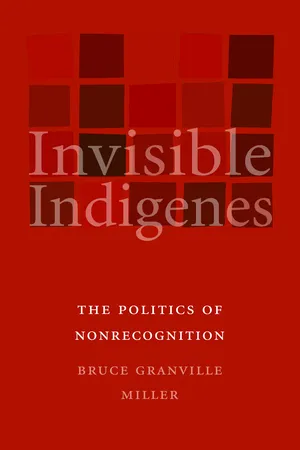
In the last few decades, as indigenous peoples have increasingly sought out and sometimes demanded sovereignty on a variety of fronts, their relationships with encompassing nation-states have become ever more complicated and troubled. The varying ways that today's nation-states attempt to manage—and often render invisible—contemporary indigenous peoples is the subject of this global comparative study. Beginning with his own work along the northwest coast of North America and drawing on contemporary examples from South America, Asia, Africa, and Europe, Bruce Granville Miller examines how national governments classify, govern, and control the indigenous populations within their boundaries through administrative, judicial, and economic means. One telling consequence of such regulation strategies is that certain indigenous peoples become unrecognized—their ethnic identities and heritages fail to find legal register and thus empowerment within the very state organizations that manage other aspects of their lives. In the United States alone reside two hundred thousand unrecognized indigenous individuals, some members of indigenous communities that were dropped from the roster of tribes and others whose ancestors were overlooked. Miller also considers some important differences between the fluid nature of ethnic identity for some indigenous peoples and the more rigid notion of identity encoded in many state regulations. Invisible Indigenes reveals a recurring issue integral to the formation and maintenance of nation-states today and highlights a common challenge facing indigenous peoples around the globe in the twenty-first century.
- 263 pages
- English
- PDF
- Available on iOS & Android
eBook - PDF
About this book
Information
Table of contents
- Contents
- Acknowledgments
- Introduction
- 1. The Politics of Indigenous Identity
- 2. The State and Indigenous Peoples
- 3. Who Are the Indigenes?
- 4. Unrecognized Tribes, Unrecognized Peoples of the United States
- 5. Other U.S. Issues
- 6. First Nations in Canada
- 7. Indigenous Peoples of Asia, Africa, Meso- and South America, Eurasia, and Europe
- Conclusions
- References
- Index
- Map: Location of indigenous peoples of the Americas
- Map: Location of indigenous peoples of Africa, Eurasia, Asia, and Europe
Trusted by 375,005 students
Access to over 1.5 million titles for a fair monthly price.
Study more efficiently using our study tools.
Frequently asked questions
Yes, you can cancel anytime from the Subscription tab in your account settings on the Perlego website. Your subscription will stay active until the end of your current billing period. Learn how to cancel your subscription
No, books cannot be downloaded as external files, such as PDFs, for use outside of Perlego. However, you can download books within the Perlego app for offline reading on mobile or tablet. Learn how to download books offline
Perlego offers two plans: Essential and Complete
- Essential is ideal for learners and professionals who enjoy exploring a wide range of subjects. Access the Essential Library with 800,000+ trusted titles and best-sellers across business, personal growth, and the humanities. Includes unlimited reading time and Standard Read Aloud voice.
- Complete: Perfect for advanced learners and researchers needing full, unrestricted access. Unlock 1.5M+ books across hundreds of subjects, including academic and specialized titles. The Complete Plan also includes advanced features like Premium Read Aloud and Research Assistant.
We are an online textbook subscription service, where you can get access to an entire online library for less than the price of a single book per month. With over 1.5 million books across 990+ topics, we’ve got you covered! Learn about our mission
Look out for the read-aloud symbol on your next book to see if you can listen to it. The read-aloud tool reads text aloud for you, highlighting the text as it is being read. You can pause it, speed it up and slow it down. Learn more about Read Aloud
Yes! You can use the Perlego app on both iOS and Android devices to read anytime, anywhere — even offline. Perfect for commutes or when you’re on the go.
Please note we cannot support devices running on iOS 13 and Android 7 or earlier. Learn more about using the app
Please note we cannot support devices running on iOS 13 and Android 7 or earlier. Learn more about using the app
Yes, you can access Invisible Indigenes by Bruce Granville Miller in PDF and/or ePUB format, as well as other popular books in Social Sciences & Native American Studies. We have over 1.5 million books available in our catalogue for you to explore.