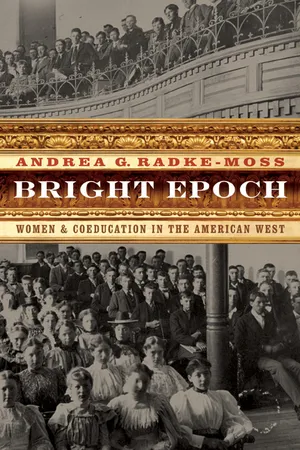
Bright Epoch
eBook - PDF

Bright Epoch

Women and Coeducation in the American West

  1. 368 pages
  2. English
  3. PDF
  4. Available on iOS & Android
eBook - PDF

Bright Epoch

Women and Coeducation in the American West

About this book

With the passage of the Morrill Act in 1862, many states in the Midwest and the West chartered land-grant colleges following the Civil War. Because of both progressive ideologies and economic necessity, these institutions admitted women from their inception and were among the first public institutions to practice coeducation. Although female students did not feel completely accepted by their male peers and professors in the land-grant environment, many of them nonetheless successfully negotiated greater gender inclusion for themselves and their peers.
In Bright Epoch, Andrea G. Radke-Moss tells the story of female students' early mixed-gender encounters at four institutions: Iowa Agricultural College, the University of Nebraska, Oregon Agricultural College, and Utah State Agricultural College. Although land-grant institutions have been most commonly associated with domestic science courses for women, Bright Epoch illuminates the diversity of other courses of study available to female students, including the sciences, literature, journalism, business commerce, and law. In a culture where the forces of gender separation constantly battled gender inclusion, women found new opportunities for success and achievement through activities such as literary societies, athletics, military regiments, and women's rights and suffrage activism. Through these venues, women students challenged nineteenth-century gender limitations and created broader definitions of female inclusion and participation in the land-grant environment and in the larger American society.

Frequently asked questions

Yes, you can cancel anytime from the Subscription tab in your account settings on the Perlego website. Your subscription will stay active until the end of your current billing period. Learn how to cancel your subscription.
No, books cannot be downloaded as external files, such as PDFs, for use outside of Perlego. However, you can download books within the Perlego app for offline reading on mobile or tablet. Learn more here.
Perlego offers two plans: Essential and Complete
  • Essential is ideal for learners and professionals who enjoy exploring a wide range of subjects. Access the Essential Library with 800,000+ trusted titles and best-sellers across business, personal growth, and the humanities. Includes unlimited reading time and Standard Read Aloud voice.
  • Complete: Perfect for advanced learners and researchers needing full, unrestricted access. Unlock 1.4M+ books across hundreds of subjects, including academic and specialized titles. The Complete Plan also includes advanced features like Premium Read Aloud and Research Assistant.
Both plans are available with monthly, semester, or annual billing cycles.
We are an online textbook subscription service, where you can get access to an entire online library for less than the price of a single book per month. With over 1 million books across 1000+ topics, we’ve got you covered! Learn more here.
Look out for the read-aloud symbol on your next book to see if you can listen to it. The read-aloud tool reads text aloud for you, highlighting the text as it is being read. You can pause it, speed it up and slow it down. Learn more here.
Yes! You can use the Perlego app on both iOS or Android devices to read anytime, anywhere — even offline. Perfect for commutes or when you’re on the go.
Please note we cannot support devices running on iOS 13 and Android 7 or earlier. Learn more about using the app.
Yes, you can access Bright Epoch by Andrea G. Radke-Moss in PDF and/or ePUB format, as well as other popular books in History & North American History. We have over one million books available in our catalogue for you to explore.

Table of contents

  1. Contents
  2. Illustrations
  3. Tables and Graphs
  4. Acknowledgments
  5. Introduction
  6. 1. Making a Welcome for Women Students
  7. 2. The Place of Women Students
  8. 3. The Early Practice of Coeducation
  9. 4. Women Students’ Sociality
  10. 5. Women’s Course Work
  11. 6. Under the Gaze
  12. 7. “The American Eagle in Bloomers”
  13. 8. Challenging Political Separation
  14. Conclusion
  15. Notes
  16. Bibliography
  17. Index