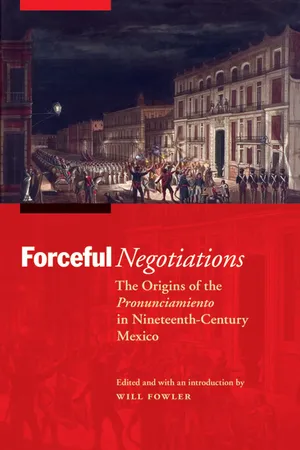
Forceful Negotiations
The Origins of the Pronunciamiento in Nineteenth-Century Mexico
- 376 pages
- English
- PDF
- Available on iOS & Android
About this book
Often translated as "revolt, " a pronunciamiento was a formal, written protest, typically drafted as a list of grievances or demands, that could result in an armed rebellion. This common nineteenth-century Hispano-Mexican extraconstitutional practice was used by soldiers and civilians to forcefully lobby, negotiate, or petition for political change. Although the majority of these petitions failed to achieve their aims, many leading political changes in nineteenth-century Mexico were caused or provoked by one of the more than fifteen hundred pronunciamientos filed between 1821 and 1876. The first of three volumes on the phenomenon of the pronunciamiento, this collection brings together leading scholars to investigate the origins of these forceful petitions. From both a regional and a national perspective, the essays examine specific pronunciamientos, such as the Plan of Iguala, and explore the contexts that gave rise to the use of the pronunciamiento as a catalyst for change. Forceful Negotiations offers a better understanding of the civil conflicts that erupted with remarkable and tragic consistency following the achievement of independence, as well as of the ways in which Mexican political culture legitimized the threat of armed rebellion as a means of effecting political change during this turbulent period.
Frequently asked questions
- Essential is ideal for learners and professionals who enjoy exploring a wide range of subjects. Access the Essential Library with 800,000+ trusted titles and best-sellers across business, personal growth, and the humanities. Includes unlimited reading time and Standard Read Aloud voice.
- Complete: Perfect for advanced learners and researchers needing full, unrestricted access. Unlock 1.4M+ books across hundreds of subjects, including academic and specialized titles. The Complete Plan also includes advanced features like Premium Read Aloud and Research Assistant.
Please note we cannot support devices running on iOS 13 and Android 7 or earlier. Learn more about using the app.
Information
Table of contents
- Title Page
- Copyright Page
- Table of Contents
- Preface
- Acknowledgments
- Introduction: The Nineteenth-Century Practice of the Pronunciamiento and Its Origins
- Chronology of Main Events and Pronunciamientos, 1821–1853
- 1. Iguala: The Prototype
- 2. Agustín de Iturbide: From the Pronunciamiento of Iguala to the Coup of 1822
- 3. Two Reactions to the Illegitimate Succession of 1828: Campeche and Jalapa
- 4. Municipalities, Prefects, and Pronunciamientos: Power and Political Mobilizations in the Huasteca during the First Federal Republic
- 5. The Origins of the Pronunciamientos of San Luis Potosí: An Overview
- 6. The British and an Early Pronunciamiento, 1833–1834
- 7. The Origins of the Santiago Imán Re volt,1838–1840: A Reassessment
- 8. A Reluctant Advocate: Mariano Otero andthe Revolución de Jalisco
- 9. Constitution and Congress: A Pronunciamiento for Legality, December 1844
- 10. “The Curious Manner in Which Pronunciamientos Are Got Up in This Country”:The Plan of Blancarte of 26 July 1852
- 11. Inventing the Nation:The Pronunciamiento and the Construction of Mexican National Identity, 1821–1876
- 12. “I Pronounce Thus I Exist”: Redefining the Pronunciamiento in Independent Mexico, 1821–1876
- Bibliography
- Contributors