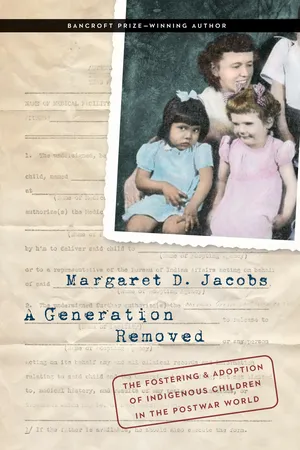
A Generation Removed
The Fostering and Adoption of Indigenous Children in the Postwar World
- 408 pages
- English
- ePUB (mobile friendly)
- Available on iOS & Android
A Generation Removed
The Fostering and Adoption of Indigenous Children in the Postwar World
About this book
On June 25, 2013, the U.S. Supreme Court heard the case Adoptive Couple vs. Baby Girl, which pitted adoptive parents Matt and Melanie Capobianco against baby Veronica's biological father, Dusten Brown, a citizen of the Cherokee Nation of Oklahoma. Veronica's biological mother had relinquished her for adoption to the Capobiancos without Brown's consent. Although Brown regained custody of his daughter using the Indian Child Welfare Act (ICWA) of 1978, the Supreme Court ruled in favor of the Capobiancos, rejecting the purpose of the ICWA and ignoring the long history of removing Indigenous children from their families. In A Generation Removed, a powerful blend of history and family stories, award-winning historian Margaret D. Jacobs examines how government authorities in the post–World War II era removed thousands of American Indian children from their families and placed them in non-Indian foster or adoptive families. By the late 1960s an estimated 25 to 35 percent of Indian children had been separated from their families. Jacobs also reveals the global dimensions of the phenomenon: These practices undermined Indigenous families and their communities in Canada and Australia as well. Jacobs recounts both the trauma and resilience of Indigenous families as they struggled to reclaim the care of their children, leading to the ICWA in the United States and to national investigations, landmark apologies, and redress in Australia and Canada.
Frequently asked questions
- Essential is ideal for learners and professionals who enjoy exploring a wide range of subjects. Access the Essential Library with 800,000+ trusted titles and best-sellers across business, personal growth, and the humanities. Includes unlimited reading time and Standard Read Aloud voice.
- Complete: Perfect for advanced learners and researchers needing full, unrestricted access. Unlock 1.4M+ books across hundreds of subjects, including academic and specialized titles. The Complete Plan also includes advanced features like Premium Read Aloud and Research Assistant.
Please note we cannot support devices running on iOS 13 and Android 7 or earlier. Learn more about using the app.
Information
Table of contents
- Cover
- Title Page
- Copyright Page
- Dedication
- Contents
- List of Illustrations
- Acknowledgments
- A Note on Terms
- Abbreviations
- Simon Ortiz’s Question
- Introduction
- Prologue
- Part 1. Taking Care of American Indian Children
- Modern Indian Life
- 1. The Bureaucracy of Caring for Indian Children
- Dana’s Story
- 2. Caring about Indian Children in a Liberal Age
- Part 2. The Indian Child Welfare Crisis in Indian Country
- John’s Story
- 3. Losing Children
- Meeting Steven Unger
- 4. Reclaiming Care
- Interviewing Bert Hirsch and Evelyn Blanchard
- 5. The Campaign for the Indian Child Welfare Act
- Part 3. The Indian Child Welfare Crisis in a Global Context
- Tracking Down the Doucette Family
- 6. The Indigenous Child Welfare Crisis in Canada
- Meeting Aunty Di
- 7. The Indigenous Child Welfare Crisis in Australia and Transnational Activism
- Finding Russell Moore
- 8. Historical Reckoning with Indigenous Child Removal in Settler Colonial Nations
- Afterword
- Notes
- Bibliography
- Index
- About the Author