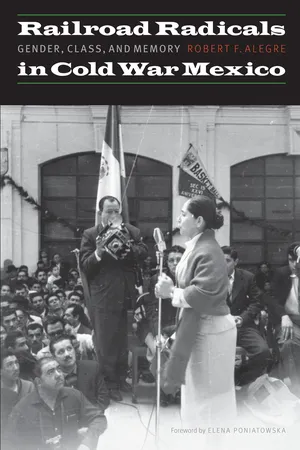
Railroad Radicals in Cold War Mexico
eBook - ePub

Railroad Radicals in Cold War Mexico

Gender, Class, and Memory

  1. 270 pages
  2. English
  3. ePUB (mobile friendly)
  4. Available on iOS & Android
eBook - ePub

Railroad Radicals in Cold War Mexico

Gender, Class, and Memory

About this book

Despite the Mexican government’s projected image of prosperity and modernity in the years following World War II, workers who felt that Mexico’s progress had come at their expense became increasingly discontented. From 1948 to 1958, unelected and often corrupt officials of STFRM, the railroad workers’ union, collaborated with the ruling Institutionalized Revolutionary Party (PRI) to freeze wages for the rank and file. In response, members of STFRM staged a series of labor strikes in 1958 and 1959 that inspired a nationwide working-class movement. The Mexican army crushed the last strike on March 26, 1959, and union members discovered that in the context of the Cold War, exercising their constitutional right to organize and strike appeared radical, even subversive.

Railroad Radicals in Cold War Mexico examines a pivotal moment in post–World War II Mexican history. The railroad movement reflected the contested process of postwar modernization, which began with workers demanding higher wages at the end of World War II and culminated in the railway strikes of the 1950s, a bold challenge to PRI rule. In addition, Robert F. Alegre gives the wives of the railroad workers a narrative place in this history by incorporating issues of gender identity in his analysis.

Frequently asked questions

Yes, you can cancel anytime from the Subscription tab in your account settings on the Perlego website. Your subscription will stay active until the end of your current billing period. Learn how to cancel your subscription.
No, books cannot be downloaded as external files, such as PDFs, for use outside of Perlego. However, you can download books within the Perlego app for offline reading on mobile or tablet. Learn more here.
Perlego offers two plans: Essential and Complete
  • Essential is ideal for learners and professionals who enjoy exploring a wide range of subjects. Access the Essential Library with 800,000+ trusted titles and best-sellers across business, personal growth, and the humanities. Includes unlimited reading time and Standard Read Aloud voice.
  • Complete: Perfect for advanced learners and researchers needing full, unrestricted access. Unlock 1.4M+ books across hundreds of subjects, including academic and specialized titles. The Complete Plan also includes advanced features like Premium Read Aloud and Research Assistant.
Both plans are available with monthly, semester, or annual billing cycles.
We are an online textbook subscription service, where you can get access to an entire online library for less than the price of a single book per month. With over 1 million books across 1000+ topics, we’ve got you covered! Learn more here.
Look out for the read-aloud symbol on your next book to see if you can listen to it. The read-aloud tool reads text aloud for you, highlighting the text as it is being read. You can pause it, speed it up and slow it down. Learn more here.
Yes! You can use the Perlego app on both iOS or Android devices to read anytime, anywhere — even offline. Perfect for commutes or when you’re on the go.
Please note we cannot support devices running on iOS 13 and Android 7 or earlier. Learn more about using the app.
Yes, you can access Railroad Radicals in Cold War Mexico by Robert F. Alegre in PDF and/or ePUB format, as well as other popular books in History & 20th Century History. We have over one million books available in our catalogue for you to explore.

Information

Table of contents

  1. Front Cover
  2. Title Page
  3. Copyright Page
  4. Dedication
  5. Contents
  6. List of Illustrations
  7. Foreword by Elena Poniatowska
  8. Acknowledgments
  9. List of Abbreviations
  10. Map of Mexico
  11. Introduction: The Working Class in Cold War Mexico
  12. 1. “The Mexican Revolution Was Made on the Rails”: Revolutionary Nationalism, Class Formation, and the Early Impact of the Cold War
  13. 2. “Born into the Railway”: Patriarchy, Community, and Underground Activism in the 1950s
  14. 3. “Who Is Mr. Nobody?”: The Rise of Democratic Unionism
  15. 4. The “War of Position”: The Making of a Strike
  16. 5. Railroaded: The Cold War Idiom in Practice
  17. Conclusion: Rethinking Postwar Working-Class History
  18. Notes
  19. Bibliography
  20. Index