Following the decision to maintain 250,000 U.S. troops in Germany after the Allied victory in 1945, the U.S. Army had, for the most part, been a model of what a peacetime occupying army stationed in an ally’s country should be. The army had initially benefited from the positive results of U.S. foreign policy toward West Germany and the deference of the Federal Republic toward it, establishing cordial and even friendly relations with German society. By 1968, however, the disciplined military of the Allies had been replaced with rundown barracks and shabby-looking GIs, and U.S. bases in Germany had become a symbol of the army’s greatest crisis, a crisis that threatened the army’s very existence.
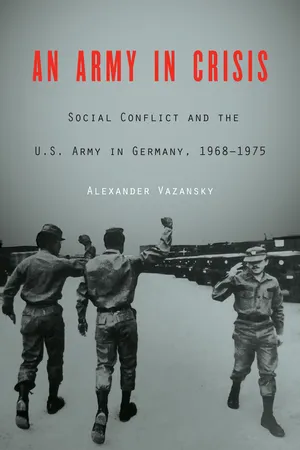
In An Army in Crisis Alexander Vazansky analyzes the social crisis that developed among the U.S. Army forces stationed in Germany between 1968 and 1975. This crisis was the result of shifting deployment patterns across the world during the Vietnam War; changing social and political realities of life in postwar Germany and Europe; and racial tensions, drug use, dissent, and insubordination within the U.S. Army itself, influenced by the civil rights movement, the Vietnam War, and the youth movement in the States. With particular attention to 1968, An Army in Crisis examines the changing relationships between American and German soldiers, from German deference to familiarity and fraternization, and the effects that a prolonged military presence in Germany had on American military personnel, their dependents, and the lives of Germans. Vazansky presents an innovative study of opposition and resistance within the ranks, affected by the Vietnam War and the limitations of personal freedom among the military during this era.
eBook - ePub
An Army in Crisis
Social Conflict and the U.S. Army in Germany, 1968–1975
- 360 pages
- English
- ePUB (mobile friendly)
- Available on iOS & Android
eBook - ePub
About this book
Information
Table of contents
- Cover
- Title Page
- Copyright Page
- Contents
- Acknowledgments
- Introduction
- Part 1
- 1. Black GIs in Postwar Germany
- 2. Growing Racial Tensions
- 3. Failed Leadership Responses and Black Power
- 4. The New Race Relations Policies
- Part 2
- 5. Resistance and Dissent in the U.S. Army
- 6. The Situation in USAREUR, 1968–1975
- Part 3
- 7. Drug Abuse Prevention in the U.S. Government
- 8. Drug Abuse in USAREUR, 1970–1975
- 9. The German Response
- Conclusion
- Notes
- Bibliography
- Index
- About Alexander Vazansky
Trusted by 375,005 students
Access to over 1.5 million titles for a fair monthly price.
Study more efficiently using our study tools.
Frequently asked questions
Yes, you can cancel anytime from the Subscription tab in your account settings on the Perlego website. Your subscription will stay active until the end of your current billing period. Learn how to cancel your subscription
No, books cannot be downloaded as external files, such as PDFs, for use outside of Perlego. However, you can download books within the Perlego app for offline reading on mobile or tablet. Learn how to download books offline
Perlego offers two plans: Essential and Complete
- Essential is ideal for learners and professionals who enjoy exploring a wide range of subjects. Access the Essential Library with 800,000+ trusted titles and best-sellers across business, personal growth, and the humanities. Includes unlimited reading time and Standard Read Aloud voice.
- Complete: Perfect for advanced learners and researchers needing full, unrestricted access. Unlock 1.5M+ books across hundreds of subjects, including academic and specialized titles. The Complete Plan also includes advanced features like Premium Read Aloud and Research Assistant.
We are an online textbook subscription service, where you can get access to an entire online library for less than the price of a single book per month. With over 1.5 million books across 990+ topics, we’ve got you covered! Learn about our mission
Look out for the read-aloud symbol on your next book to see if you can listen to it. The read-aloud tool reads text aloud for you, highlighting the text as it is being read. You can pause it, speed it up and slow it down. Learn more about Read Aloud
Yes! You can use the Perlego app on both iOS and Android devices to read anytime, anywhere — even offline. Perfect for commutes or when you’re on the go.
Please note we cannot support devices running on iOS 13 and Android 7 or earlier. Learn more about using the app
Please note we cannot support devices running on iOS 13 and Android 7 or earlier. Learn more about using the app
Yes, you can access An Army in Crisis by Alexander Vazansky in PDF and/or ePUB format, as well as other popular books in History & German History. We have over 1.5 million books available in our catalogue for you to explore.