Fray Francisco Atanasio Domínguez Award from the Historical Society of New Mexico
New Mexico-Arizona Book Award Finalist in History
For much of the twentieth century, modernization did not simply radiate from cities into the hinterlands; rather, the broad project of modernity, and resistance to it, has often originated in farm fields, at agricultural festivals, and in agrarian stories. In New Mexico no crops have defined the people and their landscape in the industrial era more than apples, cotton, and chiles.
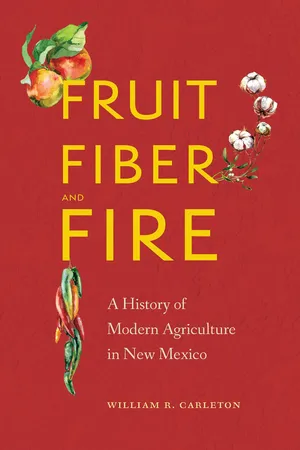
In Fruit, Fiber, and Fire William R. Carleton explores the industrialization of apples, cotton, and chiles to show how agriculture has affected the culture of twentieth-century New Mexico. The physical origins, the shifting cultural meanings, and the environmental and market requirements of these three iconic plants all broadly point to the convergence in New Mexico of larger regions—the Mexican North, the American Northeast, and the American South—and the convergence of diverse regional attitudes toward industry in agriculture.
Through the local stories that represent lives filled with meaningful struggles, lessons, and successes, along with the systems of knowledge in our recent agricultural past, Carleton provides a history of the broader culture of farmers and farmworkers. In the process, seemingly mere marginalia—a farmworker’s meal, a small orchard’s advertisement campaign, or a long-gone chile seed—add up to an agricultural past with diverse cultural influences, many possible futures, and competing visions of how to feed and clothe ourselves that remain relevant as we continue to reimagine the crops of our future.
New Mexico-Arizona Book Award Finalist in History
For much of the twentieth century, modernization did not simply radiate from cities into the hinterlands; rather, the broad project of modernity, and resistance to it, has often originated in farm fields, at agricultural festivals, and in agrarian stories. In New Mexico no crops have defined the people and their landscape in the industrial era more than apples, cotton, and chiles.
In Fruit, Fiber, and Fire William R. Carleton explores the industrialization of apples, cotton, and chiles to show how agriculture has affected the culture of twentieth-century New Mexico. The physical origins, the shifting cultural meanings, and the environmental and market requirements of these three iconic plants all broadly point to the convergence in New Mexico of larger regions—the Mexican North, the American Northeast, and the American South—and the convergence of diverse regional attitudes toward industry in agriculture.
Through the local stories that represent lives filled with meaningful struggles, lessons, and successes, along with the systems of knowledge in our recent agricultural past, Carleton provides a history of the broader culture of farmers and farmworkers. In the process, seemingly mere marginalia—a farmworker’s meal, a small orchard’s advertisement campaign, or a long-gone chile seed—add up to an agricultural past with diverse cultural influences, many possible futures, and competing visions of how to feed and clothe ourselves that remain relevant as we continue to reimagine the crops of our future.