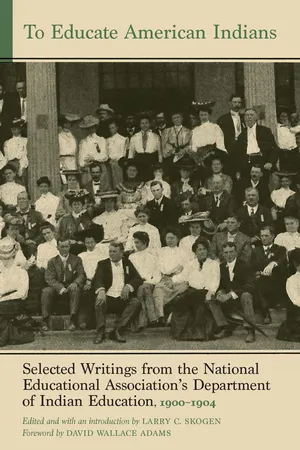
To Educate American Indians
Selected Writings from the National Educational Association's Department of Indian Education, 1900ā1904
- 406 pages
- English
- ePUB (mobile friendly)
- Available on iOS & Android
To Educate American Indians
Selected Writings from the National Educational Association's Department of Indian Education, 1900ā1904
About this book
Winner of the 2025 Dwight L. Smith (ABC-CLIO) Award
To Educate American Indians presents the most complete versions of papers presented at the National Educational Association's Department of Indian Education meetings during a time when the debate about how best to "civilize" Indigenous populations dominated discussions. During this time two philosophies drove the conversation. The first, an Enlightenment eraāinfluenced universalism, held that through an educational alchemy American Indians would become productive, Christianized Americans, distinguishable from their white neighbors only by the color of their skin. Directly confronting the assimilationists' universalism were the progressive educators who, strongly influenced by the era's scientific racism, held the notion that American Indians could never become fully assimilated. Despite these differing views, a frightening ethnocentrism and an honor-bound dedication to "gifting" civilization to Native students dominated the writings of educators from the NEA's Department of Indian Education.
For a decade educators gathered at annual meetings and presented papers on how best to educate Native students. Though the NEA Proceedings published these papers, strict guidelines often meant they were heavily edited before publication. In this volume Larry C. Skogen presents many of these unedited papers and gives them historical context for the years 1900 to 1904.
Frequently asked questions
- Essential is ideal for learners and professionals who enjoy exploring a wide range of subjects. Access the Essential Library with 800,000+ trusted titles and best-sellers across business, personal growth, and the humanities. Includes unlimited reading time and Standard Read Aloud voice.
- Complete: Perfect for advanced learners and researchers needing full, unrestricted access. Unlock 1.4M+ books across hundreds of subjects, including academic and specialized titles. The Complete Plan also includes advanced features like Premium Read Aloud and Research Assistant.
Please note we cannot support devices running on iOS 13 and Android 7 or earlier. Learn more about using the app.
Information
Table of contents
- Cover
- Series Page
- Title Page
- Copyright Page
- Dedication
- Contents
- List of Illustrations
- Foreword by David Wallace Adams
- Acknowledgments
- Introduction
- Note on Editorial Style, Citations, and Names
- List of Abbreviations
- Part 1
- 1. What Is the Relation of the Indian of the Present Decade to the Indian of the Future?
- 2. The Indian Problem
- 3. The Proper Relation between Literary and Industrial Education in Indian Schools
- 4. The Training of Teachers for Indian Schools
- 5. Teaching Trades to Indians
- 6. The Training of the Indian Girl as the Uplifter of the Home
- 7. Practical Methods of Indian Education
- Part 2
- 8. Presidentās Address
- 9. Civilization and Higher Education
- 10. The Reservation Day School Should Be the Prime Factor in Indian Education
- 11. The Unification of Industrial and Academic Features of the Indian School
- 12. What Shall Be Taught in an Indian School?
- 13. An All-Around Mechanical Training for Indians
- 14. Practical Methods in Indian Education
- 15. Character Building among Indian Children
- 16. The Day School
- 17. The Necessity for a Large Agricultural School in the Indian Service
- Part 3
- 18. Presidentās Address
- 19. The Value of an Agricultural School in the Indian Service
- 20. The Value of the Outing System for Girls
- 21. What Is Our Aim?
- 22. Needed Changes in Indian Schools
- 23. The Value of Day Schools
- 24. Newspapers in Indian Schools
- Part 4
- 25. Presidentās Address: Our Work, Its Progress and Needs
- 26. To What Degree Has the Present System of Indian Schools Been Successful in Qualifying for Citizenship?
- 27. An Alaskan Start toward Citizenship
- 28. The White Manās Burden versus Indigenous Development for the Lower Races
- 29. Heart Culture in Indian Education
- 30. Tenure in the Civil Service
- Part 5
- 31. Efficiency in the Indian Service
- 32. Indian Music and Indian Education
- 33. Whatās in a Name?
- 34. Indian Names
- Conclusion
- Notes
- Bibliography
- Index
- About Larry C. Skogen
- About David Wallace Adams
- Series List
- Illustrations