- 216 pages
- English
- ePUB (mobile friendly)
- Available on iOS & Android
About this book
An environmental humanist's study of extractive capitalism and colonial occupation in Indian fiction.
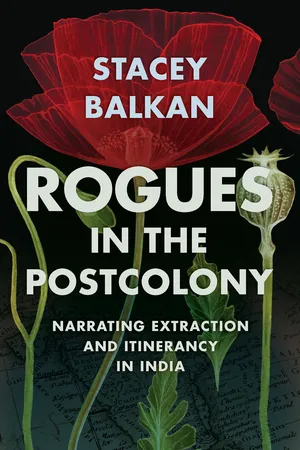
Rogues in the Postcolony is a study of Anglophone Indian picaresque novels that dramatize the impacts of extractive capitalism and colonial occupation on local communities in several Indian states. In this materialist history of development on the subcontinent, Stacey Balkan considers works by Amitav Ghosh, Indra Sinha, and Aravind Adiga that critique violent campaigns of enclosure and dispossession at the hands of corporate entities like the English East India Company and its many legatees. By foregrounding the intersections among landscape ideology, agricultural improvement, extractive capitalism, and aesthetic expression, Rogues in the Postcolony also attends to the complicity of popular aesthetic forms with political and economic policy, as well as the colonial and extractivist logics that often frame discussions around the so-called Anthropocene epoch.
Bringing together questions about settler-colonial practices and environmental injustice, Rogues in the Postcolony concludes with an investigation of new extractivist frontiers, including solar capitalism, and considers the possibility of imagining life after extraction on the Indian subcontinent and beyond.
Frequently asked questions
- Essential is ideal for learners and professionals who enjoy exploring a wide range of subjects. Access the Essential Library with 800,000+ trusted titles and best-sellers across business, personal growth, and the humanities. Includes unlimited reading time and Standard Read Aloud voice.
- Complete: Perfect for advanced learners and researchers needing full, unrestricted access. Unlock 1.4M+ books across hundreds of subjects, including academic and specialized titles. The Complete Plan also includes advanced features like Premium Read Aloud and Research Assistant.
Please note we cannot support devices running on iOS 13 and Android 7 or earlier. Learn more about using the app.
Information
Table of contents
- Cover Page
- Title Page
- Copyright Page
- Dedication
- Contents
- Acknowledgments
- Abbreviations
- Introduction: Why Can’t a Rogue Be a Hero?
- 1. Revisiting the Environmental Picaresque: Plantationocene Aesthetics and the Origins of Cheap Nature in Amitav Ghosh’s Ibis Trilogy
- 2. A Memento Mori Tale: Indra Sinha’s Animal’s People and the Politics of Global Toxicity
- 3. Slum Ecologies: Figuring (Energy) Waste in Aravind Adiga’s The White Tiger
- Conclusion: Beyond Extraction: Imagining Solarity in India’s Mineral Belt
- Notes
- References
- Index