The Kaiserchronik (c.1152–1165) is the first verse chronicle to have been written in a language other than Latin. This story recounts the exploits of the Roman, Byzantine, Carolingian, and Holy Roman kings and rulers, from the establishment of Rome to the start of the Second Crusade. As an early example of popular history, it was written for a non-monastic audience who would have preferred to read, or may only have been able to read, in German. As a rhymed chronicle, its combined use of the styles of language found within a vernacular epic and a factual treaty was a German innovation. The Book of Emperors is the first complete translation of the Kaiserchronik from Middle High German to English. It is a rich resource not only for medieval German scholars and students, but also for those working in early cultural studies. It brings together an understanding of the conception of kingship in the German Middle Ages, from the relationship between emperor and king, to the moral, theological, and legal foundations of claims and legitimacy and the medieval epistemological approaches to historiography. This translation includes a substantial introduction that discusses the historical and philological context of the work, as well as the themes of power and kingship. Each chapter begins with a brief introduction that distinguishes historical truths from the epic fiction found within the original text.
eBook - ePub
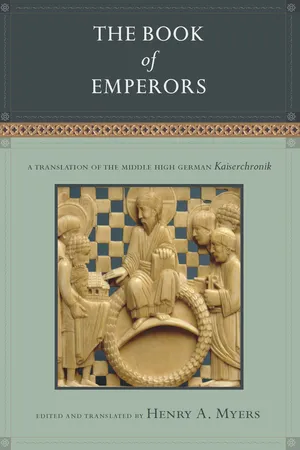
The Book of Emperors
A Translation of the Middle High German Kaiserchronik
- 411 pages
- English
- ePUB (mobile friendly)
- Available on iOS & Android
eBook - ePub
About this book
Information
Table of contents
- Contents
- Acknowledgements
- Introduction
- Prologue
- 1. Rome’s Founding: Roman Gods for Each Day of the Week and the Bells that Warned of Revolt–[43-246]
- 2. Julius Caesar–[247-602]
- 3. Augustus Caesar–[603-670]
- 4. Tiberius–[671-1114]
- 5. Caius Caligula (Jovinus Legend)–[1115-1218]
- 6. Faustinian–[1219-4038]
- 7. Claudius–[4039-4082]
- 8. Nero–[4083-4304]
- 9. Tarquin–[4305-4834]
- 10. Galba and Piso–[4835-4846]
- 11. Otho–[4847-4860]
- 12. Vitellius (Odnatus Legend)–[4861-5098]
- 13. Vespasian–[5099-5364]
- 14. Titus–[5365-5556]
- 15. Domitian–[5557-5682]
- 16. Nerva–[5683-5838]
- 17. Trajan–[5839-6096]
- 18. Philip–[6097-6150]
- 19. Decius–[6151-6450]
- 20. Diocletian and Maximian–[6451-6621]
- 21. Severus–[6622-7135]
- 22. Helvius (Helius) Pertinax–[7136-7211]
- 23. Helius Adrianus (Hadrian)–[7212-7243]
- 24. Lucius Accommodus–[7244-7425]
- 25. Achilleus–[7426-7451]
- 26. Gallienus–[7452-7603]
- 27. Constantius Chlorus–[7604-7805]
- 28. Constantine I “the Great”–[7604-10510]
- 29. Sylvester–[10511-10634]
- 30. Julian–[10635-11137]
- 31. Heraclius–[11138-11351]
- 32. Narcissus (Legend of the Two Theodorics)–[11352-12812]
- 33. Justinian–[12813-13066]
- 34. Theodosius–[13067-13650]
- 35. Constantine Leo–[13651-13824]
- 36. Zeno–[13825-14193]
- 37. Constantine VI–[14194-14281]
- 38. Charles I “the Great”–[14282-15091]
- 39. Louis I “the Pious”–[15092-15235]
- 40. Lothair I–[15236-15316]
- 41. Louis II–[15317-15399]
- 42. Charles III “the Fat”–[15400-15518]
- 43. Arnulf–[15518-15581]
- 44. Louis III “the Child”–[15582-15651]
- 45. Conrad I–[15652-15759]
- 46. Henry I–[15760-15849]
- 47. Otto I “the Great”–[15850-15974]
- 48. Otto II–[15974-16063]
- 49. Otto III–[16064-16141]
- 50. Henry II “Saint Henry”–[16142-16253]
- 51. Conrad II–[16254-16375]
- 52. Henry III “the Black” also “the Good”–[16376-16531]
- 53. Henry IV–[16532-16847]
- 54. Henry V–[16848-16941]
- 55. Lothair II–[16942-17179]
- 56. Conrad III–[17180-17283]
- Notes
- Bibliography
- Index
- About the Author
Trusted by 375,005 students
Access to over 1.5 million titles for a fair monthly price.
Study more efficiently using our study tools.
Frequently asked questions
Yes, you can cancel anytime from the Subscription tab in your account settings on the Perlego website. Your subscription will stay active until the end of your current billing period. Learn how to cancel your subscription
No, books cannot be downloaded as external files, such as PDFs, for use outside of Perlego. However, you can download books within the Perlego app for offline reading on mobile or tablet. Learn how to download books offline
Perlego offers two plans: Essential and Complete
- Essential is ideal for learners and professionals who enjoy exploring a wide range of subjects. Access the Essential Library with 800,000+ trusted titles and best-sellers across business, personal growth, and the humanities. Includes unlimited reading time and Standard Read Aloud voice.
- Complete: Perfect for advanced learners and researchers needing full, unrestricted access. Unlock 1.5M+ books across hundreds of subjects, including academic and specialized titles. The Complete Plan also includes advanced features like Premium Read Aloud and Research Assistant.
We are an online textbook subscription service, where you can get access to an entire online library for less than the price of a single book per month. With over 1.5 million books across 990+ topics, we’ve got you covered! Learn about our mission
Look out for the read-aloud symbol on your next book to see if you can listen to it. The read-aloud tool reads text aloud for you, highlighting the text as it is being read. You can pause it, speed it up and slow it down. Learn more about Read Aloud
Yes! You can use the Perlego app on both iOS and Android devices to read anytime, anywhere — even offline. Perfect for commutes or when you’re on the go.
Please note we cannot support devices running on iOS 13 and Android 7 or earlier. Learn more about using the app
Please note we cannot support devices running on iOS 13 and Android 7 or earlier. Learn more about using the app
Yes, you can access The Book of Emperors by Henry A. Myers in PDF and/or ePUB format, as well as other popular books in Literature & Literary Collections. We have over 1.5 million books available in our catalogue for you to explore.