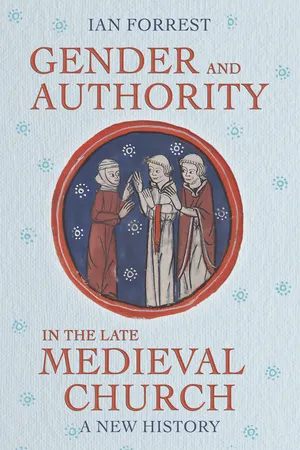
Gender and Authority in the Late Medieval Church
eBook - ePub

Gender and Authority in the Late Medieval Church

A New History

  1. 318 pages
  2. English
  3. ePUB (mobile friendly)
  4. Available on iOS & Android
eBook - ePub

Gender and Authority in the Late Medieval Church

A New History

About this book

Gender and Authority in the Late Medieval Church asks a deceptively simple question: How did the governance of the medieval institutional church remain exclusively male, despite plentiful evidence of women being as capable and devout as men? The remarkable endurance of an all-male clergy is an important element of medieval church government—one that is frequently taken for granted in the historiography—and is connected to another overlooked feature of episcopal authority: the strategies that bishops used to secure the compliance of a relatively autonomous clergy. As Ian Forrest shows, bishops kept their clergy in check through normative standards of masculinity that necessarily disqualified women from leadership roles.

Everywhere in the medieval church were women who had the capacity, the resources, and often the ambition to take part in governance, from abbesses to priests' servants, mothers, sisters, and unofficial wives. Bringing together evidence of female activity at the margins of the institutional church, Forrest argues that the male monopoly on formal power was haunted by female capability and aspiration at every turn. Drawing on case studies from the English diocesan clergy between the mid-thirteenth and early sixteenth centuries, he explores how women's involvement in governance was rendered unthinkable through the very discursive strategies that bishops used to control their male clergy. In doing so, Gender and Authority in the Late Medieval Church tells an integrated history that explains how both the exclusion of women and the inclusion of men underpin a rigidly gendered system of religious governance.

Frequently asked questions

Yes, you can cancel anytime from the Subscription tab in your account settings on the Perlego website. Your subscription will stay active until the end of your current billing period. Learn how to cancel your subscription.
No, books cannot be downloaded as external files, such as PDFs, for use outside of Perlego. However, you can download books within the Perlego app for offline reading on mobile or tablet. Learn more here.
Perlego offers two plans: Essential and Complete
  • Essential is ideal for learners and professionals who enjoy exploring a wide range of subjects. Access the Essential Library with 800,000+ trusted titles and best-sellers across business, personal growth, and the humanities. Includes unlimited reading time and Standard Read Aloud voice.
  • Complete: Perfect for advanced learners and researchers needing full, unrestricted access. Unlock 1.4M+ books across hundreds of subjects, including academic and specialized titles. The Complete Plan also includes advanced features like Premium Read Aloud and Research Assistant.
Both plans are available with monthly, semester, or annual billing cycles.
We are an online textbook subscription service, where you can get access to an entire online library for less than the price of a single book per month. With over 1 million books across 1000+ topics, we’ve got you covered! Learn more here.
Look out for the read-aloud symbol on your next book to see if you can listen to it. The read-aloud tool reads text aloud for you, highlighting the text as it is being read. You can pause it, speed it up and slow it down. Learn more here.
Yes! You can use the Perlego app on both iOS or Android devices to read anytime, anywhere — even offline. Perfect for commutes or when you’re on the go.
Please note we cannot support devices running on iOS 13 and Android 7 or earlier. Learn more about using the app.
Yes, you can access Gender and Authority in the Late Medieval Church by Ian Forrest in PDF and/or ePUB format, as well as other popular books in History & European Medieval History. We have over one million books available in our catalogue for you to explore.

Table of contents

  1. Cover
  2. Title Page
  3. Contents
  4. Acknowledgments
  5. Conventions and Abbreviations
  6. Introduction
  7. Part One: The Diocese
  8. Part Two: The Parish
  9. Part Three: Beyond the Priesthood
  10. Conclusion
  11. Bibliography
  12. Index
  13. A Volume in the Series
  14. Copyright