To Weave and Sing is the first in-depth analysis of the rich spiritual and artistic traditions of the Carib-speaking Yekuana Indians of Venezuela, who live in the dense rain forest of the upper Orinoco. Within their homeland of Ihuruna, the Yekuana have succeeded in maintaining the integrity and unity of their culture, resisting the devastating effects of acculturation that have befallen so many neighboring groups. Yet their success must be attributed to more than natural barriers of rapids and waterfalls, to more than lack of "contact" with our "modern" world. The ethnographic history recounted here includes not only the Spanish discovery of the Yekuana but detailed indigenous accounts of the entire history of Yekuana contact with Western culture, revealing an adaptive technique of mythopoesis by which the symbols of a new and hostile European ideology have been consistently defused through their incorporation into traditional indigenous structures.
The author's initial point of departure is the Watunna, the Yekuana creation epic, but he finds his principal entrance into this mythic world through basketry, focusing on the eleborate kinetic designs of the round waja baskets and the stories told about them. Guss argues that the problem of understanding Yekuana basketry is the problem of understanding all traditional art forms within a tribal context, and critiques the cultural assumptions inherent in our systems of classification. He demonstrates that the symbols woven into the baskets function not in isolation but collectively, as a powerful system cutting across the entire culture.
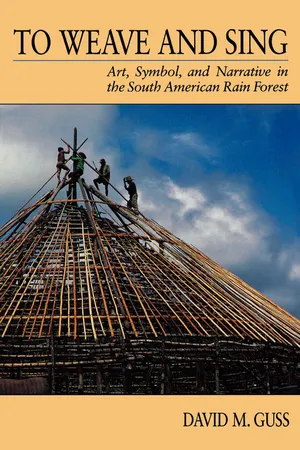
To Weave and Sing addresses all Yekuana material culture and the greater reality it both incorporates and masks, discerning a unifying configuration of symbols in chapters on architectural forms, the geography of the body, and the use of herbs, face paints, and chants. A narrow view of slash-and-burn gardens as places of mere subsistence is challenged by Guss's portrait of these exclusively female spaces as systematic inversions of the male world, "the sacred turned on its head." Throughout, a wealth of narrative and ritual materials provides us with the closest approximation we have to a native exegesis of these phenomena. What we are offered here is a new Poetics of Culture, ethnography not as a static given but as a series of shifting fields, wherein culture (and our image of it) is constantly recreated in all of its parts, by all of its members.
eBook - PDF
To Weave and Sing
Art, Symbol, and Narrative in the South American Rainforest
- 289 pages
- English
- PDF
- Available on iOS & Android
eBook - PDF
About this book
Information
Table of contents
- Contents
- Illustrations
- Acknowledgments
- 1. INTRODUCTION: The Syntax of Culture
- 2. THE PEOPLE
- 3. CULTURE AND ETHOS: A Play of Forces
- 4. "ALL THINGS MADE"
- 5. ORIGIN AND DESIGN
- 6. THE FORM OF CONTENT
- 7. TO WEAVE THE WORLD
- A GALLERY OF BASKETS
- Notes
- Bibliography
- Index
Trusted by 375,005 students
Access to over 1.5 million titles for a fair monthly price.
Study more efficiently using our study tools.
Frequently asked questions
Yes, you can cancel anytime from the Subscription tab in your account settings on the Perlego website. Your subscription will stay active until the end of your current billing period. Learn how to cancel your subscription
No, books cannot be downloaded as external files, such as PDFs, for use outside of Perlego. However, you can download books within the Perlego app for offline reading on mobile or tablet. Learn how to download books offline
Perlego offers two plans: Essential and Complete
- Essential is ideal for learners and professionals who enjoy exploring a wide range of subjects. Access the Essential Library with 800,000+ trusted titles and best-sellers across business, personal growth, and the humanities. Includes unlimited reading time and Standard Read Aloud voice.
- Complete: Perfect for advanced learners and researchers needing full, unrestricted access. Unlock 1.5M+ books across hundreds of subjects, including academic and specialized titles. The Complete Plan also includes advanced features like Premium Read Aloud and Research Assistant.
We are an online textbook subscription service, where you can get access to an entire online library for less than the price of a single book per month. With over 1.5 million books across 990+ topics, we’ve got you covered! Learn about our mission
Look out for the read-aloud symbol on your next book to see if you can listen to it. The read-aloud tool reads text aloud for you, highlighting the text as it is being read. You can pause it, speed it up and slow it down. Learn more about Read Aloud
Yes! You can use the Perlego app on both iOS and Android devices to read anytime, anywhere — even offline. Perfect for commutes or when you’re on the go.
Please note we cannot support devices running on iOS 13 and Android 7 or earlier. Learn more about using the app
Please note we cannot support devices running on iOS 13 and Android 7 or earlier. Learn more about using the app
Yes, you can access To Weave and Sing by David M. Guss in PDF and/or ePUB format, as well as other popular books in Social Sciences & Art General. We have over 1.5 million books available in our catalogue for you to explore.