A sustained critique of postwar reconstruction in Syria as a politically neutral process
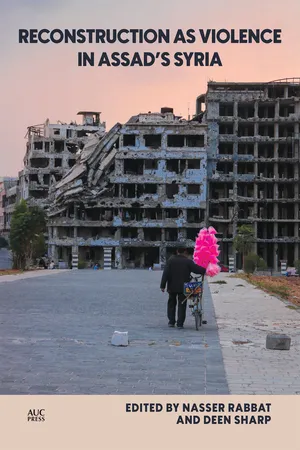
In 2011, emboldened by the Arab Spring, the Syrians rose up against their government. The Syrian regime used violence to suppress the protests, so that what began as pro-democracy protests eventually morphed into a civil war with heavy outside intervention. Today, the Assad regime has fallen, but large parts of the country lie in ruins, millions of Syrians are displaced, and the economy is in freefall. Reconstruction as Violence delves into the complex interplay of post-conflict reconstruction in Syria, challenging the traditionally held dichotomy between the end of violence and the commencement of rebuilding.
The contributors to this volume—architects, urbanists, geographers, and historians—employ critical concepts such as urbicide, domicide, and “civilian crisis architecture” to argue against the conventional theoretical frameworks that support a neat separation of phases. They illustrate how reconstruction often extends the dynamics of conflict into the urban and social realms, suggesting that the built environment becomes a battleground for further violence. They emphasize the importance of acknowledging the historical, economic, societal, legal, and bureaucratic contexts that shape reconstruction efforts, arguing for initiatives that prioritize equity, inclusivity, and community participation.
Reconstruction as Violence starkly underscores the authors’ stance that to overlook any of these dimensions, or to disengage from the reconstruction process altogether, represents a political choice with potentially detrimental effects on Syria and beyond in the Arab world, where countries like Palestine, Yemen, Libya, Iraq, Lebanon, and Sudan are undergoing similar cycles of destruction and rebuilding. It calls for a reimagined approach to reconstruction, one that fosters peace, resilience, and social justice in post-conflict societies.
Contributors:
Sawsan Abou Zainedin, Madaniya, London, UK
Ammar Azzouz, University of Oxford, UK
Valérie Clerc, Institut de Recherche pour le Développement, France
Emma Katherine DiNapoli, human rights lawyer, London, UK
Omar Ferwati, Goldsmiths, University of London, UK
Rim Lababidi, architect and independent scholar, Ohio, USA
Wendy Pullan, University of Cambridge, UK
Nasser Rabbat, Massachusetts Institute of Technology, Cambridge, MA, USA
Hashim Sarkis, Massachusetts Institute of Technology, Cambridge, MA, USA
Deen Sharp, London School of Economics, UK
Heghnar Watenpaugh, University of California Davis, CA, USA
eBook - ePub
Reconstruction as Violence in Assad's Syria
- 272 pages
- English
- ePUB (mobile friendly)
- Available on iOS & Android
eBook - ePub
Reconstruction as Violence in Assad's Syria
About this book
Information
Topic
ArchitectureSubtopic
Architecture CriticismTable of contents
- Cover
- Halftitle Page
- Title Page
- Copyright Page
- CONTENTS
- List of Illustrations
- Contributors
- Foreword: The Tell of Aleppo
- Introduction: Reconstruction as Violence
- 1 “What Reconstruction?”: History, Politics, and Clashing Identities in Syria
- 2 War by Other Means: Reconstruction in Syria
- 3 Rethinking Reconstruction through Informal Settlements
- 4 War Waged in Space and Law: Advancing Urbicide with Regulatory “Weapons”
- 5 Constructing the Endo- and Exo-Colonization of Syria
- 6 Assad and the Mythology of a Homogeneous Syria
- 7 A History of Cultural Heritage in Aleppo: A Contested Terrain
- 8 Reconstruction in Old Aleppo: People and Politics After the War
- 9 Survival Architecture in Aleppo
- 10 Domicide: Reconstruction as Re-Destruction of Home
- Backcover
Trusted by 375,005 students
Access to over 1.5 million titles for a fair monthly price.
Study more efficiently using our study tools.
Frequently asked questions
Yes, you can cancel anytime from the Subscription tab in your account settings on the Perlego website. Your subscription will stay active until the end of your current billing period. Learn how to cancel your subscription
No, books cannot be downloaded as external files, such as PDFs, for use outside of Perlego. However, you can download books within the Perlego app for offline reading on mobile or tablet. Learn how to download books offline
Perlego offers two plans: Essential and Complete
- Essential is ideal for learners and professionals who enjoy exploring a wide range of subjects. Access the Essential Library with 800,000+ trusted titles and best-sellers across business, personal growth, and the humanities. Includes unlimited reading time and Standard Read Aloud voice.
- Complete: Perfect for advanced learners and researchers needing full, unrestricted access. Unlock 1.5M+ books across hundreds of subjects, including academic and specialized titles. The Complete Plan also includes advanced features like Premium Read Aloud and Research Assistant.
We are an online textbook subscription service, where you can get access to an entire online library for less than the price of a single book per month. With over 1.5 million books across 990+ topics, we’ve got you covered! Learn about our mission
Look out for the read-aloud symbol on your next book to see if you can listen to it. The read-aloud tool reads text aloud for you, highlighting the text as it is being read. You can pause it, speed it up and slow it down. Learn more about Read Aloud
Yes! You can use the Perlego app on both iOS and Android devices to read anytime, anywhere — even offline. Perfect for commutes or when you’re on the go.
Please note we cannot support devices running on iOS 13 and Android 7 or earlier. Learn more about using the app
Please note we cannot support devices running on iOS 13 and Android 7 or earlier. Learn more about using the app
Yes, you can access Reconstruction as Violence in Assad's Syria by Nasser Rabbat,Deen Sharp, Pascal Menoret,Deen Sharp,Noura Wahby in PDF and/or ePUB format, as well as other popular books in Architecture & Architecture Criticism. We have over 1.5 million books available in our catalogue for you to explore.