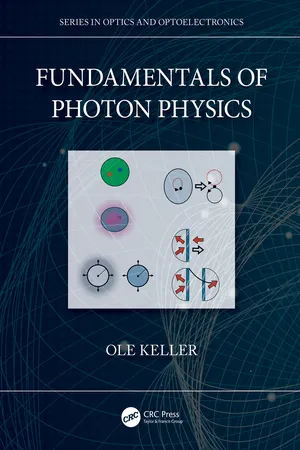
The photon, an abstract concept belonging to a global vacuum, only manifests itself during
interaction with matter. Fundamentals of Photon Physics describes the richly faceted, basic theory
of photon-matter interaction, selecting a wide number of topics. Together with the author's book
Light -- The Physics of the Photon (CRC, 2014), both written on a scholarly level, the reader is
given a comprehensive exposition of photon wave mechanics, quantum optics and quantum
electrodynamics (QED).
Divided into 10 parts, the book begins by exploring the relation between photon wave mechanics
and quantum field theory. It then describes the theories of zero- and one-photon states and
that of bi-photons. After discussing conservation laws, Lagrangian formulations, geometric
phase and topology, the author turns towards the theory of photon scattering, emphasizing a
density matrix operator approach and the role of microscopic extinction theorems. The book
next focuses on mesoscopic QED, devoting particular attention to collective jellium excitations
and photon-spin interactions. Special attention is given to the basics of the photon-magnon
interaction and nonlinear superconductor electrodynamics, including the nonlinear Meissner
rectification phenomenon, before studying the theory of transverse photons tied to (dressing)
massive particles.
The last three parts take the reader on a journey to topics usually not treated in books on photon-
matter interaction. Beginning with photons in curved space-time structures and in spatially
curved media, e.g. Möbius bands, the author discusses the extension of QED to the electro-weak
interaction at an introductory level. Fundamentals of Photon Physics ends with the establishment
of the set of isovector Maxwell equations in non-Abelian SO(3) gauge theory, leading to
the celebrated hedgehog monopole model.
Ole Keller is professor emeritus of theoretical physics at Aalborg University, Denmark. He earned his Licentiate (? PhD) degree in semiconductor physics from the Danish Technical University in Copenhagen in 1972, and the Doctor of Science degree from the University of Aarhus (1996). In 1989 he was appointed as the first professor in physics at Aalborg University by Margrethe Den Anden, queen of Denmark. The same year he was admitted to Kraks Blaa Bog, a prestigious Danish biographical dictionary which (citatum) "Includes men and women, whose life story could have an interest for a wider public". He is a fellow of the Optical Society of America.
He has written the books entitled Quantum Theory of Near-Field Electrodynamics (Springer, 2011) and LIGHT - The Physics of the Photon (CRC, 2014), as well as the monographs Local Fields in the Electrodynamics of Mesoscopic Media (Physics Reports, 1996) and On the Theory of Spatial Localization of Photons (Physics Reports, 2005). He is the editor of the books Nonlinear Optics in Solids (Springer, 1990), Studies in Classical and Quantum Nonlinear Optics (Nova Science, 1995) and Notions and Perspectives of Nonlinear Optics (World Scientific, 1996).
In recent years he has carried out theoretical research in fundamental photon physics, microscopic few-photon diffraction, mesoscopic and Möbius band electrodynamics, and studied magnetic monopole theory based on QED and the isovector Maxwell equations in non-Abelian gauge symmetry.