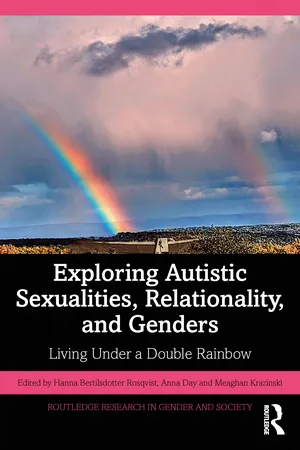
Exploring Autistic Sexualities, Relationality, and Genders
eBook - ePub

Exploring Autistic Sexualities, Relationality, and Genders

Living Under a Double Rainbow

  1. 252 pages
  2. English
  3. ePUB (mobile friendly)
  4. Available on iOS & Android
eBook - ePub

Exploring Autistic Sexualities, Relationality, and Genders

Living Under a Double Rainbow

About this book

This edited collection of contributions explores non-normative genders, sexualities, and relationality among Autistic people.

Written within an explicitly neuro-affirmative frame, the collection celebrates the diversity and richness of Autistic identity, sexuality, gender, and relationships, exploring areas such as consent, embodiment, ink, kink, sex education, and therapeutic work. All editors and contributors are neurodivergent and members of the communities that the book focuses on, providing an authentic and unique exploration of gender, sexuality, and relationality in Autistic people by Autistic/other neurodivergent authors.

The book is primarily intended for postgraduate students and academics across disciplines including sociology, social work, psychology, disability studies, inclusive and special education, and sexual education. Mental health professionals and educators will also find it a useful resource to support their Autistic clients as well as developing their own understanding about how to support Autistic people in a neurodiversity-affirming, kink-affirming, LGBTQ+, and gender-variant way.

Frequently asked questions

Yes, you can cancel anytime from the Subscription tab in your account settings on the Perlego website. Your subscription will stay active until the end of your current billing period. Learn how to cancel your subscription.
No, books cannot be downloaded as external files, such as PDFs, for use outside of Perlego. However, you can download books within the Perlego app for offline reading on mobile or tablet. Learn more here.
Perlego offers two plans: Essential and Complete
  • Essential is ideal for learners and professionals who enjoy exploring a wide range of subjects. Access the Essential Library with 800,000+ trusted titles and best-sellers across business, personal growth, and the humanities. Includes unlimited reading time and Standard Read Aloud voice.
  • Complete: Perfect for advanced learners and researchers needing full, unrestricted access. Unlock 1.4M+ books across hundreds of subjects, including academic and specialized titles. The Complete Plan also includes advanced features like Premium Read Aloud and Research Assistant.
Both plans are available with monthly, semester, or annual billing cycles.
We are an online textbook subscription service, where you can get access to an entire online library for less than the price of a single book per month. With over 1 million books across 1000+ topics, we’ve got you covered! Learn more here.
Look out for the read-aloud symbol on your next book to see if you can listen to it. The read-aloud tool reads text aloud for you, highlighting the text as it is being read. You can pause it, speed it up and slow it down. Learn more here.
Yes! You can use the Perlego app on both iOS or Android devices to read anytime, anywhere — even offline. Perfect for commutes or when you’re on the go.
Please note we cannot support devices running on iOS 13 and Android 7 or earlier. Learn more about using the app.
Yes, you can access Exploring Autistic Sexualities, Relationality, and Genders by Hanna Bertilsdotter Rosqvist,Anna Day,Meaghan Krazinski in PDF and/or ePUB format, as well as other popular books in Social Sciences & Sociology. We have over one million books available in our catalogue for you to explore.

Information

Publisher
Routledge
Year
2024
eBook ISBN
9781040131671
Edition
1

Table of contents

  1. Cover
  2. Half Title
  3. Series Page
  4. Title Page
  5. Copyright Page
  6. Table of Contents
  7. List of Illustrations
  8. List of Contributors
  9. Glossary
  10. PART I Beginnings
  11. PART I Beginnings
  12. PART II Evolving Understandings: Naming the Nameless So It Can Be Thought
  13. PART III Unlearning, Relearning
  14. Conclusion
  15. Index