- 436 pages
- English
- ePUB (mobile friendly)
- Available on iOS & Android
Ancient Greeks in Their Own Words
About this book
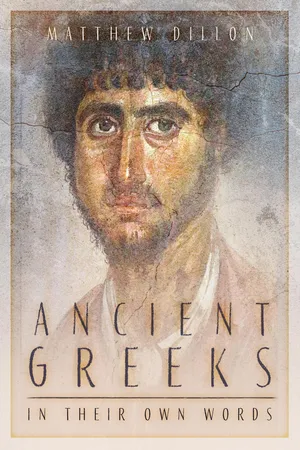
In Ancient Greeks in their own Words, historian Matthew Dillon reveals the nature of everyday life in the classical world. Using a series of telling extracts from Greek literature to provide a picture of their customs, concerns and underlying values, he allows the people to speak for themselves, both in the formal language of public office and in the colloquial speech of the household and the street.
Their words reveal activities and opinions which are sometimes remarkably similar to those of the modern day, but which are otherwise so different that they are difficult for us to understand.
Through everything from poetry, hymns and war-songs to official documents, inscriptions, laws, histories, funerary monuments, war memorials and graffiti, this book records not only the lives of famous Greeks like Sophocles and Aristotle, but also those of ordinary individuals. In Ancient Greeks in their own Words, glimpse the public and private facets of their everyday life, and gain an insight into the mentality of the ancient Greeks.
Frequently asked questions
- Essential is ideal for learners and professionals who enjoy exploring a wide range of subjects. Access the Essential Library with 800,000+ trusted titles and best-sellers across business, personal growth, and the humanities. Includes unlimited reading time and Standard Read Aloud voice.
- Complete: Perfect for advanced learners and researchers needing full, unrestricted access. Unlock 1.4M+ books across hundreds of subjects, including academic and specialized titles. The Complete Plan also includes advanced features like Premium Read Aloud and Research Assistant.
Please note we cannot support devices running on iOS 13 and Android 7 or earlier. Learn more about using the app.
Information
Table of contents
- Cover
- Title
- Copyright
- Contents
- Preface
- Introduction
- One: Gods and Mortals
- Two: Husbands and Wives
- Three: Farmers and Traders
- Four: Workers and Entertainers
- Five: Soldiers and Cowards
- Six: Philosophers and Doctors
- Seven: Citizens and Officials
- The Authors Themselves
- Glossary
- Suggested Reading